AVAILABILITY
www.symposiumrecords.co.uk
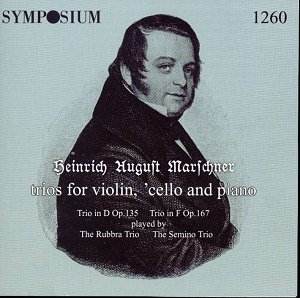
This disc occupies
an overlap between rare repertoire and
rare performances. Marschner’s chamber
music is hardly popular repertoire,
even now, but the composer of Der Vampyr
was clearly a more than accomplished,
indeed distinguished, exponent of the
trio medium. The performances here derive
from British radio broadcasts in 1947
(on the Third Programme) and from a
1952 Home Programme broadcast (at nine
in the morning if you want the full
details, which Symposium handily provides).
Symposium notes the problems with the
surviving acetates that they believe
derive from the collection of, of all
unlikely people, Humphrey Searle and
these include considerable surface noise
and some radio interference with scuffs
and scratches galore. I don’t know why
Searle should have targeted Marschner
but I do know that someone was privately
recording the cellist Norina Semino
because I have an acetate set of Semino’s
Rachmaninov Cello Sonata performance
with pianist John Pauer purportedly
from a live concert in the 1930s – but
maybe from the late 1940s or 1950s.
The D major Trio, the
earlier of the two here, is played by
the Rubbra Trio. Edmund Rubbra started
his trio in the War with his two colleagues
and they were invariably billed as Sgt.
E. Rubbra, Dvr. J. Glazier and Sgmn.
W. Pleeth though the trio did swell
when they formed part of the Army Classical
Music Group with the addition of flute
and bass. On one unfortunate occasion
however the trio found themselves at
an army camp announced to the expectant
soldiery as Ed Rubb and His Boys – a
story I hope is not apocryphal. After
the War the Trio resumed its work and
in time Glazier left and was replaced
by the Amadeus Quartet’s Norbert Brainin
and after him Erich Gruenberg. They
play the D major with real poise. Marschner’s
indelible command of long singing lyrical
line is abundantly present in the opening
movement where buoyancy, imagination,
constant rhythmic fluctuations and Weber-like
amplitude all coalesce. There are some
especially delightful exchanges between
all three instruments. It’s Pleeth who
opens the Andante with a plangent cello
solo, with Glazier and Rubbra no less
eloquent (some radio interference intrudes
a little). After the quick-fire Scherzo
the Vivace concluding movement opens
in alternating brusqueness and stately
drive. The language veers all the while
from assertive to impish and that’s
something these players are clearly
fully conversant with, though again
it’s a slight pity that the fateful
interference tends to sully Rubbra’s
imaginative and confident piano playing.
The F major Trio shows
no less of the qualities that make its
companion so forward looking a trio.
There’s comparable control of material,
with thought and imagination operating
on the long line and in the slow movement
the elegance and sparkle of the music
box like sonorities engendered is most
impressive. The musicians here are the
Semino Trio, who in addition to Norina
Semino includes violinist Granville
Jones and pianist Gordon Watson. Jones
is poised and precise in his violin
lines, extracting a melancholy charm,
whilst Semino is restrained in vibrato
usage and attractive. Watson impresses
in the Scherzo where his understated
direction is just right and all three
bring out the woodland Romanticism at
Marschner’s heart in the finale.
Clearly this is a specialist
issue and requires tolerance of the
recording limitations of the acetates.
But I’m sure there will be curious ears
keen to hear the Rubbra Trio and to
admire its composer-performer in utterly
convivial company. For all their problems
these performances are fortuitous survivors
of post-War British music-making – and
their Marschner readings are frequently
riveting.
Jonathan Woolf
 The Semino Trio (Granville Jones (violin)
Norina Semino (cello) Gordon Watson (piano)) Recorded
from a radio broadcast on 17 December 1952
The Semino Trio (Granville Jones (violin)
Norina Semino (cello) Gordon Watson (piano)) Recorded
from a radio broadcast on 17 December 1952