Some of Jongen’s early
works, such as his cantata Comala
Op.11 (1897) which earned him
the Rome Prize, his String Quartet
No.1 Op.3 (1892) and the Cello
Concerto Op.18, are ambitious,
large-scale compositions. In them the
young composer flexes his muscles and
displays his compositional skills, though
there is comparatively little pointing
towards his mature style. These works,
though overtly influenced by Franck,
Wagner or d’Indy, nevertheless betray
some remarkable formal mastery and a
distinctive expressive palette. Jongen’s
substantial Cello Concerto in
D Op.18 is the culmination of
his prentice composing years, a summation
of his stylistic leanings as well as
a pointer towards new developments.
The first movement is fairly traditional
in that it consists of a slow, majestic
introduction leading into a moderately
fast section. The slow movement, however,
already shows a typical Jongen hallmark,
in that it has a lively, dancing middle
section of lighter nature (shades of
Sibelius here). This had already been
briefly hinted at in the slow movement
of the First String Quartet. The Finale
again opens with a slow introduction
leading into an animated, eventful Rondo.
Jongen’s Cello Concerto,
in spite of the many passing
influences (Dvořák’s wonderful
Cello Concerto
may have been Jongen’s model in many
respects), may be counted as one of
his early mature works written before
he came under Debussy’s spell; an enchantment
that would have a lasting influence
on his late music. This may already
have been felt in the delightful Fantaisie
sur deux Noëls populaires wallons
Op.24 which has long been a
favourite. The music has greater freedom
and handles two well-known Walloon Christmas
carols with much imagination, while
retaining the simplicity of the tunes.
This lovely work never outstays its
welcome. No great masterpiece, maybe,
but a most attractive and engaging work
in its own right that – at long last
– is back in the catalogue.
The slightly later
Impressions d’Ardennes Op.44
is fully characteristic of Jongen’s
mature music with its blend of tradition
inherited from d’Indy, colourful Impressionism
learned from Debussy and some earthly
folk-like freshness. In some respects,
the music brings early Vaughan Williams
to mind (e.g. In the Fen Country
or Norfolk Rhapsody No.1
though Jongen does not quote any folk-song).
A mysterious, dreamy introduction evoking
the vast plateaux of the Fagnes leads
into a jolly peasant dance followed
by a tranquil, somewhat mystical final
section. Impressions d’Ardennes
is one of his best-known works and was
recorded many years ago during the LP
era, but has been shamefully neglected
for too many long years. This excellent
new recording is again most welcome.
Marie Hallynck, one
of Belgium’s most brilliant young soloists,
gives a loving, carefully prepared and
fully assured reading of the Cello Concerto.
She gets fine support from the Orchestre
National de Belgique who also make a
good cause for the orchestral works.
Jongen’s music has been neglected for
too long, and the fiftieth anniversary
of his death will, I hope, bring forth
many new recordings of his music. Cyprès
have already released a disc of chamber
music, but recordings of two string
quartets and of orchestral songs will
be forthcoming. More is to be expected
from other labels. Good news, indeed.
In any case, the present release should
appeal to all those who admire his masterly
Symphonie Concertante
but keep asking "What else?".
Hubert Culot









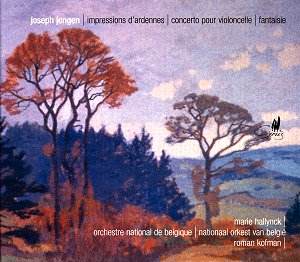
 Marie Hallynck (cello)a; Orchestre
National de Belgique; Roman Kofman
Marie Hallynck (cello)a; Orchestre
National de Belgique; Roman Kofman