Ramzi Yassa is a talented Egyptian prize-winning
pianist who has appeared with such conductors as Sir Charles
Groves and Zubin Mehta. We want to hear more from him.
I enjoyed the Beethoven. The Waldstein is a
truly great sonata and most of what this pianist does is exemplary.
The first movement is described as allegro con brio and I would
have preferred more con brio. But the fingerwork dazzles and
the pianist is always in control . There are no extremes or
excesses. This I very much admire. The pianist observes all
the tonal changes and his articulation is first class. The sforzandos
are carefully observed. I would have preferred more tension
in the fortissimo passages, such as at bar 62 with the pounding
left hand A major chords. He plays the repeat and makes a gorgeous
sound in the B flat modulation.
At least three times in the sonata Beethoven
has extended passages of broken chords, for example bar 120
- 141 in the first movement, which serve no real purpose. This
device was taken to excess by Schubert who, in one sonata wrote
9 minutes of nothing but broken chords. Nonetheless it is beautifully
played and with a sense of great expectation. Such passages
can be awkward and feel as if they do not belong, but here they
are put together very well. From bar 180 there are some gorgeous
changes of harmony which are superbly realised. I did not see
the reason for the unauthorised rallentando before the chorale
theme (bar 195, for example) or the slight rallentando before
bar 235 but the crashes at bars 252, 254 etc. are stunning.
But his other rallentandos work. The linger at the end of bar
292, and later, are very effective. It is the lingering moment
before excitement breaks forth. And it does.
There is no slow movement as such but an introduction
of 28 bars before the allegretto moderato. This introduction
is, to my mind, a marvellous piece. It begins with shifting
key centres...F, E, E minor, B, D minor and so on. And the theme
starting at the end of bar 9 is choice but never developed.
The long fermata at the end of the section really works. We
can’t wait for the rondo to begin. What delicacy the pianist
brings to this and, again, I marvelled at his control. He captures
Beethoven’s introspection wonderfully well. The cross hands
passages are so fluid and effortless. The reintroduction of
the theme at bar 115 is simply lovely, a word you may not readily
associate with Beethoven.
The episode in E flat which progresses into
C minor is strong and quite exciting but even more delightful
things are to come. The off-beat passage starting at bar 239
is gloriously telling and simple and the broken chord passage
, bars 251 to 312, is note spinning but the fingerwork is excellent.
The difficult passage from bar 349 is very exciting. If you
lose your nerve here you are in serious trouble. The control
is unbelievable. The coda is marked prestissimo and also calls
for a cool head. There is another episode, one too many for
my taste, but the playing is so good one forgets that even a
genius like Beethoven may have had a few weak moments.
The Appassionata is a curious but powerful
work which Beethoven regarded highly. He took the manuscript
in the rain to a friend in Vienna whose wife played it after
it had dried out. Was this woman Beethoven’s ‘immortal beloved’?
The Appassionata is a stormy work as if Beethoven
is fighting his feelings. If time permitted we could analyse
the score and see the mood changes and what themes or fragments
represent what emotion or character. Clearly, this is one of
those works where Beethoven bares his soul, perhaps unintentionally.
The mood changes and drama in the opening minute
is enough for an hour-long symphony. Beethoven is reluctant
to settle down. He and the music are agitated. Eighty seconds
in comes that glorious theme but it is short-lived. The anger
bursts. Here the pianist’s admirable control may not quite suit
Beethoven’s temper. The composer is turning over in his tortured
mind a soliloquy or many thoughts and emotions. The passages
for one note in each hand often prior to the main theme suggest
a dialogue and, therefore, two only are involved. Passion pours
out and that it is what it is ... the natural love and desire
of a man for a woman with its moments of hope, anger and anticipated
success. Has it ever occurred to us that Beethoven had feelings
just like any man? That he remained a bachelor does not alter
that.
The finale of this sonata is a tour de force,
one of the most exciting piano pieces Beethoven wrote - how
well Yassa plays it. I was spellbound. The CD is worth getting
just for this movement.
The Liszt pieces are gems, sensitive and beautifully
played. Anyone who can play Liszt (the greatest writer for the
piano of all time) and with such perfection must be a great
pianist.
David Wright











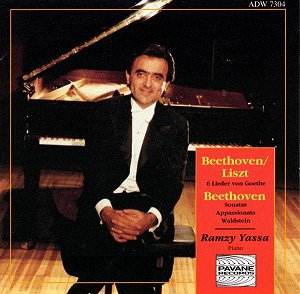
 Ramzi Yassa