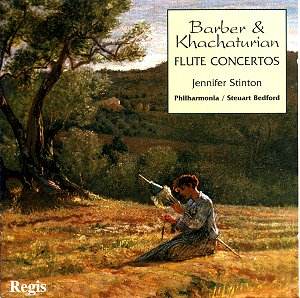
An interesting CD this because neither work was written
for the flute; they are both ex-violin concertos dating from 1940. Barber’s
was transcribed by the soloist here, Jennifer Stinton, with permission
from the Barber estate. Of the two works this perhaps underscores the
loss of the violin sound in a work which, similarly to the Korngold
violin concerto, is very much attuned to and dependent on its sounds
and colours. On the other hand the Khachaturian concerto, which Jean-Pierre
Rampal transcribed under the scrutiny of the composer, works exceptionally
well. Barber’s work has a strange history. The first two movements
were liked by the player who was to play its first performance, Iso
Briselli. However he was not satisfied with the finale and told Barber
as much, so the collaboration faltered and eventually ceased. Various
myths have blurred the facts (for example that Briselli found the finale
too difficult to play), but the truth has been well and truly established
and set out in admirable detail by Marc Mostovoy on www.isobriselli.com
(to which the reader is referred), and in Barbara Heyman's definitive
biography Samuel Barber: The Composer and His Music; (OUP, New York
1992). It was Albert Spalding who first played the complete work on
7 February 1941 with the Philadelphia Orchestra under Ormandy.
Khachaturian’s is an opulently exotic work until the
zipping finale, and is Russian to the core in terms of its orchestration.
It is also a highly Romantic work (so is Barber’s but with plenty of
other flavours such as jazz), which David Oistrakh played for the first
time on 16 November 1940 as part of the Second Festival of Soviet Music
in Moscow. There’s a lot of material which pervades the whole work from
the outset, both its rhythms and melodic shapes, while one is never
far from the Orient in its tonal colours and meandering melodic outlines.
Jennifer Stinton is a fine flautist and the Barber
deserves a public outing (apparently this recording predates any such
event though things may have changed during the past ten years since
it was made) and she goes fearlessly for the technical hurdles just
like any violinist would. Obviously she cannot double stop and both
ends of the instrument’s range are curtailed, but she provides skilful
alternatives on the whole. Rampal provided his own cadenza for the Khachaturian
and the composer professed himself highly satisfied. In the case of
the Barber, if you haven’t got it already, get the violin concerto in
its original form and add this highly interesting alternative to it.
Christopher Fifield



 Jennifer Stinton
(flute)
Jennifer Stinton
(flute)