In pointing out the continual resemblances
to Daphnis and Chloe (composed in 1912, just three years before
Pierné finished work on the three acts of Cydalise),
I fall into the trap of the sage who remarked to Brahms on the
close similarity between his tune for the last movement of his
first symphony and that of Beethoven’s last. Quite rightly,
Brahms retorted: ‘Any fool can see that!’ For this I crave your
indulgence: it does at least give you some idea of what to expect.
Further, just as the symphonies are of comparable quality with
each other, so are these ballets; and just as Brahms’s work
was essentially his own, so is Pierné’s. The booklet
doesn’t record whether Pierné actually conducted Daphnis
in his first years as director of the Concerts Colonne (a post
he held 1910-34) but I wouldn’t be a bit surprised. Franck,
Massenet and Saint-Saëns are quoted as influences here,
but the strongest stylistic correspondence (rather than influence)
strikes me as being with Szymanowski, especially in the hushed
opening for the choir – very King Roger. Once the horn and flute
enter however, this pastoral landscape is unmistakably French.
The mise-en-scène is a charming mishmash
of archaic characters and settings with the overall character
of a pastorale: nymphs, fauns, sultans and sultanas disporting
themselves in the gardens of Versailles at some unspecified
time. Our hero, Styrax, has a cheeky clarinet motif which proves
ingeniously adaptable according to context, whether lovelorn,
active or triumphant. But the further into the ballet you go,
the more wonderful tunes there are sprinkled around. The climax
of Act I’s dancing lesson settles with a bump into the a surging
melody of which John Williams would be proud. Pierné,
however, can afford to be profligate: we hear it, then again,
developed to an exultant climax, then abandoned. No matter,
there’s another just as luscious ten minutes later. Shallon
opens up at these moments but he never lingers, and this seems
all to the good.
Pierné’s orchestra is a large one (including
saxophone), exotically used. The ballet within a ballet in Act
2 has a harpsichord tinkling away, normally a mock-Baroque device
of some irritation to me, but it is redeemed and complemented
by a light and witty orchestral accompaniment.
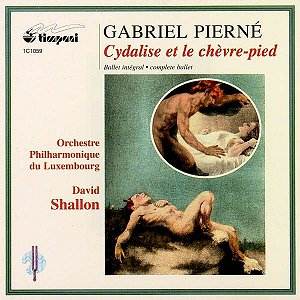
First recordings have a tendency to sound definitive
but the playing here is so rhythmically tight, tempos are so
apt and orchestral sound is so French (no matter of its Luxembourgeois
origin) that its first prize at MIDEM seems well-deserved. You
need be no particular fan of obscure repertoire to enjoy this:
and if you do, I suggest going in search of a bargain twofer
on Ultima of the Piano Quintet and a biblical cantata, Les Enfants
à Bethléem. Each of these has the same capacity
to delight a receptive ear as Cydalise, despite the claim of
the set on Timpani to house Pierné’s ‘chef d’oeuvre’.
Peter Quantrill











 College Vocal de
la Cathédrale de Metz
College Vocal de
la Cathédrale de Metz 