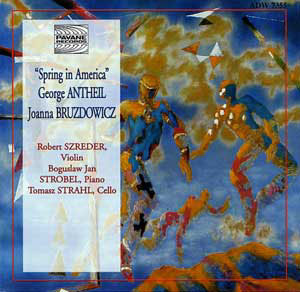
In the Sonata Bruzdowicz's writes bravura for
the violin which plays front-desk to the subservient piano role.
I was very taken with the andante's yearning simplicity
(3.34, tr 2). Quite apart from the case-hardened Kodaly-like
idiom the Polish-born composer has an evidently strong allegiance
to tonality and folksong. Dissonance and tonal fracture-lines
appear in the Trio with yet more confidence refreshed by the
soundworld of Beethoven's late quartets. Bruzdowicz is much
in the debt of three such dedicated Polish artists.
Antheil arrived like a splash of molten metal
in the early 1920s scandalising audiences with his Airplane
Sonata and like titles. The two violin sonatas are from
the same year being dedicated to Olga Rudge and written at the
commission of the poet Ezra Pound, Ms Rudge's lover. The First
Sonata bears the impress of Stravinsky's Sacre (try
the start of the third movement but the evidence is there in
the first as well) and, as the notes remind us, Antheil was
for a while viewed as Stravinsky's successor; this while Stravinsky
was still very much with us! Listen to track 05 at 3.00 for
the fruitily attacked downward slides of the violin for all
the world like an eldritch analogue of Fontaine d'Arethuse
or Tzigane. The Second Sonata is in one movement
as against the classical four of the First. While it has the
stuka-dive violin glissandi of the First (III) it is much more
taken up with dissecting and playing with American (adopted
or natural) popular music such as ragtime (with which Stravinsky
also dallied), jazz and tango. Is it possible that Peter Maxwell
Davies knew of this piece before he wrote his St Thomas Wake?
In a coup de théâtre the piano is abandoned
at 0700 (tr 8 onwards) and tenor and bass drum put in an accompanimental
appearance.
Rob Barnett