Without being in the top flight of recordings this
super bargain price collection merits the attention of anyone curious
about de Falla's music. The timing makes full use of the CD medium.
The recordings are in gripping analogue and are between thirty and forty
years old. You must not expect refined sound but in many ways the music
responds well to a rawer edge. It brings out the village overtones of
the music. Too much sophistication can be poison.
Markevich, who had residencies with Spanish orchestras,
is very good in El Amor Brujo with plenty of rhythmic attack.
His mezzo is rather shaky and her breath control when in guttural mode
is not of the best. In the Pantomime - Markevich is among the
best at shaping one of those open-hearted melodies that is a gift to
Western culture. The solo cello trembles when it shouldn't but otherwise
this is fine. One of the most appealing recordings I have ever come
across was also the rawest. It was a Melodiya recording in which the
soloist was Irina Arkhipova. This was issued on a Classics for Pleasure
LP in circa 1975. The coupling was Noches in which the pianist
was Alexander Iokheles. The sound was gritty and the strings tended
to sound strangulated but I have not since come across such spirited
attack and feeling.
Recently I have been listening to Alicia de Larrocha
in Rachmaninov's Third Piano Concerto (also on Eloquence) - a 1970s
Decca recording. Well, Haskil's Noches has similar unhurried
qualities in the solo part and although display is a sizeable proportion
of what this glorious work is about there is also poetry plenty and
Haskil is amongst the finest in this area. The Lamoureux Orchestra give
a characterful reading. As an example try the fruitily squeezed out
tone of the piano violins at 5.07 in the Generalife. The
exultant orchestral savagery in the first few pages of the Sierra de
Córdoba has hardly ever been brought out with such brilliance
- not even in the Melodiya I mentioned earlier. Markevich once again
proves himself a front-rank conductor.
The Harpsichord Concerto (really a chamber concerto
rather like Martinu's Nonet) marked the composer's flirtatious interlude
with neo-classicism. It has all the virtues and vices of that movement.
The acid-etched lines are presented lucidly and melody is not entirely
sacrificed.
Roberto Benzi is a conductor only rarely encountered
on record. I have some recollection of his Ravel on a Philips Universo
LP and I think there is also a recording or two on Forlane. The two
dances from Tricorne are snappy enough and are enhanced by the
Parisian trumpets playing with rough-gruff Mexican style. The Minneapolis
track sounds undernourished- beginning to show its age. Dorati captures
the verismo angst of the piece in the Interlude sounding for all the
world at first like the prelude to a lurid little shocker by Giordano
or Mascagni.
Eloquence have rewardingly evaded the usual suspects
and given us a sharply characterised and varied anthology.
Rob Barnett
A reader (John O'Hagan) adds (July 2010): I also recommend Benzi's recording with the LSO of the Bizet Symphony and suites from La Jolie Fille de Perth and Jeux d'Enfants on a Philips "Best of Bizet" Duo (with other pieces by other performers). This dates from the mid-1960s; it seems to have been first issued on Philips's mid-price GL/SGL LP label, and within a few years had migrated to their even cheaper Fontana Special label, and thence via other LP manifestations. It's not clear if its appearance on the "Best of Bizet" Duo is its first or only CD issue. Recording quality and performance are both excellent. Over the years, Gramophone and the Penguin Guides have approved (although the original review in Gramophone in June 1966 of the mono LP had been very disappointed with the sound). The PG warmed even more to it over the years, and finds the Philips Duo "very nearly worth getting for the Benzi performances alone". It also laments how few records he has made.
Other Benzi performances that have turned up in review journals (but not heard by JOH) include the Schoenberg orchestration for string quartet and orchestra of a Handel Concerto Grosso, with the Arnhem PO (on a 5-CD all-Schoenberg set from Chandos, featuring the eponymous Schoenberg String Quartet); Falla's "Nights in the Gardens of Spain" from 1960, with the ORTF National Orchestra, on an EMI DVD devoted to the pianist Aldo Ciccolini; and the Faure Ballade and Fantasie for piano and orchestra, with Eric Heidsieck, with the Orchestre du Festival du Grand Rue on a French label (Cassiopee). It is not known if these are still available, or even if all of them were ever issued in the UK market. But Naxos is still listing his Franck Symphony (with Le Chasseur maudit and Les Eolides) again with the Arnhem PO (which Fanfare hailed in its enthusiastic review as "one of Western Europe's better kept secrets"). "



 See
what else is on offer
See
what else is on offer 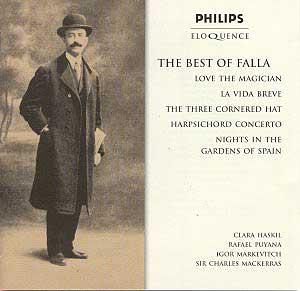
 Clara Haskil (piano), Orchestra
des Concerts Lamoureux/Igor Markevich - rec Oct 1960, France (Noches)
Clara Haskil (piano), Orchestra
des Concerts Lamoureux/Igor Markevich - rec Oct 1960, France (Noches)