This disc is a reissue of recordings made ten
years ago and fitfully available since that time. Roberte Mamou
recorded the complete Mozart piano sonatas on five CDs, and
these are now in the catalogue once again. Their return is to
be welcomed, since the performances are stylistically sensitive
and the recordings generally natural and clear.
Mamou plays a modern instrument rather than
a fortepiano, but the insert notes tell us precious little about
the circumstances of the recording. The same is true of the
music, alas, which describes the background and music of all
five sonatas within three short paragraphs. The notes we have
are rather good, in fact, offering several useful insights in
a fluently written style. There just needs to be more substance
than this.
The Tunisian-born pianist Roberte Mamou is
based in Europe, and has worked mostly in Belgium. She has just
the right manner for this repertoire, always seeming to choose
an appropriate tempo and to phrase with care for the musical
line and the thematic personality. When these things feel as
spontaneous and natural as they do here, the performer can take
due credit. For these sonatas have their demands. One of my
favourite anecdotes concerns the great Hungarian pianist Andor
Foldes, who made his debut playing Mozart at the age of only
six. After he was fifty he stopped playing many Mozart pieces
on the grounds that they were 'too difficult'.
These sonatas were written in Salzburg in 1774,
when Mozart was eighteen. Perhaps he intended to perform them
in Munich, when he went there for the premiere of his opera
La Finta giardiniera. In their under-stated way these pieces
do take the player through his or her paces. All five have a
three-movement design, but the approach changes from one piece
to the next and any sense of formula is avoided.
The Sonata in C major, K279, the first in the
series, is perhaps the least successful of these performances,
since the faster outer movements seem somewhat unyielding. The
recorded sound exaggerates this tendency, with little atmosphere
and a dead acoustic.
Fortunately this is the exception rather than
the rule, and much of the remainder of the programme is a good
deal better in every way. The recorded sound is at its best
in the atmospheric performance of the G major Sonata, K283,
which musically gives us an advance over the style found previously.
Try, for example, the very opening (track 13: 0.00), with its
appealing principal theme; this is typical of the best features
of the performances. Then the finale is a virtuoso movement
at tempo Presto, which shows the dexterity of the playing to
excellent effect.
Terry Barfoot
see review
Volume 2











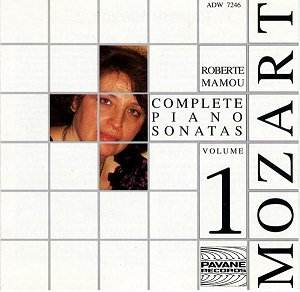
 Roberte Mamou (piano)
