Julian Cawdrey was the 1984 BBC Young Musician
of the Year, making his Queen Elizabeth Hall debut two years
later and the recipient of the dedication of a flute sonata
by Alan Hoddinott. Amongst his teachers was Geoffrey Gilbert.
He has had the courage to arrange the Op 1 Caprices for flute,
a Herculean feat that involves some wholesale rearrangements.
Since its impossible to replicate double stopping, string crossing,
extra parts and chordal writing amongst other things he has
had to "revamp" (his word) the flute part. In that
respect, maybe surprisingly, he's not the first. There's an
arrangement. I believe, by Jules Herman dating from the early
1970s and the French flautist Patrick Gallois has also brought
out his own arrangement, published by Leduc, which sounds a
good deal more avant-garde than Cawdrey's employing as it does
circular breathing, flutter tongue and humming; in fact Gallois
has recorded his edition on DG 435 768 2GH.
Cawdrey prefers a degree of flexibility allied
to more conventional means. He advocates crisp articulation
at fast tempi, replacing, for instance, the double-stopping
of No 8 with octave leaps (Gallois here employs "double
articulation" to provide an octave effect). In No 9 Cawdrey
uses grace notes to imitate the Caprice's huntsman's call; in
the same Caprice the French flautist engages in some suitably
pyrotechnic humming. I was anticipating No 6 with its sustained
single string melody and simultaneous trill with some interest;
here Cawdrey plays the melody with the trills pps, quite
an inventive solution. It takes quite some violinist
to tackle the Caprices let alone a flautist and the young Englishman
acquits himself well. Of course there are problems; the scintillating
runs in No 2 are difficult to sustain (the flutes limitations
here, due to breath taking, are really considerable and take
their toll). Intrusive breaths compromise the melodic line;
the trills of No 11 could have been more deftly and quickly
taken, although I did most certainly enjoy Cawdrey's elegance
in this rhetorical Caprice. Its very difficult to bring off
the register leaps of No 15; quite a lot of line fracturing
is involved. Transpositions are inevitable in a transcription
of this kind but Cawdrey has an acute musical ear for incongruity
and an occasionally frisky one as well listen to the over drone
melody of No 12 and its attendant buzzing tone. No 22 emphasises
an occasional fault of the recording which is to expose a certain
shrillness in Cawdrey's tone, especially maybe inevitably at
the top of the compass, though this is hardly surprising given
the remorseless virtuoso rhetoric he has deal with. Its good
that flautists are increasingly looking to this kind of repertoire;
if you're going to do it at all you might as well do it as well
as Cawdrey.
Jonathan Woolf











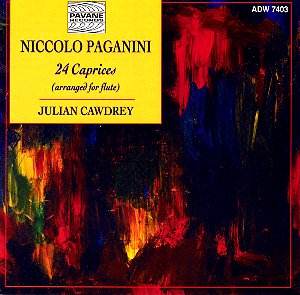
 Julian Cawdrey, flute
