Albert Wolff was born a Parisian though of
Dutch parents. He graduated from the Paris Conservatoire as an
accompanist. Gallant service in the French Army during the Great
War was followed by three years at New York's Met conducting French
repertoire. There he directed the premiere of his opera
The
Blue Bird. He was conductor of the Lamoureux from 1928 to
1934 and while there had an exclusive recording contract with
Polydor - a reminder of this appears on the handbill facsimile
on p.17 of the set booklet. From 1934 to 1940 he conducted the
Pasdeloup and remained its chairman and chief conductor until
his death. During the Second War he toured South America and conducted
regularly at the Teatro Colón in Buenos Aires (1939-45).
The Lamoureux shared Parisian concert life
with a number of other society based orchestras. The Lamoureux
had their contractual recording ties with Polydor while the
Colonne were with Odéon and the Société
des Concerts du Conservatoire with Columbia. Other orchestral
societies included the Pasdeloup, Poulet, Siohan and Straram.
Until the election of Wolff to the Lamoureux the society had
been directed largely by the Lamoureux 'dynasty', the founder
Charles Lamoureux and his son-in-law, the composer-conductor,
Camille Chevillard (1897-1923) then Chevillard's assistant,
another composer-conductor, Paul Paray. Paray was later to achieve
considerable fame through his Detroit SO recordings with Mercury.
Paray, who directed the orchestra from 1923 to 1928, preceded
Wolff.
Wolff conducted the premiere of Les Enfants
et les Sortilèges in 1926 at the Opéra-Comique
and indeed there was an overlap in orchestral personnel between
the O-C and the Lamoureux. Roussel was one of Wolff's favourite
composers and he directed the 1929 premiere of Roussel's Psalm
LXXX. Wolff is the dedicatee of the Roussel Fourth Symphony.
He was at the helm for the 1947 first performance of Poulenc's
opera Les Mamelles de Tirésias. He gave local
premieres of Pelléas et Mélisande at Naples, Buenos
Aires, Hilversum, Stockholm, Oslo and Copenhagen.
His Polydor recordings, many of which are here
in this set also included Liadov's Baba Yaga, Mussorgsky's
Night on the Bare Mountain, Rimsky's Capriccio Espagnol,
Franck's Symphony, Redemption and Chasseur Maudit.
In the 1950s Decca recorded his Balakirev Tamara,
the Bizet l'Arlésienne music, Massenet's Scènes-
Pittoresques and Alsaciennes, as well as an anthology
of overtures: Donna Diana, Zampa, Si j'étais
roi, Pique Dame, Merry Wives of Windsor, Fra
Diavolo, Cheval de Bronze, Masaniello - all
with the Paris Conservatoire Orchestra.
This munificently packed set starts with the
Méhul overture. This is prime Beecham territory and it
would not surprise me if Beecham had heard Wolff conducting
this work on one of his recces to the music libraries of Paris
scouting for toothsome delicacies for his concerts. The overture
has a long pastoral introduction (not unlike Beethoven's own
Pastoral) and a chasseur finale which picks up speed
with Rossinian abandon. Orchestral execution is fine though
there is at least one watery moment from the horns. The Berlioz
Menuet hiccups and flutters along while the Sylph
dance goes with a halting swing. The Namouna score
is not Lalo's most consistently inspired creation though the
old Martinon DGG LP (which also coupled Namouna
with the Rapsodie) once had me thinking otherwise. In
Namouna Wolff does a charming job as he does in the first
section of the Rapsodie. The best thing to do is to approach
this music as the Gallic equivalent of Farnon, Coates, Haydn
Wood and Montague Phillips. The rumbustious second section of
the Rapsodie goes with stomp and bubble (tr 10, 00.35).
The Saint-Saëns has sharply focused attention to rhythm.
It is followed by two sections of a Charpentier work he later
recorded complete, post-War, for Decca in LP days. It saw considerable
currency on the budget Eclipse label in electronically contrived
stereo. The Impressions d'Italie is diverting enough
though tending to sound rather over-blown in relation to the
musical ideas.
Roussel dedicated his Fourth Symphony to Wolff
but, as far as I can tell, never recorded it. The splendid recording
of the Third Symphony is full of vigour and disciplined playing
- clean almost neo-classical, objective and not at all romantic.
The allegro spirito has a memorably steady sweetness
in the tone of the Lamoureux leader M. Charmy.
Dupont's La Farce du Cuvier is of the
tradition of Suppé and Reznicek. It offers some tight
playing for example in the shrill shudder of the violins at
1.19. D'Indy's Fervaal prelude must have been taken from
a very beat-up 78. The steady rustling background is to be expected
and is common throughout this set in which the transfer engineer
has used minimally intrusive methods. This one suffers from
a cyclical shushing beat. The piece itself is given an affectionately
mesmerising character.
Jeanne-Marie Darré is well respected
for her Saint-Saëns piano concertos on EMI. This is her
with Wolff in 1932 in the French Mountain Song symphony.
They give a highly romantic performance with a finale of
good humoured rusticity sounding just a little like a cross
between the finale of Vaughan Williams' A London Symphony
and Falla's Tricorne. It needs and gets real engagement
to make it 'speak'. Was this the first recording, I wonder?
Further interest is added by a booklet photograph of the desperately
attractive pianist at the piano at a Lamoureux concert - presumably
from the 1930s.
Franck's Psyché excerpts take
up almost 18 minutes and the birdsong and light and languid
eroticism is well projected though not as successfully as Pierre
Bartholomée's with Liège forces on Pathé-Marconi
(EMI Classics). Of course Bartholomée did have the
benefit of 1970s technology and stereo.
Well I suppose the style of Rameau on disc
3 would not be acceptable nowadays being just too legato and
charm-sweet. This is Rameau as I would have expected Beecham
or Goossens to do it. The Chabrier tracks have sparkle and bustle
although I have heard España go with more lively
rhythmic engagement than this. The 1933 Gwendoline goes
superbly, benefiting from the seriousness and tension Wolff
finds in the music. No doubt Wolff's success in this field was
why he was the conductor of choice when it came to recording
old-fashioned sparkling overture anthologies. His experience
in conducting the Opéra-Comique imbues his sense of drama.
His Rabaud Procession Nocturne has a
relaxed rocking motion, slowly unfolding romance and some of
the atmosphere of the Siegfried Idyll - all in a softly
focused dream without any hint of anxiety. The jolly little
Laparra prelude is nice to have but not greatly memorable. What
a pity there is no Wolff conducting Biarent or Guridi. The famous
Sorcerer's Apprentice has all the mystery you would expect.
The Schmitt, written in 1911, is one of his rarest pieces and
bears some signs of the later La Valse of Ravel (1920).
The waltz is the material out of which exuberant fantasy is
made in the Caprice. If the waltz accounts for the Viennoise
aspect the Caprice element must owe something to
Tchaikovsky's Caprice Italien. This squares well with
Parisian tastes of the time. Russian pieces (often played by
the Lamoureux) were very acceptable concert companions to French
works. On the other hand German novelties were not often welcomed.
It is fascinating to note that Wolff conducted one of the earliest
French performances of Mahler's Fourth Symphony in Paris in
1931 to receive a bewildered reception.
There are some Debussy and Ravel tracks as
well. Of the two Nocturnes, Nuages has mystery
and self-absorption but one misses modern recording quality.
This reminded me of Jean Fournet's old Supraphon recording with
the Czech PO. Fêtes is given a swift virtuoso performance
- excellent. His vulnerable Prélude a l'après-midi
d'un faune has a an appealing fragility. Wolff's Ravel concludes
the last disc. Wolff's style must surely have helped shape that
of Monteux as heard in the Ravel Philips 50 series CD
I reviewed last year. I have not compared timing but Wolff seems
a shade slower. He has mastered the alchemy of the deliberation
he wanted but at the same time never sacrifices the illusion
of forward movement. The Mère l'Oye suite goes
wonderfully well with the diaphanous orchestration communicating
still. In La Valse Wolff takes a different tack. Here
he brings out, as never before, a certain anxious, guilty or
hunted feeling.
Side joins are managed without drawing attention
to themselves. Some surface is allowed to continue at the end
of each piece to avoid those cliff-edge truncations so disturbingly
present among the more ham-fisted transfers sometimes found
elsewhere. Just one lapse I noticed - at the end of the Malagueña
from Ravel's Rapsodie Espagnole where the cut off
is just too abrupt.
Hiss and busy surface noise is left intact.
As the notes suggest the objective of the transfer engineers
was to capture the maximum amount of musical information from
the seventy year old grooves. Clicks and pops have in general
been 'majicked' away - although it seems a pity that the momentary
cyclical scuffing at the end of La Jardin Féérique
could not have been elided. Timpani achieve results comparable
with those of Pearl. Admirable.
To assemble this set Timpani had to draw on
both public and private collections. The metal matrices either
did not exist or were not accessible to Timpani so they had
to use the best issued pressings they could find. The dedicated
restoration work of Jean-Pierre Bouquet has richly paid off.
This set would not have existed without the sound collections
and libraries of Claude Fihman, Fondation Armand Panigel, Discothèque
de Radio France and René Trémine. We owe thanks
to all of them and to Timpani's Stéphane Topakian.
The set was first issued in 1994. It is very
well presented with a good bilingual booklet (French and idiomatic
English) by Alain Pâris. Discographical details are given.
For example you will find matrix numbers but as far as I can
see there is no indication of the recording location(s). The
exact dates of the recording sessions are not given; only the
mechanical copyright year from the disc.
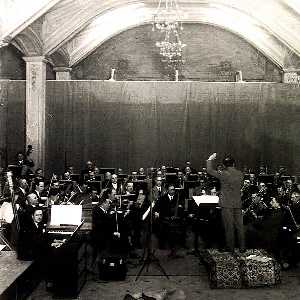
The card slipcase holds a double width case
and a typically pleasing Gallic touch is that the box includes
a 'pull' strip which when pulled transforms the inset photograph
of Wolff with the Lamoureux from one where Wolff looks back
at the photographer to another where his back is to us as he
conducts the orchestra.
Inevitably this lovingly assembled and produced
set is not likely to draw the generalist. It is for dedicated
collectors with interests in the Concerts Lamoureux, Wolff,
French performing practice in the 1930s, composer enthusiasts
as well as Ravelians and Debussians anxious to document all
versions.
Rob Barnett











 TIMPANI 4C4024
[77.41; 75.30; 73.37; 75.06]
TIMPANI 4C4024
[77.41; 75.30; 73.37; 75.06] 