A short number of weeks
ago
I reviewed an excellent Zefiro disc
by Gwendolyn Toth of Bach’s Goldberg
Variations played on a lautenwerk. The
disc at hand takes us further back in
time to the 17th Century
and to the music of the masterful composer
Heinrich Scheidemann.
Scheidemann initially
studied with this father who was the
organist at the St. Katherine Church
in Hamburg. At the age of fourteen,
the St. Katherine congregation funded
a three-year apprenticeship for Scheidemann
to study in Amsterdam with the Dutch
master J. P. Sweelinck. The congregation
expected Scheidemann to return to Hamburg
after the three years and become its
organist, and Scheidemann did just that.
He remained the St. Katherine organist
until his death in 1663.
Why would Scheidemann
compose, teach, and perform in Hamburg
for such a long period? Essentially,
Hamburg was an economic haven during
the 17th century as many
merchants and artists migrated there
for its religious, commercial and artistic
freedoms. Scheidemann led a fine life
in Hamburg and was even excused from
paying taxes and other fees that ordinary
citizens of the area had to contribute.
Scheidemann’s study
with Sweelinck was a tremendous boost
to his reputation, architectural proficiency
and artistry. In Hamburg, Sweelinck
was known as the "maker of Hamburg
organists". Each of the four major
churches in Hamburg had organists who
had studied under Sweelinck, another
being Jacob Prætorius who shared
the Hamburg limelight with Scheidemann.
Of these two great
composers, Scheidemann was considered
the more affable in personality and
in music composition. He was also the
more inventive composer, helping shape
the chorale prelude and initiating the
use of echo patterns. Scheidemann was
the leading figure of the North German
Organ Movement in the first half of
the 17th century. His music
ranges from the sublime to the majestic,
set through a blend of severity and
sweetness. Actually, I can’t emphasize
enough that this mix of severity and
sweetness is at the heart of the appeal
of Scheidemann’s organ music, and that
it is important for performers to use
organs that naturally highlight the
mix.
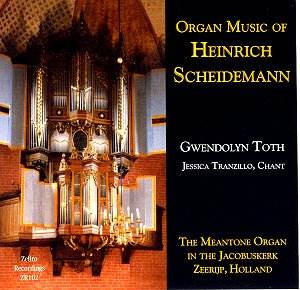
Gwendolyn Toth plays
her Scheidemann program on the meantone
organ built by Theodorus Faber of Groningen,
Holland in the years 1645-1651; reconstruction
was accomplished in the late 1970s by
Bernhardt H. Edskes and S.F. Blank.
This is a perfect organ for Scheidemann’s
music in that the meantone temperament
with its incisive key traits tends to
result in the strengthening of both
the severity and sweetness of Scheidemann’s
organ music. Although the Faber organ
is a small one with two manuals and
nineteen stops, it offers ample scope
and power.
Toth gives us a generous
and varied group of works played in
splendid fashion. Her blend of severity
and sweetness is always compelling,
and we are easily transported back to
the Scheidemann’s Hamburg. In addition
to conveying the tenderness of the music,
Toth also uses the full resources of
the Faber organ to create strikingly
majestic images so prevalent in Scheidemann’s
music.
There are other advantageous
features as well. In "Jesu, wollst
Vns weisen", Toth invigorates this
delightful piece with a ‘bird-song’
stop that is rarely encountered on other
recordings. Another great touch is the
use of applicable chant in three of
the programmed works. Singing the chants
is Jessica Tranzillo, a soprano of beautiful
voice who creates all the mystery that
the chant form requires. I should also
add that the sound reverberation is
ideal for Tranzillo.
Of course, perfection
is a hard destination to achieve, and
Toth doesn’t quite reach it. Her registrations
could be more imaginative and varied,
and her echo effects are rather drab
as they are played at a volume too similar
to the primary lines in the Magnificat
8 Toni and the Toccata.
The above reservations
do little to detract from Toth’s artistry
and the fact that each of the works
on the program is highly rewarding.
The most substantial and magnificent
work is the Magnificat 6. Toni, having
four verses and clocking in at over
seventeen minutes in length. There is
not a dull moment in this piece that
is a compendium of the prevalent styles
used in Scheidemann’s era.
In conclusion, recordings
devoted to Scheidemann’s organ music
are infrequent. Toth’s excellent disc
certainly will be highly desirable to
Scheidemann enthusiasts and a fine addition
to those already on the market from
the Johnson siblings on the Calcante
label and the four existing volumes
from different organists on Naxos. Each
of these recordings is excellent, and
Naxos obviously has the price advantage.
Also, Volume 2 of the Naxos series,
performed by Karin Nelson, is the greatest
Scheidemann organ disc I have yet to
encounter. However, you will only find
the birds and sublime chant on Toth’s
recording. I recommend it highly to
anyone wishing to become familiar with
the organ music of the early 17th
century.
Don Satz



 Gwendolyn Toth, organ