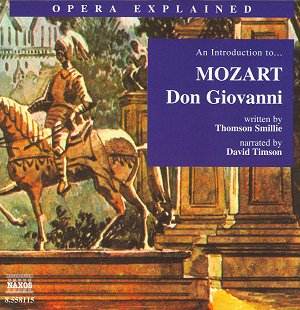
This issue can either
be taken in isolation or as complementary
to the companion ‘Marriage of Figaro’,
(NAXOS EDUCATIONAL 8.558078) with similarities
in the background, section titles and
content (trs. 1-6). What I found particularly
striking in tr. 1, titled ‘The beginning
of Don Giovanni’ are the facts that
in the decade 1781-1791, during which
the opera was composed, Haydn composed
76 major works, including one opera,
whilst Mozart composed 158, and to quote
the narrative, ‘including four, some
might say six, of the greatest operas
in the repertoire’. Such facts are
included, informally and appropriately,
in the narrative of this series. I believe
they make for enhanced interest and
enjoyment for the opera buff as well
as the beginner. I would, however disagree
with promoting the idea, in the next
sentence, that Don Giovanni was Mozart’s
greatest work; the Marriage of Figaro
maybe, but then that’s just my opinion!
These statements, like all the narrative
in the 22 minutes of the ‘background’,
are interspersed with relevant musical
snippets. ‘Mozart’s genius’ (tr. 2)
quickly passes over the influence, malign
or otherwise, of his father Leopold,
to extolling the early exhibition of
the composer’s diversity, with reference
to his church music, string quartets,
concertos and symphonies. Smillie is
not above noting that Beethoven wrote
only one opera, Brahms none, whilst
Verdi and Puccini wrote no symphonies.
There is mention too of Mozart’s renowned
musical memory, which allowed him to
play over, in his mind, once heard,
any work by any other composer. Reference
is made to earlier operas (tr. 3), again
backed by brief musical illustrations,
before moving on to more detailed consideration
of ‘Cosi’ and ‘Figaro’ (trs.4 and 5),
the other operas of the Da Ponte trilogy.
The last section of the background,
titled ‘historical context’ (tr. 6),
deals with the origin of the story of
the opera and how it was used by Da
Ponte and Mozart, its preparation for
the premiere in Prague and why the premiere
took place in that city rather than
the composer’s home base of Vienna.
It is only pointed out later, and then
rather coincidentally (tr. 15), that
there are distinct differences between
what was written for Prague and what
was later presented in Vienna, and what
promoted these differences. I think
those differences, and reasons, deserved
separate and distinct treatment.
The remaining tracks
of the disc (trs. 7-18), a total of
56 minutes, take the listener through
the opera with a superbly cogent description
and analysis of the development of the
story, with relevant musical illustrations
being taken from Naxos’ excellent complete
recording of the opera (reviewed
by me elsewhere on this site). The
booklet gives details of first performances
in the UK, as well as a summary of the
background to the story, repeating some
of the more germane points made in the
spoken narrative. There is also a synopsis
setting out the bones of the opera,
scene by scene. The clarity of the explanations
together with the incidental insights
along the way, make an enjoyable journey
for both the newcomer and even the enthusiast
who may have seen the work many times.
Strongly recommended.
Robert J Farr



 Narrative written by Thomson Smillie and spoken
by David Timson
Narrative written by Thomson Smillie and spoken
by David Timson