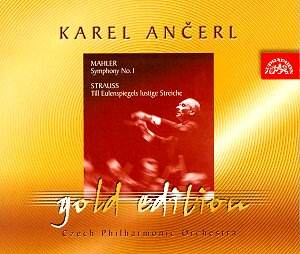
It is becoming easier
and easier to see why this is called
a ‘Gold’ Edition, for there is so much
special about these Czech readings.
The Ančerl
Petrushka and Rite of Spring
(SU3665-2: see my
review) brought with it many revelations.
This Mahler/Strauss coupling is hardly
less impressive.
There are, indeed,
many fine Mahler 1s in the catalogue.
Of digital ones, Bernstein on DG is
about as exciting
as they come, with supreme playing and
with the feeling of live performance
at its most imposing. Kubelík, too,
was an imposing interpreter of this
score, as was Bruno Walter. Ančerl
provides an entirely individual, thought-through
account of the score, and the
members of the Czech Philharmonic play
like gods for him.
But all does not begin
well. The atmospheric initial sustained
octaves has high violins sounding like
an outbreak of tinnitus. If the woodwind
do not really represent a ‘Naturlaut’
(sound of nature), the distanced fanfares
are remarkable. Horns have a creamy
vibrato typical of this geographical
area (although they choose a strange
place to breathe in their initial statement,
breaking the phrase). The arrival of
the Wunderhorn song, ‘Ging heut’ Morgen
über’s Feld’ is rather literal,
lacking a spring in its step. And yet
as the movement progresses there is
more of a sense of space … of the music
flexing its muscles.
The second movement
(Scherzo) is lusty and decidedly rustic
in its rhythmic emphases (Quote 1).
No polite one-to-a-bar lilt, this is
earthy, thigh-slapping stuff. All credit
should go to Ančerl
for highlighting Mahler’s progressive
scoring of interruptive hand-stopped
horns and making them sound modern and
disturbing.
The famous March that
makes up the third movement is expertly
handled. The smooth layering of the
famous subject makes the perfect contrast
to the acidic-sounding oboe. Some of
the middle episodes go with a decided
swing. The finale is equally impressive.
The opening is very dramatic (Quote
2), especially the fast rising string
passage – for once every note is audible,
yet Ančerl
ensures it maintains its gestural function.
Particularly impressive is the way Ančerl
presents the text as a gradual unfolding
rather than a stasis – and this unfolding
is of the utmost care (listen to the
delicacy at 7’50-8’00). Good also that
even in moments of relaxation
there is an underlying current of tension,
a tension finally culminating in a scored
‘shriek’ at 17’07, leading to the final
brass-dominated peroration. Memorable
Mahler.
This Eulenspiegel
was originally coupled with the above-mentioned
Petrushka; an inspired idea bringing
the two together (Bohuslav Vitel’s notes
rightly point out the similarities between
the two jesters). The little space allowed
between the two pieces is not enough
here – suddenly, from Mahler’s emotive
climax we are in the midst of Straussian
antics (Track 5). The spot-lighting
of the woodwind may initially be distracting,
but it is worth persevering for the
famous horn solo – listen how the player
seems to ‘squeeze’ the appoggiaturas
out of his instrument. A cheeky clarinet
seems to sum up Till’s impish character
– indeed, Ančerl
capitalises on this and presents some
of the episodes in distinctly cartoon-like
fashion. A word of praise also for the
solo violinist, who hits his top note
spot-on and whose ensuing descent is
faultless. Ančerl gives his Till
all the confident swagger of an inebriated
Cockney – there is no doubt that we
are in the presence of a Germanic wide-boy
here.
Colin Clarke



 Czech Philharmonic Orchestra/Karel Ančerl.