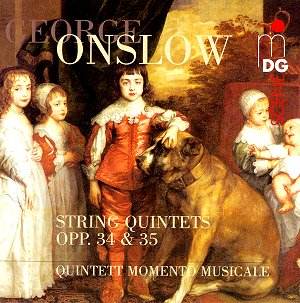
The French-born Georges
Onslow, who studied composition with
Anton Reicha in Paris after training
as a pianist in London, was best-known
during his lifetime for his chamber
music, his star fading as French tastes
gravitated towards the larger designs
of the symphonic poem and grand opera.
Cordula Timm-Hartmann's notes cite classical
models for these four-movement string
quintets, specifically Boccherini, but
it's more complicated than that. The
two "minuets" are nothing of the sort:
that of Opus 34 is temperamentally akin
to a Beethoven scherzo, while that of
Opus 35 has a genial, Ländlerisch
buoyancy. And the yearning, expressive
harmonic idiom and long, singing lines
suggest the lyrical side of Schumann,
infused with an extra measure of elegance.
On the other hand,
the outer movements of both quintets
are rigorously worked-out, substantial
sonata structures - that of Op. 34 is
nearly fourteen minutes long. And Onslow
does copy Boccherini's use of two cellos
- rather than the customary two violas
- in the ensemble, releasing one of
the cellos from bass duties for melodic
use, and thus enlivening the textures.
(In these performances, the substitution
of a double-bass for the second cello,
as approved by the composer, offers
an additional measure of depth and further
enhances the sense of "symphonic" dimensions.)
The dramatic Opus 34
quintet sustains the listener's attention
from the cello's agitated statement
of the opening phrases. The first movement's
powerful, expansive development imaginatively
explores the expressive possibilities
of the two themes. Flickering major-key
harmonies all too briefly lighten the
anxious, uneasy minor mood of the "minuet."
The Adagio espressivo begins
with strongly weighted suspensions producing
large-scale tension, while a secondary
theme sings with poised simplicity over
a walking bass. The Finale offers
a lively interplay of various melodic
and accompanying strands, with a moment
of hushed anticipation at 5:14 further
ratcheting up the tension. Opus 35 is
quirkier and less imposing, but still
most enjoyable: the outer movements
offer well-wrought conflict and resolution,
while the Andante cantabile opens
with a dignified chorale worthy of Beethoven.
The members of the
Quintett Momento Musicale serve up Opus
34 with clear purpose, hair-trigger
attacks and releases, impeccable balances,
and an attractive, burnished ensemble
tone. They have a nice feeling for the
musical ebb and flow, the thrust and
contrasting lyricism, of Opus 35 as
well, but the odd detail gets away from
them. The bassist can't quite make his
running figures (originally intended
for cello, of course) intelligible in
the first movement; the chord that launches
the development is smudged - it seems
to take the players by surprise; and
the motivic fragments that begin the
Finale don't immediately coalesce into
a clear scansion.
Still, this music and
these performances are well worth getting
to know, and the clear, vivid, subtly
ambient recorded sound makes it a pleasure
to do so.
Stephen Francis
Vasta



 Quintett Momento Musicale