Mozart wrote three
symphonies (K183, K200, K201) during
1773-4, and they represent a change
in approach from the 'entertainment'
music he had previously written under
that title. Although his employer, the
Prince Archbishop of Salzburg, was a
poor judge of music, Mozart still continued
to produce masterpieces for him, and
the present symphony is an example of
how the composer was writing very much
for his own satisfaction. Henceforth
his symphonies became vehicles for some
of his most profound musical thoughts.
Yet the instrumentation is by no means
indulgent, since it was determined by
the size of the standard Salzburg orchestra:
two oboes, two horns and strings.
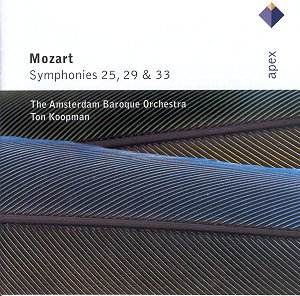
Therefore this compilation
from Ton Koopman and the Amsterdam Baroque
Orchestra makes perfect artistic sense.
It is all very nicely played and very
tastefully shaped, but not everything
comes off as well as it might. For example,
Symphony No. 29 is the first item on
the programme, and Mozart marked the
opening movement Allegro moderato. Koopman
plays it as an unequivocal Allegro,
very much up-tempo. The music can take
it, of course, but in truth there is
more poetry in it than this performance
finds. Likewise the second movement
Andante has a somewhat matter-of-fact
character in its phrasing, though here
the tempo is not at issue. There is
a vein of tenderness in, say, Karl Böhm’s
performance (DG) that eludes Koopman,
or perhaps he does not seek it. The
remaining movements are direct and make
their virtuoso point, with thrilling
horns towards the end of the finale.
Symphony No. 33 comes
next, and Koopman makes a compelling
statement at the opening balancing this
against the lyrical phrases and the
consequent lively symphonic development.
For this is a compelling performance;
perhaps the music suits these performers
better. Again tempi are lively, but
this time Mozart asks for Allegro assai
(and gets it). There is some particularly
sensitive string playing in the second
movement. These are gut strings, of
course, but they sound just right as
the music swells through the opening
expressive phrases. The minuet is crisply
articulated, the finale driven buoyantly,
to complete this enjoyable performance.
Symphony No. 25 concludes
the programme, and in many respects
this ‘Sturm und Drang’ piece suits Koopman
best of all. Perhaps a little more weight
or body of violin sound would have brought
a more pleasing sonority, though some
would argue that pleasing sonority was
not on Mozart’s agenda here. Certainly
the music drives along at Allegro con
brio with an intensity that anticipates
Beethoven, and the horn players in particular
acquit themselves with distinction.
The string sound issue is at its height
in slower music, of course, when the
quality of sound is paramount. The Andante
does put this issue on the agenda, and
perhaps the tempo is a little driven,
the stabbing figures missing a little
of their intensity. But the playing
is undoubtedly of a high order and offers
compensations to match. The finale sounds
for all the world like one of Haydn’s
Sturm und Drang pieces, which Mozart
may or may not have known, though he
knew the style well enough. The finale
builds considerable momentum, but with
subtle nuances of phrase and gesture.
This symphony is one of the great achievements
of Mozart’s early maturity.
Terry Barfoot



 Amsterdam Baroque Orchestra/Ton Koopman