What is a mezzo-soprano? This is a question
which has occupied a good many of my thoughts over the past year or
so since an Italian soprano with whom I do much work changed teacher,
was diagnosed as a mezzo-soprano and is now blossoming vocally in a
way hitherto unimaginable. I have therefore witnessed the transformation
stage by stage. But what are the signs? How can you tell what a singer’s
real voice is?
I suppose I had vaguely presumed up till that time
that a mezzo-soprano was a soprano voice pitched about a third down,
but it doesn’t seem quite that simple. For one thing, the category hasn’t
always been recognised, at least not explicitly. In Mozart’s C minor
Mass, for example, there are parts for two sopranos (however, according
to the edition you have, one of them may be labelled "mezzo-soprano").
But the big solo for the lower of the two, while it descends to a low
A, is not suitable for all mezzo-sopranos since its coloratura passages
lie fairly high, and it is sometimes taken by a "normal" soprano
who can "manage" the lower notes. But an ability to "manage"
the lower notes does not necessarily turn a soprano into a mezzo-soprano,
for the part of Fiordiligi in Così fan Tutte also descends to
a low A. But elsewhere a lot of the role goes extremely high and it
has never been suggested that a mezzo-soprano might take it (well, recently
there have been hints that Cecilia Bartoli might do so, but she is a
special case; more of this later). There are also Mozartian parts which
go neither particularly high nor particularly low (Cherubino, Dorabella)
and which can be taken by either, and there are also some leading parts
(Oktavian in Rosenkavalier, Rosina in Barbiere, Carmen) which have been
taken by one or the other; the choice regards the tone-colour one wants
to hear in the part (in the case of Rosina some of the decorations change
according to which voice sings). So, while the actual label "mezzo-soprano"
seems not to date back very far, there has always been a recognition
by composers that voices all had their individuality and the strict
definitions "soprano" and "contralto" ignored the
reality that many singers were not wholly one or the other.
If you hear any female singer rehearsing, you will
realise that women have a faculty which men do not have. When they sing
a phrase over, not projecting the voice but to themselves, maybe to
check word underlay or intonation, they mostly sing an octave down,
at tenor pitch. Even a high soprano can get remarkably low when not
singing "in voice". This of course has no practical application
in classical music since the sound reaches no great distance (in light
music, with a microphone, the technique is actually cultivated). Then
they take a deep breath and project the music in their singing voice,
which usually means an octave up. If the singer is a contralto then
she might sing at the same pitch since she will have rich, natural tones
which take her down to a G or even an F with little need to employ her
"chest voice". Even a soprano can project her voice
on these low notes, but she will have to use exclusively her chest voice.
Singers of light music (those with what we call a "smoky"
lower register) use this technique extensively and actually learn to
carry their chest voice up quite high (think of Shirley Bassey, for
example). Classical singers will tell you this hurts their voice and
they avoid doing it. Occasionally you will hear a soprano doing what
sounds like a Marlene Dietrich imitation as a stunt, by and large, though,
a singer has to train as one or the other and any attempt to run parallel
careers only ends in grief.
But there is also a way of catching some of the chest
resonance to enrich the lower notes. If you listen to a singer like
Christa Ludwig you will hear that even as high as the F above middle
C she catches this resonance which then gives fullness to her timbre
as she descends to her lower notes. This is a very different matter
from the throaty roar which we hear from Risë Stevens in her recording
of Gluck’s Orfeo – the effect there is not of enrichment, for there
is nothing to enrich, it sounds merely worn out and jaded. So, setting
aside what is just unpleasant singing, if you compare a pure contralto
like Ferrier and a mezzo like Ludwig singing the same music, you will
hear two quite distinct timbres, two different kinds of richness, equally
beautiful.
That’s one end of the voice. Then there’s the question
of the passaggio, or break, between the middle and upper registers.
Again, you might think that a mezzo-soprano would have this about a
third below the soprano and the contralto lower still, but actually
it seems to be in roughly the same place for all women, around the F
on the top line of the stave. A contralto will probably stop here, a
light soprano will be as happy as a lark singing above it. Between these
extremes each singer finds the area where she is happiest, and also,
one hopes, that in which she can exhibit what is most individual in
her own timbre of voice. So a mezzo-soprano may have all the top notes
of a soprano, yet feel she is giving the best of herself in her middle
register. A light soprano could presumably develop her chest register
to descend as low as a mezzo, but will have chosen not to do so, probably
on the basis that her upper register is where she feels happiest and
where her voice appears to best advantage. There is at least some degree
of choice in the matter, since for psychological reasons a singer may
feel she is expressing herself best up on high or down in the depths.
And the voice itself may shift up or down with the passing of time.
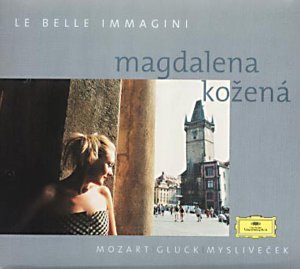
Magdalena Kozena – to get down to brass tacks at last – has told how
she used to sing Gluck’s Orfeo but now finds the role too low for her.
My query – which formed itself in my mind before I saw the interview
in question – is how long she is going to remain a mezzo-soprano at
all.
The test piece is the Lucio Silla aria. This goes down
to a low A, and she resolves it with a weakish chest-note. Any soprano
could manage this. The bulk of the aria is pretty high, with a top C
in the cadenza which does not seem to trouble her (but we don’t know
how easily she can hold this note for a long time). She seems entirely
happy – as she had already shown in Myslivicek’s Antigona aria – to
rattle off coloratura around and above her break. From her middle register
up to her highest notes her voice has a natural, fairly light, golden
sound. Her vibrato is, shall we say, inclined towards the maximum acceptable,
but for the moment it is a voice you can just sit back and drink in
for its own sake.
One pleasing aspect of mezzo-sopranos (whether they
really are that or not) is their willingness to look out new repertoire,
presumably a reflection of the fact that standard operatic pieces don’t
quite fit them. Recently Cecilia Bartoli had a tear-away success with
a disc of pre-reform Gluck (Decca 467 248-2 – see my review
of this). One of the Clemenza di Tito arias turns up again in Kozena’s
collection of fairly rare Mozart (a swift but actually rather gentle
"Voi che sapete" being the exception), rarer Gluck and even
rarer Myslivicek. The obvious point when comparing the two versions
of Gluck’s "Se mai senti spirarti" is that Bartoli sings it
a tone higher (so what was the original key?), carrying her up to a
high B which she resolves with celestial ease. Her tempo is also much
slower (involving considerable feats of breath control) and time seems
to stand still as her almost disembodied tones float languidly on the
orchestra. Kozena’s estimable version seems plain beside this. So if
Kozena is hardly a mezzo-soprano, what is Bartoli? Well, she could sing
as a soprano, but her lower register assumes a contralto-like richness,
which she can carry right down without undue use of chest tones. So
yes, I think she is a mezzo, if one with a rather exceptional range.
Leaving aside the technical questions, what matters
is that Kozena has a lovely, fresh-timbred voice, whether you regard
it as a mezzo or not. Her manner of interpretation is more straightforward
than Bartoli but her commitment is not in doubt. She does her compatriot
Myslivicek proud (Gluck was a compatriot too, of course). Mozart always
retains his special qualities but she makes out a case for Myslivicek
being on a level with the lesser-known works of Gluck: He emerges as
a little more traditional, more inclined to take at face value the florid
traditions of opera as he found it, while Gluck moved towards reforming
them. There is a bitterness in the text of "Dunque Licida ingrato"
which I don’t find in the music (and I don’t think this is any failing
of Kozena’s) but the music is otherwise vital, soundly composed, never
banal and a fine vehicle for the voice. With good support from orchestra
and conductor this is a disc which should be bought even by those who
resist hype on principle.
From a mezzo-soprano who may not be a mezzo-soprano
I next move to the other end of the scale to consider the case of a
singer who is billed as a mezzo-contralto, Rebecca De Pont Davies (Fleurs
Jetées: Songs by French Women Composers, LORELT LNT109: to
be reviewed shortly).
Christopher Howell



 Philharmonia/Michel Swierczewski