RECORDING OF THE MONTH


RECORDING OF THE MONTH

BARGAIN OF THE MONTH

VAUGHAN WILLIAMS
A London Symphony
Oboe Concerto
£11 post free World-wide


RACHMANINOV Elegy, Preludes, Piano concerto 3
£12 post free World-wide

CHAUSSON, DEBUSSY
RACHMANINOV
TRios
2CDs £16 post free World-wide

Search
What's New
Classical CD Reviews
Live Reviews
Jazz CD Reviews
Composers
Resources
Contact Us

Every Day we post 10 new Classical CD and DVD reviews. A free weekly summary is available by e-mail. MusicWeb is not a subscription site and it is our advertisers that pay for it. Please visit their sites regularly to see if anything might interest you. Purchasing from them keeps MusicWeb free.
  Classical Editor: Rob Barnett  
Founder Len Mullenger   


EXPLORE
Musicweb - CLICK

------------------
Message Board
Announcements
Twitter @MusicWebINt
------------------


Schubert complete symphonies
Bamberger Symphoniker
Jonathan Nott


Only complete set on the Market
35CDs £67


RECORDING OF THE MONTH

Momentous!

BARGAIN OF THE MONTH

Italian Cello Concertos and Sonatas
3CDS £10.95


Brahms Symphonies Zinman
£26.85


RECORDING OF THE MONTH

Beethoven Symphonies
Thielmann


Magic Moments of Opera
10 Operas Arthaus £95


Brilliant Classics 40CDs


Brilliant Classics 60CDs


9 Symphonies Chailly
£31.90


9 Symphonies C Davis
£18.70

BARGAIN OF THE MONTH

Absolutely marvellous!
£5.99 post free


Bruch VC1 Gluzman
Quite the finest performance of the Bruch concerto I have ever heard.


The best opera DVD of the year so far [ST]


Mahler Song Cycles
Katarina Karnéus

Available again

The Raga Guide
4CDs + 196 page book
£33 post-free world-wide
15,000 copies sold


Would you like a hyperlinked weekly summary of the CDs we have reviewed?

Click for further details

Sample: See what you will get

Editorial Board
Classical Editor
   
Rob Barnett
Seen & Heard
Editor Emeritus
   Bill Kenny
Editor in Chief
   Stan Metzger
MusicWeb Webmaster
   Len Mullenger
Assistant Webmaster
   David Barker


REVIEW


Advertising Rates
Visitor stats
MusicWeb International
has over 40,000 Classical CD reviews on offer

Discs received

Having a problem Donating?


Gerard Hoffnung Concerts &
The Bricklayer Story

MusicWeb can now offer you discs from the following catalogues:
Prices include postage

There will be NO VAT Rises

[Acte Préalable £13.50]
[Arcodiva £12.00]
[Avie from £6.25]
[British Music Society £12.00]
[CDACCORD from £13.50 ]
[ClassicO £12.50]
[Hallé from £11]
[Heritage £10]
[Hortus £14.99 ]

[Lyrita ONLY £11.75 ]
[Nimbus Special prices]
[Northern Flowers £13.50]

[REDCLIFFE £11 ]
[Sheva £11]
[Tactus £11.50 ]
[Talent from £12.00 ]
[Toccata Classics £10.50 ]

Musicweb
Special Offers

Monthly Best Buys


Naxos Classical


New Releases

Hyperion


New Releases


MusicWeb sells the Polish
catalogue CDAccord
£10.50 post free W-W


MusicWeb sells the
Arcodiva catalogue
£12.00 post free W-W


£11.75
post-free
world- wide


Google Ads - for information about privacy matters, click here
Amazon Musicweb International is a participant in the Amazon EU Associates Programme, an affiliate advertising programme designed to provide a means for sites to earn advertising fees by advertising and linking to Amazon.co.uk and Amazon.com


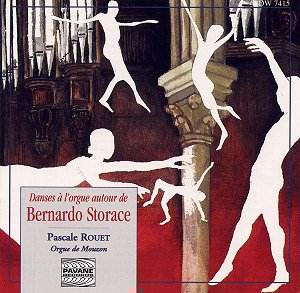
PASCALE ROUET - ORGAN
DANSES À LORGUE

1. Bernado Storace Balleto 240"
2. Giovanni Picchi Ballo alla Polaccha 210"
3. Ballo hongaro 226"
4. Ballo todescha 120"
5. Passe e mezzo 405"
6. Bernado Storace Folia 437"
7. Anon. Estampie 628"
8. Bernado Storace Chaconne 712"
9. Anon. Intabulata Nova (9 danses) 808"
10. Bernado Storace Passacaille 1223"
11. Pierre Attaignant 6 Danses 721"
12. Bernado Storace Spagnoletta 430"
13. Béla Bartók Danse ruthène & 5 danses
populaire Roumaines 614"
Pascale Rouet
Recordings made on the Christophe Moucherel organ (1725 - rebuilt by Barthelémy Formentelli 1991) in the church of the Abbey of Our Lady of Mouzon on 2 & 3 July 1990
PAVANE ADW 7415 [7038"]


Experience Classicsonline

French organs are known for their distinctive ability to produce the widest range of colours. Where organ builders of the 17th century German and Netherlandish schools concentrated on the melding of each of the separate divisions of an organ into a blended and powerful unit, with a few solo stops added, and English 19th century organ builders preferred the thicker orchestral imitations so characteristic of Willis or Harrison, French instruments have always placed emphasis on the individual timbres of stops. This was a feature of 17th and 18th century French organs that was resurrected in the 19th century by Aristide Cavaillé-Coll when creating the great instruments such as that in Notre Dame de Paris. This characteristic makes French organs some of the most enjoyable to hear, and the most suitable for recording in a varied programme on CD. The organist on this disc, Pascale Rouet, has been raised in this French tradition, culminating in her winning the first prize at the Toulouse International Contemporary Organ Competition in 1986. Since 1991 she has been the organiste titulaire of the Abbey of Mouzon and clearly knows the instrument well. Arguing that the organ started out as a secular instrument she makes a reasonable argument for the performance of dance music upon it, although it is debatable in the extreme whether a work like the Robertsbridge Codex from which comes the anonymous estampie of track 7 would have been played on an instrument any larger than a couple of ranks - certainly not on a large 18th century organ. Either way she plays the music with enough flair and conviction to allow the secularisation of the Abbey church to be momentarily put out of mind.

The main body of the programme is taken up with music by Bernado Storace. Unjustly neglected, this is wonderfully invigorating music that places Storace firmly at the beginnings of the Italian baroque. The great chaconne on track 8 (sample 1) could easily run the risk of monotony, so short and memorable is its chaconne theme. Rouets performance is brisk (maybe a touch too brisk) and forceful in that the variation of registration is limited to pleno throughout. However, her facility and clarity of articulation make for a tremendous sense of forward drive, which is exciting. At the other extreme, the delicate balleto with which the programme opens, and the four dances of Giovanni Picchi, show individual stops illustrating the subtle side of this fine organ. (sample 2) Rather strangely, the programme ends with a transcription of Bartóks Rumanian folk dances. This is apparently just because Rouet likes them. Thats a fair enough reason, but the sudden gear change from the baroque to the 20th century is unprepared and not entirely successful, although the playing is impressive. (sample 3)

The most amusement of the programme comes, once again, from the dismal translation of the booklet notes. In this instance gems such as "Bartók dances, drewed from Rumanian folklore, seemed to me not so far from the spirit of irridescents musics, also popular, coming rigth (sic.) from the past" Do it? Do it really? Of course it is impolite to moan about peoples bad English, but the notes are meant to be there to illustrate the music, not to provide obfuscation. In this case the unfortunate translator is one Michel Dehaye, who also turns out to be the organ tuner. Pavane on the cheap here methinks... Of the Chaconne, M. Dehaye manages "Very closed from Passacaille, the Chacony is nearly the same model. Mattheson precise that his tempo is rather slowly than those of Passacailles. We must mention here the magnificents Chaconies by H. Purcell." Why? None of them are played, and nothing further is said about them. In fact, the notes in French are by Pascale Rouet herself, and bear no resemblance to this banal undergraduate effort. And one can hardly blame poor Mattheson if his tempo is a little bit rather slowly - hes been dead for 238 years.

Peter Wells



Untitled Document


Reviews from previous months
Join the mailing list and receive a hyperlinked weekly update on the discs reviewed. details
We welcome feedback on our reviews. Please use the Bulletin Board
Please paste in the first line of your comments the URL of the review to which you refer.