Other Links
Editorial Board
- Editor - Bill Kenny
Assistant Webmaster -Stan Metzger - Founder - Len Mullenger
Google Site Search
SEEN AND HEARD
INTERNATIONAL OPERA REVIEW Puccini, Manon Lescaut: Soloists, Chorus and Orchestra of Juventus Lyrica. Conductor: Antonio Maria Russo, Teatro Avenida, Buenos Aires. 25.6.2010
(JSJ) Director/sets: Ana D’Anna Costumes: Ponchi Morpurgo Lighting: Ana D’Anna and Fernando Micucci Chorus: Miguel Pesce Manon Lescaut: Eugenia Fuente / Sabrina Cirera Des Grieux: Darío Sayegh Geronte: Mario De Salvo / Orestes Chlopecki Edmond: Sebastián Russo / Santiago Bürgi Lescaut: Sebastián Angulegui / Fernando Santiago
For its second opera of the season Juventus Lyrica put on Puccini’s Manon Lescaut, rounding off a trio of the composer’s works that have been presented locally in recent weeks and also one of a trio of works on the Manon story on this year (Kenneth MacMillan’s ballet having just been presented and Massenet’s version upcoming in August, both at the Teatro Colón).
Cast:
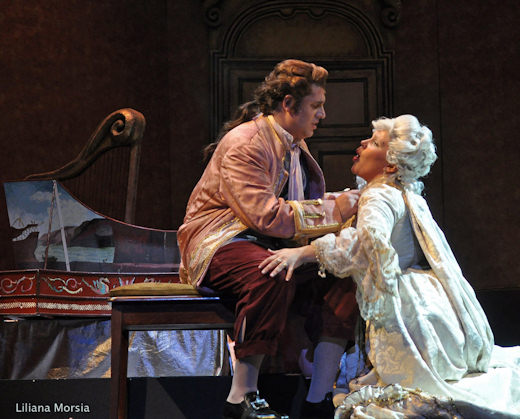
Darío Sayegh (Des Grieux) and Eugenia Fuente (Manon)
Despite being regarded as Puccini’s first success this work is not that as widely presented as it should be. Sure, given how the libretto evolved, the storyline is not entirely coherent with various gaps, such as when Manon and Des Grieux live together and why they are on the run in the last act, but the work contains a wealth of wonderful melodies, including the wonderful Intermezzo that forms a prelude to Act 3, instantly familiar to anyone who knows his more popular works.
This was a nice bright “period” production – the scenery at least for the second and third acts having a passing resemblance to Ugo Gheduzzi’s designs for the work’s premiere (as illustrated on Wikipedia). However, it was let down by the three lengthy intervals between the four acts, not only extending the total length by about half again but breaking the musical and dramatic tension.
After a shaky start the two leads, Eugenia Fuente as Manon and Darío Sayegh as Des Grieux, warmed to their roles, with the latter ultimately being the more even overall, and in particular showing his best in the second and last acts. Mario de Salvo was a little too lecherous and lacking in nobility for taste, and Sebastián Angulegui was a very satisfactory Lescaut. Sebastián Russo’s Edmond was particularly notable, and his musical development over the past year is striking. Antonio Maria Russo gave a taut and pleasing reading of the score and the chorus were irreproachable.
Jonathan Spencer Jones
Picture © Liliana Morsia