Other Links
Editorial Board
-
Editor - Bill Kenny
Assistant Webmaster - Stan Metzger - Founder - Len Mullenger
Google Site Search

SEEN AND HEARD INTERNATIONAL OPERA REVIEW
A. Vives, Doña Francisquita: Soloists, Orquesta de la Comunidad de Madrid. Coro del Teatro de la Zarzuela,
Conductor: Miquel Ortega, Teatro de la Zarzuela de Madrid.
3 and 4.3.2010 (JMI)
New Production
Director: Luis Olmos
Sets: Jon Berrondo
Costumes: María Luisa Engel
Lighting: Juan Gómez Cornejo
Choreography: Florencio Campo
Casts:
Doña Francisquita: María José Moreno/Sonia de Munck
Fernando: Ismael Jordi/Carlos Cosías
Aurora La Beltrana: Milagros Martín/Marina Pardo
Cardona: Emilio Sánchez
Doña Francisca: Amelia Font
Don Matías: Enrique Baquerizo
Lorenzo: Arturo Pastor
Irene: Isabel Cámara
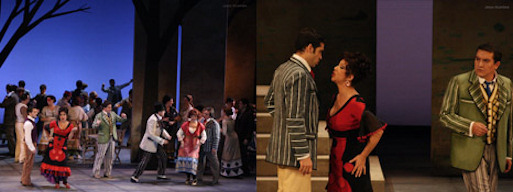
Production Pictures © Teatro
de la Zarzuela de Madrid
Doña Francisquita has always been
one of the most popular zarzuelas. Its popularity
began with the premiere in Madrid in 1923
which lasted for more than four hours after almost every number was repeatedly encored.
The Catalan Amadeo Vives wanted to compose a zarzuela based in Madrid.
and accomplished it with his librettists Federico Romero and Guillermo Fernández Shaw, who together adapted
the plot from a Lope de Vega comedy “La Discreta enamorada”.
According to the program notes,
Such the popularity of Doña Francisquita was such that twenty years after its premiere it had chalked up 5,210 performances in Spain and South America.
Doña Francisquita has twice been made into a movie and the then very young tenor Alfredo Kraus made an unforgettable success of it in this very theatre in
the1950s. Fernando’s aria "Por el humo se sabe dónde está el fuego” or “Through smoke you know where fire is” and Francisquita’s Nightingale’s Song are common fixtures in concerts and recitals in Spain.
The work is a witty comedy set in the mid-19th century during the Madrid Carnivals. It traces the manoeuvres of the young Francisquita to attract Fernando, himself in love with Aurora la Beltrana. Francisquita promises herself to Don Matías, Fernando’s father, to raise jealousy in Fernando, who falls finally
into Francisquita’s arms.
The role of the Teatro de la Zarzuela in Madrid in promoting
the genre that gives the theatre its name is worthy of study. Performances of zarzuela have always had the favour of public, regardless of artistic results
and it is not easy to believe that there have been some 37 performances of Doña Francisquita between February 12 and March 28
this year. More incredible still is that each house has been sold out every single day.
Previous Doña Francisquita productions in this theatre were a great success. In this Emilio Sagi
has played a considerable role
and if my information is correct, the above-mentioned production ended up being sold to Toulouse, where it was performed closing the 2006-2007 opera season. The actual new production bears the signature of Luis Olmos, who is the General Director of Teatro de la Zarzuela. The production will travel to Barcelona’s Liceu in July 2010.
Whether or not due to the Liceu's commitment, the libretto in this production has been cut and shaved. Sagi’s production offered true Madrid sets, while in this production, the sets are more figurative. Costumes are attractive, although somewhat monotonous, and the lighting is no more than routine. Choreography plays an important role in zarzuela and here it left something to be desired. The directorial hand of Luis Olmos also leaves something to be desired, particularly in the massed scenes where his work does little more than provide traffic control: the production falls significantly below the standards set by Emilio Sagi.
Musical direction was in the hands of Miquel Ortega, whose reading was boringly effective. Few virtues can be highlighted
and his reading did little
for his reputation despite his having conducted it dozens of times. The orchestra fell below the standards we should be able to take for granted from an important theatre.
Vocally, there were three different casts. At the premiere (which I was unable to attend), the protagonists were José Bros and Mariola Cantarero:
both were also present in the old production.
For the first performance I saw, Doña Francisquita was sung by soprano Maria José Moreno
who was really very good. Her soprano voice is very well suited to the role’s vocal demands
and she did fairly well in the famous Nightingale Song. Sonia Munck
in the second cast is no more than a soubrette and this is hardly ideal for Francisquita.
Her casting was a serious mistake on the part of the theatre.
Ismael Jordi was not the Fernando I would have hoped for and expected. His voice is too light for the character. He has an enviable figure, but his stage performance was rather lacklustre. I remember seeing him in his role in Toulouse three years ago
where he was better and while
his performance of the most famous aria was good, it
was somewhat short on brilliance. The only barely acceptable singer in the third cast was Barcelona tenor Carlos Cosías. This singer has a long history in Spanish theatres, but it has only been in recent years that he has begun to sing top roles. His lyrical voice is well suited to Fernando
but I found him rather short on musicality and his diminutive figure does not help
him either.
Milagros Martin was Aurora Beltrana, as in the previous production. She was an excellent interpreter of this role, where you need a good singer and an excellent actress. She was both. Marina Pardo was miscast. Her voice falls short of the minimum quality required.
Emilio Sánchez was a colourless Cardona. This singer is not at his best in pure vocal terms and he is far from what we have the right to expect from a comic tenor in zarzuela. Cardona is a comic tenor; Emilio Sanchez is not.
Amelia Font was a good Doña Francisca. Enrique Baquerizo made an outstanding Don Matias, the best I have seen from him.
There was a full house both days. The audience was satisfied, although there was no great enthusiasm. The strongest applause went to María José Moreno, Ismael Jordi and Milagros Martin.
José M Irurzun