Other Links
Editorial Board
- Editor - Bill Kenny
Assistant Webmaster -Stan Metzger - Founder - Len Mullenger
Google Site Search

SEEN AND HEARD UK OPERA REVIEW
Puccini, Tosca (New Production): Soloists, chorus and orchestra of English National Opera. Conductor: Edward Gardner. London Coliseum, London, 18.5.2010. (JPr)
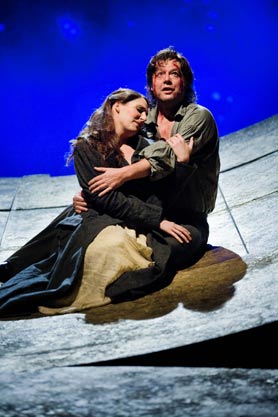
Many with only the vaguest interest in opera would be able to name the one where the story is about a jealous Diva, her artist-lover who is complicit in the escape of a political prisoner and a hate-fuelled, sadistic, chief of police. There follows the sexual harassment of the Diva who is about to make the ultimate sacrifice to save the life of her lover when in a frenzied moment she stabs the police chief. The Diva, who thought they could escape to freedom, is in despair when her lover is assassinated and jumps to her death.
This ‘shabby little shocker’ as this melodrama has been memorably called is of
course Tosca and is still one of the most performed operas across the
globe. At the English National Opera, over the last couple of decades there have been a number of
(quickly abandoned) attempts at staging it by Jonathan Miller, Keith Warner and David McVicar,
none of which were well-received. A former world-famous Tosca, Catherine Malfitano, has now been given the opportunity
to direct. Singers do not necessarily make the best directors, but I guess the season planners thought there was something
that Ms Malfitano could bring to it given her stage experience of the role, as well as appearing with Plácido Domingo, in the memorable 1992 broadcast
which filmed Tosca live at thetimes of day and locations specified by Puccini.
In a recent interview, Catherine Malfitano has spoken about how ‘The minute the audience feels “we’ve been here before”, we’re in trouble’.
But the real point here is that we have all ‘been there before’ with every previous Tosca
staged: so surely money could have been saved on new sets by bowdlerizing previous ones and just re-imagining the production
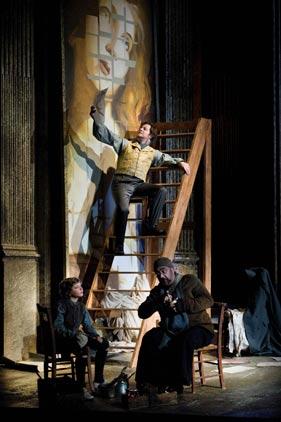
this time? You go to Tosca and in Act I you expect the interior of the church of Sant’Andrea della
Valle, a crucifix, a Madonna, a chapel stage left and an unfinished painting
stage right; in Act II there will be Scarpia’s ornate apartment at the Palazzo Farnese and there must be a table set for dinner and a chaise longue.
Finally, for Act III, we are on the upper level of the Castel Sant’Angelo from which Tosca will eventually plunge to her death; and
to which the soldiers usually enter stage left and Cavaradossi stage right. This is the accreted tradition to this opera and you can tick
off all of these in Catherine Malfitano’s staging.
Is this good or bad? It depends on your point of view. Watching this reminded me of any one of the famous Petipa ballets that companies have recreated year on year since the nineteenth century, in similar sets and with similar steps. This is deemed perfectly acceptable – until someone like Matthew Bourne comes along – so what is the problem with this in opera
exactly? After all, the words and music never change, at least not usually. So
apart from the detailed attempt to bring a few apt psychological nuances to the reactions of the three principal characters
to one another, a hint of cubism in the Act I paintings and the semi-circular walls of Castel Sant’Angelo in Act III
being shown laid down as though we were looking up into the night sky towards ‘space the final frontier’, there was nothing that
we would not have seen in most Tosca productions over the opera's 110 year history. Frank Philipp Schlössmann’s sets and Gideon Davey’s costumes give us 1800 Rome as Puccini wanted, though it must be admitted that David Martin Jacques’s eccentric lighting did not always reveal them to the best advantage. As accomplished as the performance was, I longed for something to have to think about: what about Scarpia
strangling Tosca as she stabs him and Act III being only her dying visions?
Now there’s a thought..
What can save any Tosca however, is the strength of the musical performance and with ENO’s music director, Edward Gardner, in charge
a high standard was only to be expected. In a sense, ENO is like a Championship football team with a Premier League manager and it will be
very much to ENO’s credit if they can stop their young Music Director being poached
too soon by one of the bigger international opera houses. Every moment of Puccini’s rampant score with its ‘heart on sleeve’ outbursts of jealousy, love, hate, betrayal, murder and torment was uninhibitedly played for all it was worth by
Gardner's excellent orchestra. I revelled in the care and attention that he and his musical staff had given to even the smallest details, such as the church bells and sound-effect cannons.
Julian Gavin is a forthright, ardent, bright-toned Cavaradossi; he made a powerful hero with his cries of ‘Victorious! Victorious!’ in Act II, yet brought such great sensitivity and beautiful phrasing to his Act III aria, ‘All the stars shone in heaven’ that I thought I heard a future Wagner singer
in his voice. Anthony Michaels-Moore lacked the sheer malevolence in both voice and personality that Scarpia requires:
he was more oleaginous than predatory and reminded me of those school teachers who think they can control a class when the students
are really controlling them. This role requires a bass-baritone with some darker resonant notes rather than Michaels-Moore’s more mellifluous voice. Pauls Putninš (Angelotti) and Christopher Turner (Spoletta) did their best with their small roles.
So what about Amanda Echalaz as Tosca? She is deemed a rising star amongst current young sopranos but I was left with the impression that she is not yet
quite the finished article. She has a steely voice which is edging out of the spinto territory and verging on the dramatic
but she sang at an unyielding forte virtually throughout the evening without much of the light and shade this role needs. As the Diva she had some good comic moments
being jealous, was suitably girlish and vulnerable at times, but she lacked the haughtiness or sexual magnetism of Angela Gheorghiu, to name one other current Tosca, or
even of Catherine Malfitano at her prime. Ms Echalaz undoubtedly has a bright future in the right roles
which might also include some Wagnerian ones, and undoubtedly Turandot will feature sometime in the future. Adding a further negative note
though, I must remark about her occasional poor diction particularly at the top of her voice: when she sang the phrase in Act II (‘The torture must stop, it is more than I can bear’) she might as well have been singing in Italian. On the plus side, her thrilling backwards leap into ‘infinity’ was a
real coup de théâtre at the end of the evening.
The late Edmund Tracey’s venerable translation is now rather archaic and perhaps resurrects the debate about whether such familiar works need to be sung in English. Tosca’s cries of ‘Die! Die!’ simply lacks the emotional impact of ‘Morte! Morte!’ and ‘Love and music, these I have lived for’
has little of the same resonance as, ‘Vissi d'arte, vissi d’amore’.
Whether this production has any more staying power than some of its predecessors, will entirely depend on the singers attracted for the revivals and on who is conducting in the pit.
It will need the best of the best.
Jim Pritchard
Pictures © Robert Workman