Other Links
Editorial Board
- Editor - Bill Kenny
Assistant Webmaster -Stan Metzger - Founder - Len Mullenger
Google Site Search


SEEN AND HEARD INTERNATIONAL OPERA REVIEW
Shostakovich, Lady Macbeth of Mtsensk: Soloists, Chorus, Orchestra of Teatro Argentino. Conductor: Alejo Pérez, Teatro Argentino, La Plata. 21.3.2010. (JSJ)
Director: Marcelo Lombardero
Sets: Diego Siliano
Costumes: Luciana Gutman
Lighting: José Luis Fiorruccio
Chorus: Miguel Fabián Martínez
Cast:
Katerina: Natalia Krieslina
Boris: Hernán Iturralde
Sergey: Enrique Folger / Marcelo Puente
Zinovy: Pedro Espinoza
Aksin’ya: Sonia Schiller
Miller and Chief of Police: Gustavo Gibert
Sonetka: Alejandra Malvino
Drunken worker: Carlos Bengolea
Priest and Old Convict: Ariel Cazes
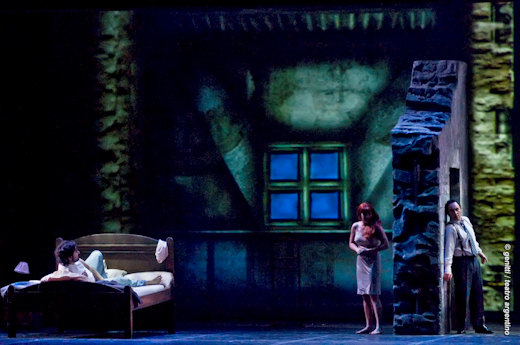
Sergey (Enrique Folger) reclines on the bed as Katerina (Natalia Krieslina) stalls her husband Zinovy (Pedro Espinosa) on his return.
The Teatro Argentino opened its 2010 season with a bang – literally, with Shostakovich’s brutal and best known opera, Lady Macbeth of Mtsensk, and in Russian to boot.
A premier for the opera at the Argentino in this important year – which marks both Argentina’s bicentenary and the theatre’s 120th anniversary – the production itself was not new, however, coming from the Teatro Municipal of Santiago de Chile, where it was well received at its premier last July. As such, and also bringing with it the three main principals who had sung some of the performances in Santiago, it was well polished, if less than perfect in parts.
For this production, and perhaps appropriately for its South American location, the merchant Boris and his son Zinovy run a “mataderos” (slaughterhouse). Complete with beef carcases and men in blood-stained overalls, this added a further level of menace to an already menacing story. And their office, alongside the slaughterhouse, assumes a central importance: it is here, in the office strongbox that Boris keeps his liquor stock and Zinovy’s body is dumped and found by the one of the workers raiding his “cellar”.
By and large the individual scenes were well conceived – the slaughterhouse, the Izmaylov’s home, the police station with the mafiosi-like police, and a gulag-like compound in which the convicts stay overnight – excepting the last, which appeared to be the shores of a lake, rather than the raging river in which Sonetka and Katerina are swept away.
The work is intense and dramatic, driven along by the frequently dissonant music. But two of the most dramatic moments took place out of sight – the consummation of Sergey and Katerina’s union, which was behind the bed, and Katerina’s attack on Sonetka and their fall into the river, which took place off-stage.
Without exception all of the cast were excellent. In the lead role Rigan soprano Natalia Krieslina was a powerful Katerina, while Enrique Folger was an earthy Sergey. As Boris, Hernán Iturralde was suitably seasoned, if a bit young looking, and Chilean tenor Pedro Espinosa was an eloquent Zinovy. Gustavo Gibert was a convincing chief of police and Alejandro Malvina was a scheming Sonetka, while Sonia Schiller as Aksin’ya, Carlos Bengolea as the drunken worker and Ariel Cazes as the priest and old convict were all acceptable.
The chorus too were noteworthy under Miguel Fabián Martínez, and the orchestra played with precision and passion under the authoritative baton of Alejo Pérez.
Jonathan Spencer Jones
Picture © Genitti - Teatro Argentino