Other Links
Editorial Board
- Editor - Bill Kenny
Assistant Webmaster -Stan Metzger - Founder - Len Mullenger
Google Site Search


SEEN AND HEARD INTERNATIONAL OPERA REVIEW
Mozart, Don Giovanni:
Soloists, Orquesta y coro de la Sinfónica de Galicia. Conductor: Víctor Pablo Pérez. Palacio de la Ópera de La Corunna. 21.5.2010 (JMI)
Production from Macerata’s Sferisterio.
Direction: Pier Luigi Pizzi.
Sets and Costumes: Pier Luigi Pizzi.
Lighting: Vincenzo Raponi.
Cast:
Don Giovanni: Ildebrando D’Arcangelo.
Leporello: Andrea Concetti.
Donna Anna: María José Morerno.
Donna Elvira: Monica Bacelli.
Don Ottavio: Alexei Kudrya
Zerlina: Manuela Bisceglie.
Comendatore: Gudjon Oskarsson.
Masetto: David Rubiera.
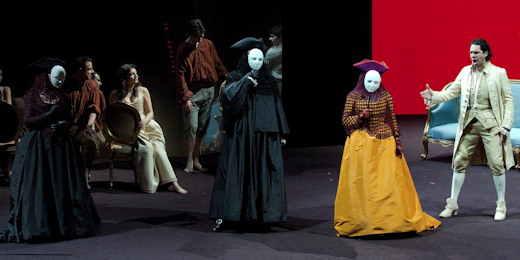
Production Picture © Miguel A. Fernández.
The La Coruña Mozart Festival offered Don Giovanni once again, for the third time in the last ten years – a little surprising when one considers that only one or two operas by Mozart are produced each year at this Festival.
The production bears the signature of Pier Luigi Pizzi and was premiered last summer at Macerata’s Sferisterio. This production represents some sort of change from Mr. Pizzi’s traditional style which usually elegant, realistic, and aesthetically attractive in a tasteful fashion. Things were a little different this time, since the Venetian director had decided to follow the path of minimalism, on the one hand, and to put little else than sex and a bed at the centre of his concept for Don Giovanni. The set put before us hand only dark panels and a few curtains to facilitate changes of scene, with on other single and often repeated element: a large bed. Don Giovanni was in the bed in the orchestral prelude; he shared the bed with Donna Anna in the first scene; it was in the bed that Leporello sang the catalogue aria to Donna Elvira; it was in the bed that Zerlina and Masetto made love; Leporello and Donna Elvira shared the bed in the second act. Donna Anna also chose the bed from which to sing "Or sai che l'onore", and it was also from the bed that she sang "Mi tradí". Furthermore, this Don Giovanni does not waste his time on elegance and chivalry, leaving such matters behind him in the dressing room and going straight for female curves and skirts, meeting with ready acceptance from the female characters, whether Zerlina, Elvira or Anna. The final punishment of Don Giovanni involved his descending to hell in the company of several nude ephebes. In my view, there was altogether too much sex, and a consequent lack of charm and variety in the production. Mr.Pizzi’s shift towards apparent modernity provides more loss than gain.
Not for the first time, then, we had Don Giovanni in Corunna and once again Victor Pablo Pérez was in charge of the musical direction, as on all the previous occasions. In amongst these, I also had the opportunity to hear him conducting this same opera at the Teatro Real, some five years ago now. I have no doubt that this opera has a great appeal for any conductor, and Victor Pablo Pérez is evidently not immune to this appeal - but I was not convinced by his reading. Mozart called this opera a "drama giocoso", but Victor Pablo Pérez seems to overlook the adjective "giocoso" and puts all his emphasis on the drama, so that his interpretation lacks lightness and life and often has an excessive volume of sound; it made for a rather boring first half. Only when the drama is no longer ‘giocoso’, i.e. in the final scene, does his reading really make sense. He uses a complete version of the work, the sum of the Prague and Vienna scores, including the final moral. The orchestra gave a technically accomplished performance, as is usually the case when they have their Mr. Pablo Perez, on the podium.
The protagonist was Ildebrando D'Arcangelo, whose performance was dominated by a certain monotony of voice. His stage interpretation was rather too boastful, as on other occasions when I have seen him as Don Giovanni. He is short of colours and shades in voice, everything sung forte. He had some difficulties in "fin ch'an dal vino". He might have been better suited as Leporello. Andrea Concetti was serviceable in that role, though his voice lacks the flexibility necessary for this character and he was not too convincing as an actor either.
María José Moreno has been one of the most brilliant interpreters of Zerlina in the past, but has now decided to make the jump to Donna Anna. Her voice still seems to me most appropriate to Zerlina, because she is still a light soprano, while Donna Anna requires greater vocal weight than she can bring to the role. However, she was the best of three women on stage and she made a generally successful Donna Anna, particularly in the aria “Non mi dir”, where her voice was attractively bright. Monica Bacelli was poorly cast as Donna Elvira. Her voice is too small, problematic at the top and she only really fulfilled the requirements of the role as an actress.
Tenor Alexei Kudrya offered an interesting Don Ottavio in vocal terms, with a voice of relatively small size and pleasant timbre. Manuela Bisceglie was an attractive Zerlina, although her voice still reveals some signs of immaturity here and there; she is an interesting singer, though she has room for further improvement. Gudjun Oskarsson was the Comendatore; unfortunately his voice broke in the final scene, making for a painful performance, after being far more acceptable in the first act and in the scene at the cemetery. David Rubiera was a coarse Masetto, largely without interest.
The Palacio de la Opera was almost sold out. There was only rather timid applause at times, though approval was more unanimous for Maria Jose Moreno after "Non mi dir". At the close there was a generally warm reception for the artists, particularly so for Victor Pablo Pérez and his Orchestra.
José M Irurzun