Other Links
Editorial Board
- Editor - Bill Kenny
Assistant Webmaster -Stan Metzger - Founder - Len Mullenger
Google Site Search
SEEN AND HEARD
INTERNATIONAL OPERA REVIEW Gounod, Faust:
Soloists, chorus, orchestra of San Francisco Opera, Maurizio Benini, conductor, War Memorial Opera House, San Francisco. 16.6.2010 (HS) Faust: Stefano Secco Marguerite: Patricia Racette Méphistophélès: John Relyea Valentin: Brian Mulligan Siebel: Daniela Mack Marthe: Catherine Cook Wagner: Austin Kness Conductor: Maurizio Benini Director: Jose Maria Condemi Production Designer: Robert Perdziola Lighting Designer: Duane Schuler Chorus Director: Ian Robertson Choreographer: Lawrence Pech
So many moments played so well in San Francisco Opera’s current production of Gounod’s evergreen opera, Faust, including a terrific final scene that hit the heights musically and dramatically, that it’s a puzzle why the net effect was so unexceptional. Harvey Steiman
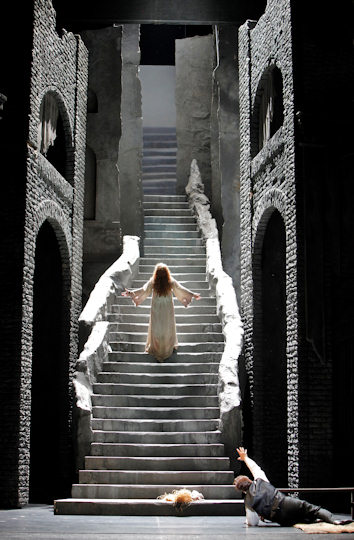
Patricia Racette (Marguerite) and
Stefano Secco (Faust)
Perhaps it was the sporadic nature of the high points, interspersed with stretches of the routine, even sub-par. It wasn’t conductor Maurizio Benini’s fault. He led a vital, throbbing orchestral performance that caught the beauty, emotional tugs and essential French character of the score. The singers were in sync with him, so that wasn’t the problem.
More likely it was the uneven cast. The tall, suave John Relyea delivered a strong characterization as Méphistophélès and dark-hued, sardonic singing especially in his signature aria, “Le veau d’Or.” The plish-textured singing of diminutive, perky mezzo-soprano Daniela Mack made her Siebel a more ardent and musically attractive suitor than did tenor Stefano Secco as a pinched-voiced, reedy-sounding Faust. Baritone Brian Mulligan as a bluff, uninflected Valentin failed to create much of an impact.
And that brings us to Patricia Racette, whose many triumphs in this opera house include most recently all three soprano roles in Puccini’s Il Trittico. Her strength is human drama, infusing the music with the sense of a real personality in real situations. Her role of Marguerite doesn’t get close to those emotions in Acts I, II and III, before she gets pregnant and becomes an outcaste. As a soubrette Racette can sing lightly and charmingly, as she proved as Lauretta in Gianni Schicchi, but the coloratura of Gounod’s Jewel Song is decidedly not her forte. She played those early scenes well; dramatically it was easy to see how Faust could be enamored enough of her to sell his soul to the devil to regain the youth to have her. But vocally the sparks had to wait until after Marguerite’s downfall.
This production ran Acts IV and V together, omitting the penultimate Walpurgisnacht scene, which had the effect of creating a Marguerite-centered final act. It began with the pregnant Marguerite at the spinning wheel (here a loom so she could stand behind it and move around it), Racette locking in to the wrenching emotions of “Il ne revient pas.” Her confrontation with Méphistophélès in the next scene at the church was nothing short of majestic, both Racette and Relyea capturing and clarifying the sense of intimidation that rumbles through it. Relyea’s mock serenade, “Vous qui faits l’endomie,” was more of a highlight in the next scene than Valentin’s more famous death scene. Mulligan sang all the notes but could not rev up the drama. The Walpurgisnacht scene that normally follows was omitted, leading directly to that final scene.
Set in a dark gray stone prison, the walls push the action in the final scene downstage, a steep staircase rising in the middle to a shaft of light high upstage. Racette began in full mad scene mode. Singing to a bundle of straw she believes is her baby, she set the tone for the electrifying trio to follow, as Relyea and Secco arrive to try to get her out before her execution. But in the end, her mind clears and she sings her final lines as she ascends the stairs to the light, accompanied by the ecstatic sound of the chorus. It made for simple, taut drama and a great musical payoff.
In the production, borrowed from Chicago Lyric Opera, medieval stone arches tower over every scene, often evoking church ruins. That plays best in the church scene, of course, and in the final scene. The rest of the time it simply reminds us how much the story relies on a fanciful theology. In the end, though, Faust is about the music. And when it all comes together the results were stunning. Too bad the rest came up short.
Picture © Cory Weaver