Other Links
Editorial Board
- Editor - Bill Kenny
Assistant Webmaster -Stan Metzger - Founder - Len Mullenger
Google Site Search
SEEN AND HEARD
INTERNATIONAL OPERA REVIEW Catalani, Loreley: Soloists, Chorus and Orchestra of Casa de la Opera. Conductor: Lucía Zicos. Teatro Avenida, Buenos Aires. 11.6.2010 (JSJ) Costumes: Mariela Daga Chorus: Ezequiel Fautario Choreographer: Luciana Prato Loreley: Adelaida Negri Walter: Miguel Geraldi Hermann: Douglas Hahn Anna: Maria del Rocio Giordano Margrave: Victor Castells
Director/lighting: Eduardo Casullo
Ballet Surdanza
Cast:
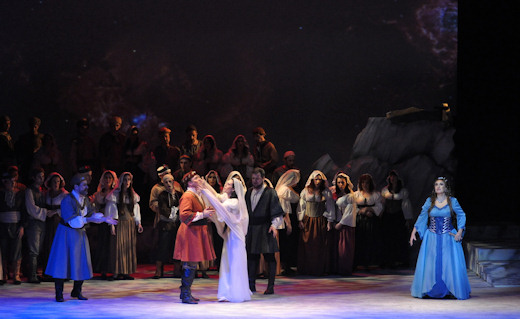
L-R Victor Castells (Margrave), Miguel Geraldi (Walter),
Maria del Rocio Giordano (Anna), Douglas Hahn (Hermann) and Adelaida Negri (Loreley)
Each year diva Adelaida Negri’s Casa de la Opera dusts off a little performed and often long forgotten work and this year the choice was Catalani’s Loreley. Probably the second best known of Catalani’s works (after La Wally), Loreley, first performed in February 1890 as a revision of his first opera Elda from 1880, is set on the shores of the Rhine ca 1300. Walter is in love with Loreley but feels duty-bound, encouraged by his friend Hermann, to keep to his promise to marry Anna, niece of the Margrave of Biberich. Loreley then offers her life to Albrich, god of the Rhine, who allows her to plunge into the river and emerge irresistibly beautiful, and she appears as the wedding is about to take place as a mirage to Walter, who leaves Anna to follow her. As Anna dies of a broken heart, the spirits remind Loreley of her pact and she returns to Albrich in the river, followed by Walter who throws himself after her filled with remorse and despair.
The work contains some wonderfully descriptive music and this was here well and expressively played by the “Orquesta Loreley” under the young Argentine Lucía Zicos, who conducted with style and precision.
Ms Negri was an attractive Loreley, responding well to the lyrical and dramatic demands of the work, even though her voice is perhaps not a supple as before. Alongside her, Brazilians Miguel Geraldi as Walter and Douglas Hahn as Hermann were both well cast – Geraldi bright and expressive and Hahn solid and powerful. The Anna of the young Maria del Rocio Giordano was outstanding, and hopefully will encourage more regular appearances on local stages, while Victor Castells was a business-like Margrave.
The chorus and dancers, also so important in this work, were polished and the production in the experienced hands of Eduardo Casullo was broadly good, with the main scenic elements provided by photographic backdrops. However, the schloss contrasted a little too sharply with the cosmic nebulae and detracted from the general ambience.
With the last appearance of Loreley in Buenos Aires in 1934 remembered by few if anyone, and its earlier relative popularity – with productions in no less than 10 earlier seasons – unlikely to be repeated, this was a welcome and within the obvious budgetary constraints, worthy production.
Jonathan Spencer Jones
Photo © Liliana Morsia