Other Links
Editorial Board
- Editor - Bill Kenny
Assistant Webmaster -Stan Metzger - Founder - Len Mullenger
Google Site Search

SEEN AND HEARD INTERNATIONAL OPERA REVIEW
Rossini, Il Barbiere di Siviglia: Soloists, Orquesta Sinfónica de Castilla y León. Coro de Cámara del Palau de la Música Catalana. Conductor: Jean-Christophe Spinosi. Centro Cultural Miguel Delibes de Valladolid. 20.5.2010 (JMI)
Concert Version.
Cast:
Figaro: Christian Senn.
Rosina: Sylvia Schwartz.
Almaviva: Antonino Siragusa.
Doctor Bartolo: Luciano di Pasquale.
Don Basilio: Gabor Bretz.
Berta: Gwénaëlle Chouquet.
Fiorello/Officer: Iñigo Martín.
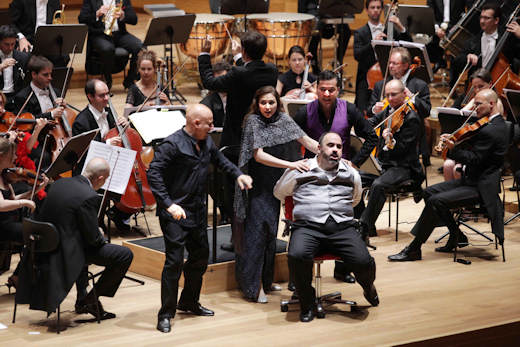
Picture © Nacho Carretero
A performance of Rossini’s opera, in a concert version, formed part of this season’s programme from the Castile and León Symphony Orchestra – and the concert proved a major success.
On the face of it Il Barbiere di Siviglia, or more correctly, “Almaviva, ossia l'inutile precauzione” seems an opera ill-fitted for concert versions, as with all buffo operas. However, on this occasion we witnessed a concert, in which only sets and costumes were lacking from a fully staged performance. Many so called semi-staged versions offer far less movement and stage vitality than what was on offer at the Valladolid Auditorium. The program does not credit the person responsible for the stage movement throughout the performance; rather it gives the impression that it was the collective work of the singers, and probably conductor Jean-Christophe Spinosi was the Master of Ceremonies. It was clear that the artists were all having fun and this sense transmitted itself immediately to the audience. As suggested above, the singers benefited from the inventive collaboration of Mr. Spinosi, who was effectively also an actor on the podium, communicating the atmosphere of opera buffa even to the members of the orchestra, getting comical movements from them, as they played sometimes seated, sometimes standing, or wore hats during the Tempest intermezzo.
As musical director Jean-Christophe Spinosi, was, in effect, was the major protagonist of the opera. His reading was full of joy and sparkle. Spinosi showed himself a most original conductor, full of life and energy and the orchestra gave an outstanding performance. Not only did they provide a very good performance musically, but played a full role in the playfulness of the occasion and surely enjoyed themselves just as much as the audience. The chorus were secure in all they did, without any especial brilliance.
The cast formed a very compact team, who, working together produced a remarkable performance, even if individually they were not necessarily ideally cast in their characters. The overall outcome was more than the mere sum of the parts.
Following the original title of the opera, the protagonist is Count Almaviva, sung by tenor Antonino Siragusa, who had had a great success in the role in Turin only a few days earlier. In terms both of voice and stage presence his performance was magnificent; without a doubt he was the most outstanding member of the cast, and is surely one of the best Rossini tenors of today. The only questionable aspect of Siragusa’s work relates to the timbre of his voice, which is not truly beautiful. However, his technique, expressiveness, stage skills and bright top notes are of the highest quality. After an outstanding performance, his spectacular "Cessa di più resistere", full of warmth and joy, put the Auditorium into tumult.
Chilean baritone Christian Senn was a suitable Figaro, in song and speech; though his voice may not be extraordinary, this was a good interpretation of the role. Sylvia Schwartz, a Spanish soprano living in Germany, was Rosina; her performance was good, sung in a light and small voice, perhaps a little too small at the top. But she interpreted role well. Although she was, naturally, singing the soprano version of the role, she did not sing the aria "Ah, se è ver che in tal momento”.
Luciano di Pasquale made for an enjoyable Dr. Bartolo; like many interpreters of this role he was perhaps a better actor than a singer, though he was particularly pleasing in "A un dottor de la mia sorte”. The Hungarian Gabor Bretz created a positive impression in the role of Don Basilio; he is a bass baritone more than a true bass. The young and attractive French mezzo soprano Gwénaëlle Chouquet proved a very rewarding Berta, offering a remarkable rendering of her aria in second act. Iñigo Martin completed the cast as Fiorello and the Officer.
The Auditorium was almost sold out. The audience applauded loudly at every each aria, duet or concertante, especially "Cessa di piú resistere". At the final curtain there was a truly enthusiastic reaction, as the audience cheered all the artists, especially Spinosi and Siragusa. The final applause lasted for eight minutes - which is almost an eternity in a Spanish opera house.
José M Irurzun