Other Links
Editorial Board
- Editor - Bill Kenny
Assistant Webmaster -Stan Metzger - Founder - Len Mullenger
Google Site Search

SEEN AND HEARD INTERNATIONAL OPERA REVIEW
Rossini, Armida: Soloists, Orchestra and Chorus of the Metropolitan Opera, Riccardo Frizza (Conductor) New York, 4.5.2010 (LS)
Production:
Conductor: Riccardo Frizza
Production Mary Zimmerman
Set & Costume Designer Richard Hudson
Lighting Designer Brian MacDevitt
Choreographer Graciela Daniele
Associate Choreographer Daniel Pelig
Cast:
Goffredo - John Osborn
Eustazio - Yeghishe Manucharyan
Armida - Renée Fleming
Idraote - Peter Volpe
Gernando - José Manuel Zapata
Rinaldo - Lawrence Brownlee
Astarotte - Keith Miller
Ubaldo - Kobie van Rensburg
Carlo - Barry Banks
Love - Tele Ude
Revenge - Isaac Scranton
Ballet Rinaldo Jesse Marks
Violin Solo David Chan
Cello Solo Rafael Figueroa
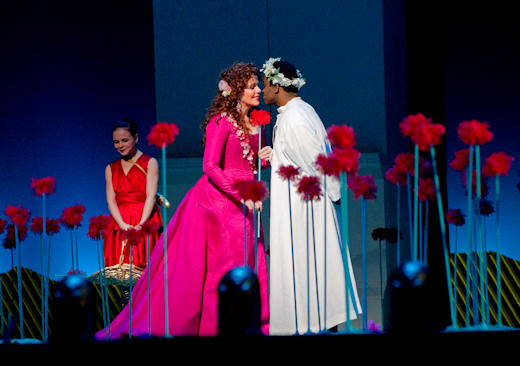
Renee Fleming (Armida) and Lawrence Brownlee (Rinaldo)
Armida, Rossini’s 22d opera, was first staged on November 11th, 1817. It was only moderately well received, being regarded as too “German” or romantic. And, indeed it was romantic
- the famous Rossini historian Francis Toye called it ”one long love scene”.
The story of Armida had long been a favorite of operatic composers including settings by Ferrari (1639), Lully (1686), Handel’s Rinaldo (1711), Salieri (1771), Gluck (1777), and Haydn (1784). The most recent Armida, by Dvořak, was first performed in 1904.
Rossini’s treatment of the tragic romance between the Sorceress Armida and the Crusader Rinaldo
was unusual, to say the least. The opera is scored for one soprano, Armida
hersef, six tenors and two basses. The overture features a fiendish part for the horns that make the horn
writing in Der Freischütz (still to come in 1821) seem like child’s play. There are virtuoso solos for cello and violin
ands an extended ballet that culminates with a chorus - not unlike the chorus which suddenly appears in the midst of Rossini’s overture to Ermione. There are
also not one or two, but three sensuous Armida-Rinaldo love duets and a spectacular terzetto in the third act for three tenors. The
overpowering finale is a scene in which Armida literally brings the house down .
In spite of all this the plot is simplicity itself. Crusaders are attacking Jerusalem.
and Armida plans to destroy them by enchantment, but falls in love with their champion Rinaldo
instead. When Rinaldo abandons his companions and looks forward to a life of happiness in Armida’s palace,
two of the crusaders – Carlo and Ubaldo - track him down and force him to choose between love and duty. After seeing his debauched self in his shield-mirror, Rinaldo turns away from Armida and returns to his warriors. The distraught Armida cries out for revenge and destroys her palace.
Armida is not often performed partly because the soprano role requires both extraordinary lyricism and dramatic coloratura. Maria Callas revived the opera in 1952 and since then it has been sung by Cecila Gasdia, Christina Deutekom, June Anderson, and
now Renée Fleming. Additionally, although the six tenor roles can be performed by four singers, most productions including the Met serve up all six even though it’s not easy to find six tenors willing to compete with each other
In this cast, Lawrence Brownlee sang Rinaldo with beauty and precision. He does not have the large overpowering voice of (say) Chris Merritt, but
that wasn’t required, especially in his scenes with Renée Fleming. Brownlee has recently sung several bel canto roles including Don Ramiro in Cenerentola, Count Almaviva in Il Barbiere di Siviglia and Tonio in La Fille du Régiment.
José Manuel Zapata sang the villain role of Gernando with an appropriate sinister tone. In the relatively brief first act subplot,
the jealous Gernando seeks revenge against Rinaldo, because he was passed over for command of the ten warriors
chosen to accompany Armida back to Jerusalem and he finally challenges Rinaldo to a duel and is slain. Zapata, too, has sung many Rossini roles including Don Ramiro and Count Almaviva as well as Don Narciso in
Il Turco in Italia and Dorvil in La Scala di Seta.
John Osborn played Goffredo the crusader commander. His entrance aria “Arditi, all’ire” has long been one of my favorites and Osborn did it full justice. He too is a Rossini specialist having sung title roles in Guillaume Tell, and Otello as well as the tenor leads in L’Italiana in Algeri and Cenerentola.
Barry Banks from the United Kingdom sang Carlo with plenty of gusto. He, Kobie van Rensburg from South Africa and Brownlee belted out the famous third act Terzetto “In quale aspetto imbelle” to the
obvious delight of the audience. The two basses –Peter Volpe as Idraote and Keith Miller as Astarotte were quite effective in their minor roles. Miller was especially fascinating as he led a dancing chorus of singing demons while being carried
along horizontally.
The most critical component of Rossini’s Armida though is the soprano singing the title role. Renée Fleming first sang it in 1993 at Pesaro and again in 1996 at Carnegie Hall. Each time she received rave reviews so naturally enough, the question arose, how would she fare in 2010? I
am happy to report that although she might not be as dramatically powerful as she was a decade or so ago, her wonderful lyrical voice carried the day
in fine style. She handled Rossini’s roulades effortlessly, her rendering of the
tripartite ” D’Amore al dolce impero” was a triumph, her three love duets with Rinaldo were joys to the ear and I only wish that she could have been just a bit more forceful in the dramatic finale “Dove son io? Fuggi!”
I’m also glad to be able to express pleasure with the production. In the spirit of full disclosure let me say that I was not a fan of Mary Zimmerman’s recent Met productions of Sonnambula and Lucia di Lammermoor but she certainly redeemed herself with Armida. There were wonderful background colors
to the set, with beautiful costumes, and some magical stage effects, - Rinaldo and Armida dropping out of the sky in an ornate elevator near the beginning of Act II and the transformation of a spooky forest into Armida’s love palace
were good examples. I even had no problem with the non-Rossinian female figure representing Love and the male creature representing Revenge who appeared from time to time
at the top - and sometimes in the middle - of the set.
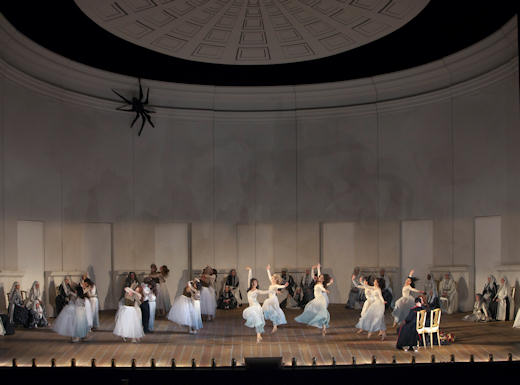
The Act II Ballet
The production was also enhanced by the 15 minute ballet which focused on the seduction of the crusaders by Armida and her companions. Just as the ballet came to a conclusion, the chorus dramatically sang out “Tutto spira d’Armida all’aspetto pace, amore, diletto, amistà.”and the curtain fell: one of many magic moments.
The Met chorus is renowned for its singing and acting abilities and Armida provided every opportunity for chorus members to show off their talents The result was an excellent and refreshing contrast to the commonly static choruses, we see so often, without ever being overdone. Riccardo Frizza conducted the Metropolitan Opera orchestra with precision and was rewarded with spectacular horn, cello, and violin performances.
With two intermissions,
this Armida lasted for four hours—which passed only too quickly - and
was a wonderful evening.
Lew Schneider
Production pictures © Ken Howard / The Metropolitan Opera