Other Links
Editorial Board
-
Editor - Bill Kenny
Assistant Webmaster - Stan Metzger
- Founder - Len Mullenger
Google Site Search
SEEN AND HEARD INTERNATIONAL OPERA REVIEW
Donizetti - L’elisir d’amore at Lyric Opera of Chicago:
Soloists, Chorus and Orchestra of Lyric Opera of Chicago, Bruno Campanella (conductor) Civic Opera House, Chicago, 24.1.2010 (JLZ).
Lyric Opera of Chicago continues its 2009-2010 season with a masterful staging of Gaetano Donizetti’s L’elisir d’amore or The Elixir of Love, as it is billed. The revival of this venerable production is enhanced by an excellent cast, led by Lyric’s Ryan Opera Center alumna Nicole Cabell. The deft conducting of Bruno Campanella makes the familiar comedy flow beautifully on stage so that the opening night on 23 January was an exciting event, with Lyric’s audience enthusiastically responsive to the production.
Production:
Stage Director:Vincent Liotta
Set and Costume Designer: Ulisse Santicchi
Lighting:Jason Brown
Chorus Master:Donald Nally
Conductor:Bruno Campanella
Cast:
Giannetta: Angela Mannino
Nemorino: Giuseppe Filianotti (Frank Lopardo 7 to 22 February)
Adina:Nicole Cabell (Susanna Phillips 7 to 22 February)
Belcore:Gabriele Viviani
Dulcamara:Alessandro Corbelli
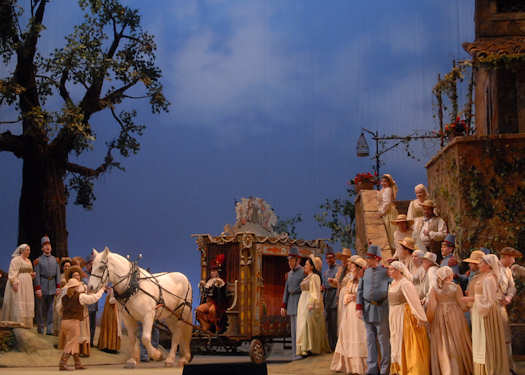
The Act I Set – Picture © Dan Rest
The situation at the beginning of the opera is typical of many librettos, with the object of a young man’s desire hardly noticing him. In loving the much sought after Adina, Nemorino seems to aspire to a love beyond possibility. Much more the rustic than his rival, the polished soldier Belcore, Nemorino is too determined to be dissuaded and his single-mindedness leads him to be duped by the quack-doctor Dulcamara whose ‘infallible’ love potion is nothing more than Chianti wine. While the potion only causes Nemorino to become inebriated, Adina notes his absence when she is just about to wed Belcore, and ultimately realises that Nemorino is the devoted husband she actually desires. It is a simple plot which works convincingly simply because of its fine music.
To that end, the cast is admirable in giving the well-known numbers fresh and ardent readings. Tenor Giuseppe Filianotti made the opening number “Quanto è bella” vibrant ; and if his delivery seemed somewhat aggressive in this piece compared with some other singers, it still served the text well. Moreover, his sensitive and moving performance of “Una furtive lagrima” contained all the nuances many performers strive to bring off, but rarely achieve as admirably. Filianotti worked well with Nicole Cabell throughout their on-off-on again romance and was particularly effective in the duet “Chiedi all’aura lusinghiera.”
Nicole Cabell also gave a first rate performance as Adina. She displayed all her character’s necessary self-confidence – she’s rich and the most beautiful girl in the village after all - and made a particularly strong impression in the opening aria “Della crudele Isotta,” in which she recounts the story of Tristan and Isolde to her audience. Her vocal confidence was also very evident in “Chiede all’aura lusinghiera,” her duet with Filianotti and was even more notable in the later duet “Eulsti pur la Barbara.” Her ensemble work with the other principals was also solid, with her concluding aria “Il mio rigor dimentica” as fresh and emotionally resolved as anyone could hope. At times however, it was difficult to hear some of her lines, perhaps because of the sets which leave much of the large stage space vacant, but this also happened to Filianotti on occasions when he moved stage left.
As Nemorino’s rival Belcore, Gabriele Viviani gave a fine and engaging performance, and the clarity the baritone brought to his role was certainly appropriate to the opera’s style, with refreshingly fine rubato touches to “Come Paride vezzoso.” Belcore is supposed to ooze confident bravado, yet Viviani augmented this sometimes tiresome characteristic with constant alertness to the other actors on stage. The comic missteps of his soldiers resulted in stunned expressions of amazement which were always funny without becoming slapstick and at the conclusion of the opera Viviani’s Belcore was as ardent as Nemorino had been at the beginning – a nice reversal of situation for a man with a girl in every village, which added greatly to the appeal of this perennial comic opera.
The charlatan Dulcamara can sometimes be a thankless role, but Alessandro Corbelli brought long experience to it which made it seem almost afresh. Having played Belcore earlier in his career, Corbelli clearly knows L’elisir backwards, and all of his expertise was apparent in this production. His delivery was firm and appealing in Dulcamara’s scene with the villagers in the first act, “Udite udite, or ristici,” with a welcome fluidity that made the scene work easily. He also engaged beautifully with Cabell in the number they sing for the villagers at the planned nuptials, “Io son ricco e tu sei bella.” As familiar as that piece is, both Corbelli and Cabell brought it off more than stylishly.
Throughout the production Bruno Campanella led the orchestra admirably. The overture itself sounded fresh, with distinct rhythms and clear phrasing. The tempos in the overture set the tone for the fine delivery of the numbers that followed in the first act, and Campanella was equally impressive afterwards too. Comedy needs timing, and the challenge of L’elisir is the seamless combination of comic and lyrical sentiments. Almost unobtrusively, Campanella’s direction gave cast , chorus and orchestra the leadership that made all of this readily apparent, drawing the best from every member of this fine team. Likewise, Donald Nally had prepared his chorus impeccably, so that clear diction and crisp rhythms made the essential difference in conveying all of the text effectively to the audience.
This opera, familiar as it may be, is always welcome when it involves such a group of first-rate performers, and the enthusiasm they brought to opening night was outstanding. Even those who know L’elisir well might wish to see this production, with its fine cast and delightful settings and some of its subtleties will surely continue to intrigue even the cognoscenti - like the reference to Wagner’s Tristan during the exchange between Nemorino and Dulcamara about the recipe for Isotta’s love potion. While it is possible to find places where some balances might have been slightly awry or a line or two here and there, which other performers might have articulated differently, such quibbles remain minor ones. The audience at this premiere was enthusiastic, as demonstrated by its sustained applause for Filianotti, Cabell, Viviani, Corbelli and Campanella, and in fact for the entire company.
James L. Zychowicz