|
Editorial Board
Melanie
Eskenazi
Webmaster: Len Mullenger
|
Seen and Heard Opera Review
Donizetti, La Fille du Régiment
: Soloists,
Orchestra and Chorus of the Royal Opera House, cond. Bruno
Campanella. New production by Laurent Pelly.
Covent Garden, 14.01.2007 (ME)
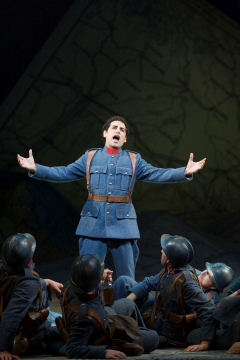
Now that the tenor Juan Diego Flórez has officially been designated a world class singer - in other words, now that it is safe to praise him, it’s quite fascinating to read critics falling over themselves to do so - the very same critics whose initial response to his recitals was sneering, filling their copy with stuff about expatriates rattling their jewels, about how he only really impresses in Peruvian folk songs, and hilarious remarks such as ‘he should stick to Puccini’ (well, this would be hilarious if it had not been written by someone who was actually paid to be knowledgeable about opera.) Of course, critics such as the present writer and John Steane, who discerned Flórez’ unique art when he was barely known here, can feel satisfied, since his Tonio at the ROH is the nearest thing to vocal perfection that I have ever heard.. Naturally, he was the one reason why I elected to cover this production, but in the end he was not the only reason to enjoy it.
The piece is tosh, of course – it’s the sort of thing that gets opera a bad name, and would probably never have re-entered the light of day if it had not been an ideal vehicle for Joan Sutherland in the fifties and sixties. I’ve been fascinated to read critics who profess to be younger than I am, making direct comparisons between Sutherland’s singing of Marie at the Royal Opera, and that of the present ‘owner’ of the role, Natalie Dessay – surely they cannot be of an age to have experienced ‘La Stupenda’ and the equally legendary assumption of Tonio by Luciano Pavarotti, in live performance? The Italian critic seated next to me said ‘Pavarotti’s high Cs are better, of course, but Flórez is the better singer’ - I’m not sure what this means, since it’s obvious that the effortless production of high Cs is a necessary part of the singing required in this role, and I can’t hear much difference between Flórez and Pavarotti in that department. I have not heard the latter ‘live,’ but cannot imagine how he could outshine the present tenor: not only does Flórez pitch those notes into the auditorium as though they were little silver arrows, he also sings the quieter, more lyrical music with perfect tenderness and skill: he was rightly accorded as thunderous an ovation for ‘Pour me rapprocher de Marie’ as he got for ‘Ah! mes amis,’ and what is more he is an unaffectedly graceful actor with a winning presence.
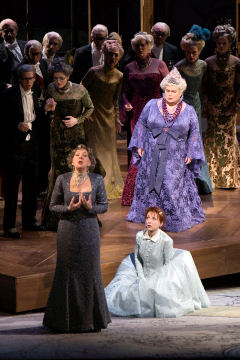
Flórez shares the vocal and histrionic honours, in my opinion, with Felicity Palmer’s wonderful Marquise: initially a formidable figure with a hint of ridicule, she mellows into a vulnerable mother, and her singing is superb throughout, from the stentorian first aria to the fragile confession. Her fellow ‘femme de nom’ is played with much relish by Dawn French – I think the line ‘Don’t be stingy with the chocolate fountains, darling’ got the evening’s biggest laugh. Alessandro Corbelli is the ideal Sulpice – a genuine comic actor as well as a great singer, and Donald Maxwell’s Hortensius showed what a subtle performer this under-rated baritone is.
The much-hyped Natalie Dessay (the programme carries an airbrushed advertisement for her latest CD in which the phrase ‘The Miracle of the Voice’ is used) was a feisty, busy-bee Marie, mopsing and moueing all over the place so that eventually she grated on one’s nerves. Dessay’s voice is rather like her person, that is to say diminutive and fragile, and it was noticeable that most of the cheering for her came from the stalls and Grand Circle – we were probably the only ones who could hear her properly. I’m told she is the greatest living coloratura soprano, or something – well, I don’t pretend expertise in coloratura history, but to me this is a small, neatly produced, very agile voice, rather on the sharp side, and entirely lacking in colour, fire or poetry, and to compare it to that of Callas or Pons or Sutherland is stretching things somewhat.
The production (Laurent Pelly) is great fun – I loved the doddery guests at Berkenfield, looking so like most of the Royal Opera’s patrons – and one’s eye and ear are constantly delighted with new gags and routines; just as well given the not exactly first division quality of the work. Bruno Campanella conducts with great style and collaborative sympathy for the singers, and the orchestra gives a loving account of the score. No point in exhorting you to go, since it has to be sold out - but if there’s a chance of a ticket, you shouldn’t miss out on hearing the tenor who really is without parallel in this music.
Melanie Eskenazi
Back to the Top Back to the Index Page |
| ||
|
||||