Music Webmaster Len Mullenger
© David
Wright
Ph.D
This article, or any part of it, must not be
reproduced in part or in whole in any way whatsoever without prior written
consent of the author.
see also Portrait Gallery
Book: Contemporary British Music (1945-1970) on-line
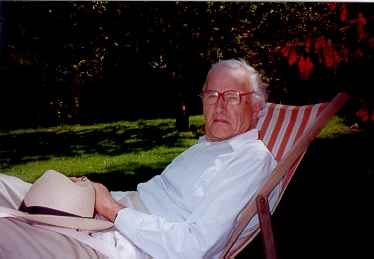
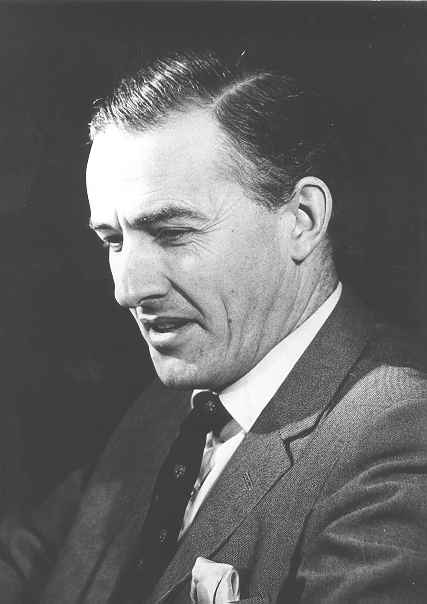
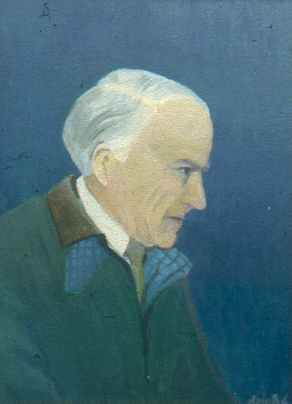
Portrait by Diana RouthFrancis Routh has undeniably rare talents. He shares with very few composers the ability to write successfully for the piano, which genre is the Achilles heel for many international composers. Taking his work overall and judging from the works of his that I have heard (and, fortunately, these are several) I can testify to their consistent high quality. Furthermore, he has the refreshing ability to write exciting, sparkling music of great energy and drive. And if honesty is to prevail in music it will readily be admitted that few composers of the present century can write an exhilarating fast movement. Routh's quick movements have an exuberance and momentum as seen in the best examples of Haydn and Mozart. His writing for the organ may be among the best British organ music ever written and when one realises how much attention is given to the organ works of Olivier Messiaen, some of which are very fine indeed, one wonders why Routh's equally splendid music in this genre is ignored.
Francis Routh was born in Kidderminster in 1927. He read classics at Cambridge and studied at the Royal Academy of Music where his composition teacher was William Alwyn. That tuition being unsatisfactory Routh went to probably the best composition teacher of his generation, Matyas Seiber.
Routh is a fastidious composer and usually only composes with a specific performance or performer in mind. His first recognised work is the carol, Balulalow, Op. 1, of 1955 but the work that established him as a composer was the song cycle A Woman Young and Old Op. 4 of 1962. The inspiration of much of his vocal music was the soprano, Ilse Wolf. He also had a very happy association with the violinist Maria Lidka which generated two concert works, the Dialogue for violin and orchestra, Op. 16, of 1968 and the Double Concerto, Op. 19, of 1970 in which the cellist was Christopher Bunting for whom he was later to write his Cello Concerto, Op. 27, in 1973. The composer, Alan Rawsthorne, once told me that he being present at the first performance of the Dialogue was fascinated by Routh's 'remarkable gift of melody'. An expressive quality is to be found in Spring Night, Op.23, inspired by the poet Sidney Keyes. This aria holds the interest not only by its beauty but by its constant harmonic shifts. I recall a very moving performance by the late Susan Kessler.
The only symphony so far, Op.26, dates from 1973 and has only been performed once in Dublin. It is a appealing work of telling vibrancy. The unashamed ebullience is also present in the outer movements of the Piano Concerto, Op. 32, of 1976.
His chamber music is also important. His three Concertos for Ensemble are monuments to the very best music of this kind and, again, the music yields a virtuosic reward as well as an intellectual and emotional response. The Sonata for solo cello, pp.21, of 1971 made a great impression particularly in Germany. The Oboe Quartet, Op.34, of 1977 seems to introduce a new style of intensity.
In 1963 Routh founded the Reddiffe Concerts which, while they are not confined to contemporary British music, have given first performances of works by Maxwell Davies, Fricker, Richard Rodney Bennett and Britten, among others.
Routh's recent works include a Poème Fantastique for piano and orchestra, a Fantasy Duo for violin and piano, written for Tasmin Little, and a Clarinet Quintet, written for Nicholas Cox.
The composer recently told me that he is not interested in making money, but in making music. And in his own music there is tremendous value and worth and a captivating energy. While his music may vary in quality, as is the case with all composers, his music is never dull.
© David C.F. Wright 1996
|
1996 |
|
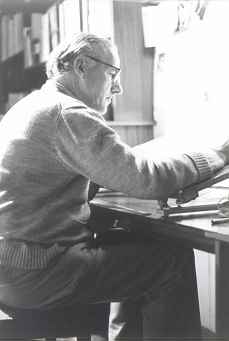
1985 |
|
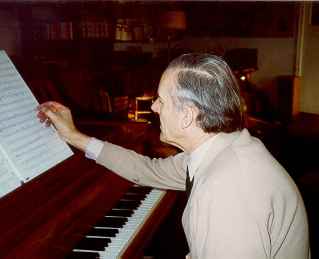
early 1980s |
|
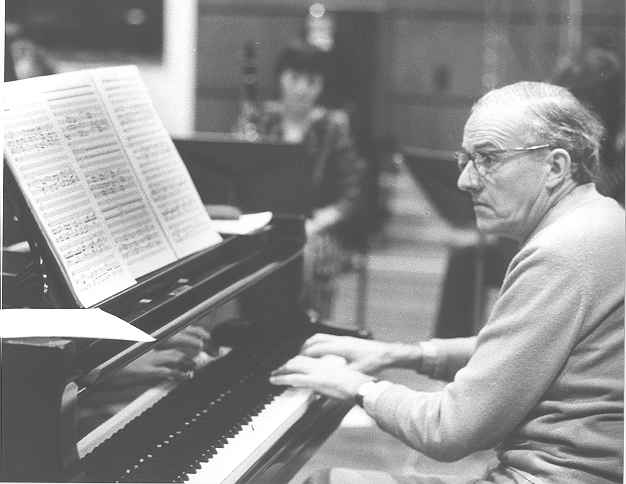
late 1970s |
|
early 1970s |
See also:
Discography
Oboe Quartet Op.34 (1977) and Tragic Interludes Op.43 (1983)
A Sacred Tetralogy for Organ: I The Manger Throne (Christmas) II Lumen Christi (Easter) III Aeterne Rex Altissime (Ascension)
Since November 1998 you are visitor
number
Return to:
Classical
Music on the Web
These pages are maintained by Dr Len
Mullenger.
Mail me.