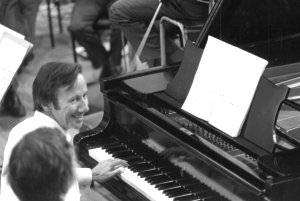
The concert pianist, Peter Roy Katin, was born in London on 14 November 1930 and is of Anglo/Canadian nationality. He is a perfectionist and, without doubt, one of the finest pianists of our time and a devoted and loyal servant to music.Peter, will you please tell us something about your parents?
My father Jerrold was born in London in 1899 and died in 1991. He was from an Orthodox Jewish family (his father came from Vilnius and his mother from central Russia), attended a Hebrew School but was ostracised from his family for marrying a Christian. He worked mostly as a self-employed brass engraver (some of the doctors' and dentists' brass plates in the Brighton area can still be seen). The war put paid to this and although he tried to continue, he turned his hand to basic cosmetics (bath salts etc.) and managed to earn a living between these and other ventures. One was the production of a detergent which made a great success at the end of the war. However, the sudden and fierce competition from Lever Bros. (who had started marketed another detergent called Dreft) steamrollered my father's comparatively modest product out of the running. He was offered a job with Lever Bros. But he turned it down, saying that - like me - he could not be an employee. Due mostly to my mother's extravagance he was left almost without resources and spent the rest of his life in semi-retirement, although until within a few months of his death he was still able to make the signs for which he had been known.
My mother's maiden name was Gertrude May. She was born in London in 1897 and died in 1975. I knew little about her except that she was maniacally possessive, unmusical, and never told anyone her age, so these dates I only discovered after she died. She had no job except as a shop assistant when she was young.
Do you have brothers and sisters?
One brother: Leslie, born in 1923, and died in 1972. He took Holy Orders very early in life, and was a very popular figure as a priest in the High Anglican Church. His last office was that of Chaplain at the Royal School of Church Music.
Tell us something about your school years.
General school education was virtually nil. I think this was due partly to the war, when we were living in various places to avoid the worst of the blitz. I went to private schools in Balham, Caterham, East Grinstead (one of the worst experiences of my life) and finally the (then) Henry Thornton School in Clapham when we returned to London. I was allowed to leave at the age of 14. I have no academic strengths whatsoever.
On our return to London I auditioned for the newly-formed Westminster Abbey Choir and was accepted as head chorister in 1943. At the same time I was the first person to be accepted by the Royal Academy of Music's senior department. I had no university education, and the eventual degrees etc. that I achieved were ARCM in 1952, LRAM in 1960, Chopin Arts Award (New York) in 1977, and an Honorary Doctorate (de Montfort University) in 1994.
Will you give details of music 'lessons', dates, teachers, standards achieved?
Strangely, although I started playing the piano at the age of 4, I had no lessons for two years, then I went to a very disagreeable teacher from my local school. The second teacher, in Caterham, had a kinder disposition, and in East Grinstead I was taught by the wife of the late Dr. Harvey Grace (ex-organist of Chichester Cathedral), and was head chorister in the Parish Church. Through them I was introduced to Harold Craxton and went to London to play for him several times privately before joining the Royal Academy. I studied there until 1948 (in 1945 I had a bad accident and was in hospital for virtually a year). I don't think I achieved anything although I won the Eric Brough Memorial Prize in 1944.
Apart from your 'main' instrument, do you play any others and how proficiently?
Apart from singing, I studied the violin and cello at an early age - I can't recall why I gave them up, as I achieved a reasonable standard on both, as I did when I was allowed to study the organ as an extra "first study". I think it was a lack of guidance; I think this is where an artistic background can make so much difference.
Please tell me about your wife and children.
I was married in February 1954 to Eva Zweig who has recently published her own account of her wartime experiences in Siberia. Before this dreadful wartime episode she had shown a lot of talent as a pianist and studied with a pupil of Schnabel. When she got to London she was awarded a scholarship to the Royal Academy of Music but after some time she gave up. I went to Canada in 1978, and Eva came in 1980, where we decided to separate. She returned to London in 1982 (I returned at the end of 1984) and we were divorced in 1988. One son, Nicholas, was born in July 1955, and another, Andrew, in April 1960. Nicholas started here as a gas fitter but went to Australia where he became a specialist in home and office heating, and Andrew, who came to Canada with us, has remained there in a managerial post of Purolator Couriers.
Your debut as a performer. When, where, what?
13 December 1948, at Wigmore Hall, where I played Scarlatti, Mozart, Beethoven, Rachmaninov, Skryabin and Chopin. My 50th anniversary is this year and I am playing a largely similar programme in the same hall on the same date.
Which professional orchestra/conductor did you first work with?
My first appearance with a major orchestra was at the Royal Albert Hall with the London Symphony Orchestra in 1951. The conductor was a strangely-forgotten one by the name of Royalton Kisch, who was responsible for some Beethoven cycles at the Albert Hall. I played Beethoven No.4 and received a very enthusiastic review in The Times.
What are the highlights of your career to date?
Too many! As a result of the Albert Hall concert I was offered the same concerto the next year at the still-new Royal Festival Hall with the London Mozart Players conducted by Harry Blech, which produced the same critical response. In those days one gave Prom auditions, and naturally I looked upon the Beethoven as my "lucky" concerto, so I played it at the Royal College of Music with (I think) Eric Gritton accompanying. For some reason, although I passed the audition, I was offered Tchaikovsky No.2 for my first Prom in 1952! I was tempted to disregard its success as a "highlight" apart from the fact that it was my first Prom (my reaction to meeting Sir Malcolm Sargent was rather like that of most of my colleagues), as my repertoire was gaining strength from the classical sphere, from chamber music, Lieder etc. But in 1953 I accepted happily Beethoven No.2 for my second Prom but was devastated when the BBC asked me to play Rachmaninov No.3 instead. After insisting that I should think about it for a week I decided to meet the challenge. It was certainly a highlight in one sense - the applause was timed at over 5 minutes and 30 seconds, I had the sort of reviews that people would kill for, and only afterwards I realised that my previous classical "image" had been thrown out of the window. However, despite being typecast for some 15 years, there were other highlights: the apparent incongruity of Rudolph Kempe in Rachmaninov No.2 which turned out to be the sort of triumph that made people disbelieve that in fact we had seen so much eye to eye (and agreed that the piano was too badly out of tune) that we didn't rehearse the last movement, but then nothing was ever incongruous where Kempe was concerned. My first Chopin recital at the Royal Festival Hall in the early sixties, a Beethoven No.5 with Paavo Berglund in 1975, a Chopin recital in New York during 1983 at which I was greeted as though I was a pop star, and a recital in the same year at the Canadian University where I taught, which included the best performance of the Liszt Sonata that I had ever given (or expected to give). But I tend to look upon all concerts as highlights, as nothing can be routine. When that happens, one gives up!
Will you name any works that have been specially written for you?
There are but two. One is Malcolm Lipkin's 4th Sonata, which I played in the 1955 Cheltenham Festival of Contemporary Music, and the other is a Tango by Bryan Kelly, which was published in 1961 (it had previously been part of a suite).
Tell us something about other soloists you have worked with in a duo, trio, etc:
Since the 1953 Prom, I had little chance of playing chamber music or Lieder, although the odd occasion would arise when I was asked to play, for instance, the Schubert B flat Trio, the Brahms F minor Quintet, and of course I started working with Alfredo Campoli in the mid-fifties; we gave several concerts and broadcasts together. There were no Lieder opportunities although in 1972 I did a Schubert recital at the Queen Elizabeth Hall with Ilse Wolf. Otherwise I created chances by working with young singers. In Canada there was an extraordinarily fine tenor called Kevin McMillan studying at the university, and we gave a recital there in 1983 which included Schumann's Dichterliebe. On returning to England I came back to a rather depressing situation and failed to find any chances of working in these spheres, so in 1997 I formed my own Trio and can no longer moan about the lack of work! I did three recitals with Victoria de los Angeles in the seventies; the first was in Barcelona, the second was in Warsaw (rather flatteringly, she refused to go without me - it was her first visit) and then at the Festival Hall.
What are your favourite concertos to play and why?
There are so many. I suppose my tastes are "conventional" in that I like the concertos of Beethoven, Brahms, Chopin, Grieg, Mozart, Schumann, etc. My early musical tastes were centred round these; Tchaikovsky and Rachmaninov came later. There are concertos that strangely fall into the background for years - I think that in thirty years I haven't heard Rachmaninov No.1 more than once (except in those concert series in which they are all played), and I rather think the Brahms No.1 has suffered the same fate. It has, for me, because before 1997 I can't remember when I played it, and yet it "come back" last year and its mighty structure seemed more natural than before. I love the Prokofiev No.3, but technically I could never come to grips with it, and after playing it six times I gave it up, with a mixture of relief and regret. I know the Grieg tends to be regarded as a safe box-office draw, and I must admit that I didn't see so much in it until I made that big series of recordings in Oslo during the late eighties, and through the atmosphere (to say nothing about all the discussions that went on) I began to see it as having a stronger and darker character than the prettiness that one hears so often. In 1989 I recorded all the Lyric Pieces and felt that my understanding of the concerto had been influenced for all time (if a broadcast I gave of it in 1990 is anything to go by, I was right). The Schumann is also special for me, and although the last movement can hardly be called inventive, if played at a tempo that allows the player to observe all the phrasing, semi-staccatos, etc., the dancing energy is far more apparent than when played as though on a racing track. Rachmaninov No.3 remains a towering romantic work - when I first played it in 1953 very few people would attempt it, and recently there was a BBC programme dwelling on its tremendous difficulties, which I thought rather silly, as it is now part of the staple diet of the International Competition circuit. All the same, much as I love the work, I have not been asked to play it for eleven years and I simply feel faint at the idea of having to relearn it.
Do you suffer from pre-performance nerves and how do you remedy this?
In general, I have never suffered from pre-concert nerves, except when I'm playing something for the first time, and I think that's unavoidable. There are trivial things that can make me unsettled, but if people understand that for about an hour before I play I don't want to talk to anyone, then its avoided. Otherwise, a perfectly natural question like "Do you want some mineral water in the interval?" will actually throw me (apart from the fact that these details should always be seen to beforehand). There is also the feeling, often not realised, that two things are happening when one walks onto the stage. One is that the artist is greeting the audience, and the other is that the audience is greeting the artist. There's no enmity, there's nothing to be afraid of. I know that this is over-simplifying things, and there are artists who fly into a panic for no reason that anyone would know. I will stick my neck out and quote myself on one occasion when I played three Scarlatti Sonatas and the Schubert B flat Sonata at a lunchtime concert. The moment I sat at the piano I started shaking uncontrollably and had memory lapses in all three Scarlattis, yet as soon as I started the Schubert (all 45 minutes of it!) this strange feeling vanished and might as well not have been there. But normally I am dying to get to the stage and start playing - and with a warm-hearted audience, what more can an artist want?
Do you smoke or drink and does that enhance your playing?
I don't smoke. Strangely, I used to smoke up to 50 cigarettes per day, but even more strangely, I gave it up one day at least 25 years ago without the slightest effort - I suddenly didn't want to smoke. A packet of 200 Rothman's has sat in my lounge for so long that they might be worth something for rarity value! I drink, but I have to like what I'm drinking, otherwise there's no point. This narrows it down to certain whiskies and certain wines, but I'm told that senseless drinking does bad things to the memory. I would have said that smoking must, too, as it restricts what should go into the lungs, but I can't fly that flag in view of the amount I used to smoke! Drinking can't enhance the playing, much as it can't enhance one's ability to drive a car. Smoking - Solomon smoked twice as much as I did, and it was the cause of his disastrous stroke (the carotid artery closed up) but I don't think it contributed to such heavenly playing.
Name some conductors you prefer to work with and why?
I would say that most conductors I work with are at the least reliable and co-operative, and at the most they are inspiring. Its difficult to name them - not because I don't want to, but I have to think about certain performances that have left me walking on air because the conductor has somehow become part of what I was trying to achieve. I want to put it that way because the same conductor just might not quite get to a similar level on another occasion. It can happen, of course. I recall three performances of the Chopin E minor Concerto with Christopher Seaman: I took along the full score, which I had marked with various dynamics for the orchestra (Chopin hardly wrote any), and when I looked at his score I found that he had almost identical markings. It followed that he took a lot of care over what some conductors tend to disregard as indifferent scoring, and in all three performances his involvement was evident. Another - this time it was the F minor Concerto - was in Hong Kong, with its beautifully sensitive orchestra, conducted by George Cleve, whom I met there for the first time. I was flattered to learn that he was familiar with my Chopin recordings, and at the first rehearsal it was obvious that this was not going to be a "rubato fly-swatting exercise" but an integrated performance, which it certainly was. I also recall a Rachmaninov No.2 at the Festival Hall with the LPO and Mathias Bamert, who had been quoted by a colleague as saying that he found Rachmaninov somewhat uninteresting, but in this performance I would have disagreed with that from start to finish. I also found a great amount of care and patience from Owain Arwel Hughes when I played Rachmaninov No.3 in 1987 for the first time in five years - then of course, I was nervous but his manner in rehearsal gave me an enormous amount of confidence. We played it a week later with a different orchestra and by then everything had settled down and the only thing that got in the way was a very toneless piano with an inaudible top register. A conductor with whom I haven't worked for a long time is Paavo Berglund. I'm mentioning this particularly in connection with a tour of seven concerts, all including the Rachmaninov No.3. We started in Llandudno and finished at the Festival Hall. In Llandudno we sat and waited for the orchestra's instruments to arrive, but they didn't get there until the doors were opened. In the meanwhile we sat at the piano and talked about the work - and did seven concerts without a rehearsal! I had so much confidence in him - when Olympia's plans were about to bear fruit we decided to record all the Rachmaninovs and to ask Paavo. Unfortunately these plans came to nothing.
Have you ever had any disastrous performances?
Oh yes! Fortunately few, but although I could quote three concerto performances that were sabotaged by the conductors, I should stick mainly to recitals. The Hong Kong Festival asked me to play two concerts, and one was a recital. When I started the recital, I realised that jetlag, always an unknown thing with me, was still there, and my fingers fumbled through the Schubert A flat Impromptu like bananas. That, of course, made me nervous (not in the way I described in an earlier question) and the rest you can imagine. But in general, however self-critical I am, recitals tend to go as I want them to, except that one work will leave me thinking that there was something missing, which means a sleepless night. There have of course been occasions (one very recent) when a music society chose a programme which wasn't the one I originally suggested, and I wasn't told by my agent. It doesn't come under the heading of "disastrous performances" but I try to make a compromise which won't upset the audience.
Have you ever taught your instrument to others, privately or at music college/school and can you name any such pupils who have 'gone on to greater things'? where did you teach and when?
Always, right from the time I was 18. I have always taught privately, and three pianists have made successes - Gordon Fergus-Thompson, Howard Shelley, and Philip Fowke. Apart from that I taught at the Royal Academy from 1956-1959, the University of Western Ontario from 1978-1984, and the Royal College since 1992. Also I had a large studio in my former English house and from 1968 to 1978 I held regular series of master classes, and additionally arranged, thanks to tremendous help and support from my wife, yearly series of recitals in order to give young artists a "platform", probably prior to a London début. These weren't all piano recitals; we had a lot of chamber music, young singers, even Balinese dancing, and every Christmas we would arrange a totally mad evening to give the artists a chance to let their hair down.
Any subsequent degrees, awards, etc:
The LRAM was awarded in 1960 when I left the Academy, and the Doctorate was awarded in 1994.
How important is the public to you? Do you ever feel they may possess hero-worship rather than a genuine regard for the music?
No. I have a great respect for the public. Their feelings are unfiltered, in that they may not know technically what they are hearing, but they do know instinctively - like me, they go to a concert in order to enjoy the music. A few inevitably suffer from hero-worship, or perhaps put the artist on a pedestal, but in general audiences want to go somewhere to relax and probably go with the moods of the works that are being played. Especially in this age, people are trying to get away from commercialism and "hype", because these elements work largely on the periphery of what I still insist on calling "the musical world".
How do you respond to harsh criticism and reviews?
We all like to be flattered and none of us like being criticised! But a real critic will assess the qualities and shortcomings of the player, and if he has to find us wanting, he will say why. Strangely, adverse criticism seems often born of ignorance, as I found recently when my Chopin square piano recording was reviewed. The critic didn't like it (which doesn't matter) but paid me one compliment about the effects I achieved with the soft pedal. Square pianos don't have soft pedals... If the critic takes the trouble to understand what one is trying to achieve, I can take it on board.
What are your hobbies and spare-time pursuits?
Too many. Apart from listening to music and collecting records, I am hooked on photography, reading, writing, the theatre. I used to fish, but I gave that up when fly-fishing started to affect an already damaged tendon in my right hand.
What do you consider the most demanding works you have played and why are they so demanding?
I suppose most people would say Rachmaninov No.3, and in a way they are right. But this is very subjective. Rachmaninov himself used a practise keyboard on his way to playing this concerto for the first time, but others find the difficulties not so Everest-like. For me, I had to stop playing the Prokofiev No.3 because his piano writing makes no sense to me. Unlike Rachmaninov, his writing has no pattern, and no doubt it is my shortcoming that I can't come to terms with it. I would say (for myself) that Tchaikovsky No.2 would be another very demanding work technically, but that's because, in my opinion, Tchaikovsky didn't write well for the piano. Perhaps I would prefer to quote Rachmaninov No.3 because of the enormous musical returns from enormous technical demands.
Do you prefer to perform in a live concert or a recording studio and why?
There's nothing like a live audience to make the artist give that much more, and to some artists even nervousness is preferable to the recording studio. Probably "recording nerves" are different. From one point of view, the performance can only have one attempt, whereas a recording can have several. From another point of view, that is just what makes recordings so fraught. The knowledge that you can play it again can make me feel that if I do, I'll make a mistake somewhere else, and if I don't, there could be sudden extraneous noises to cope with. Thinking purely musically, the performance is always going to be the best representative element - one can take chances that these days one wouldn't take in the studio. Having said that, I must also add that I largely prefer to listen to recordings made at a time when they were intended to mirror the artist, and I've tried to follow that principle, which means that I have to immerse myself in the music and in a way forget about the absence of an audience. A lot can be done to help achieve this - a hall or a church is a far better venue than a studio, for reasons of atmosphere, and if the players are placed where they would normally expect to be for a concert, then the feeling of a performance is easier to get. For several years I have been lucky in finding recording teams that agree to keep the tape running, simply because I can play for how long and when I like. Its unfair on the team, especially if they're used to "timed sessions", but in the long run I not only get recordings finished in less time, but the end result is more likely to be what I wanted. However, given that I manage to achieve a concert feeling when recording, the live performance is really the ultimate experience. The communication is there because the audience is there and the "projection" doesn't have to be simulated.
What artistes do you admire and why?
Very few, if we're talking about pianists. Not many seem to have escaped the International Competition mentality, with the result that all too often I have no idea who I'm listening to. There are some, of course, but I'm not going to mention who in case I miss someone out! Obviously I admire any artist who has something to say, but with the ever-increased feeling of "anything you can do, I can do faster", many artists have nothing much to communicate except keyboard wizardry, which in itself I find predictable and boring. Fortunately there are other performers (e.g. violinists, cellists, singers) who have more musical things to offer. But I tend to live in the past...
There seems to be a classical/modern music divide, once encapsulated in a remark, 'Bach can do no wrong; Bartôk can do no right'. Where do you stand on this issue?
These days I don't see a divide. If this were true, artists who played Bach and Bartók in one programme would be frowned upon as having no musical taste. Its a question of what one feels one can do justice to. There was a time when one did NOT sing both Mozart and Gershwin, but its happening without question now, and I think its a wonderful ability to have.
What other well-known figures do you know or have you met and how have they influenced you?
You have to remember that I can remember seeing pianists like Fischer, Schnabel, Cortot, Gieseking, Arrau, the younger Clifford Curzon, Solomon, Myra Hess, and other artists such as Suggia, Beecham, Menuhin, Callas in her Covent Garden début, Furtwängler, etc., most of whom it was possible to hear in one season. It stands to reason that such figures were the cause of my rather late musical awakening (by "late" I mean that without encouragement of the right kind, playing the piano was little more than "something I could do" until these great performances began to really tell me something). More particularly I want to quote three people who finally convinced me in one meeting that another "door" had been opened. I played for Myra Hess when I was seventeen, and although she tore me to shreds for three hours it dawned on me several months later that if she hadn't seen something I wouldn't have been in her house for anything like three hours. In 1949 I met Clifford Curzon who was equally exacting but in a way that finally fired my awareness of what I had been missing, and my enthusiasm about what now had to be done. The final - and different - approach came from Arrau in 1952, when I was depressed about my playing. I shall never forget the emphasis he laid on the absolute necessity of appreciating all forms of art, saying that whatever I saw or heard would influence my own work, directly or indirectly. I don't think I could have wished for more. Myra's abrasive manner aside, I learned more in three long afternoons than I ever learned anywhere else.
Do you have any political persuasion, what and how keenly do you follow it?
No political persuasion - I have never voted because we really have no genuine leader, and governments rarely do what they say they are going to do. Why should I walk down the road and put an "X" in a box for someone who promises to make life heaven and then mistakes the direction!
Do you have any religious following, what and how keenly do you follow it?
No. I was brought up in the Church of England, but conversations with my brother haven't resulted in more than an awareness that human beings are (a) not God, and (b) should have no right to determine such things as personal restrictions in the name of God. There is something greater than us - Socrates called it perfection, and my brother called it Divine Wisdom - an artist or musician might call it inspiration. Nobody has seen perfection, and as we won't see it until we die, it will remain an unknown thing in our lives. This unknown thing is probably God, regardless of what we call it.
Which modern composers do you admire and why?
This depends on what is modern. I can only generalise, not being a "modern" pianist. I have heard several works new to me that I have found myself reacting to and wanting to hear again, but others (sometimes by the same composer) that sound too like experiments. In general I will willingly listen to anything, but if I want to hear it again, the first impression must be that my emotions in some way are stirred.
How far do you think a composer's work must be cerebral or emotional? What is his function?
Its a very difficult question to answer. It has to be both, I think, because the structure has to be cerebral and the content emotional. The function, as you say, is surely an urge to create, and to me both elements have to be there.
As a performer, what criteria do you employ in playing any work? How far is it self-expression or a full realisation of the composer's intentions?
I remember Claudio Arrau saying that although performance should have more self-expression than is the case, when learning a work it was essential to start (given a reliable edition) by doing exactly what is in the score, regardless of any pre-conceived notions. This becomes part of the "mental digestion" process and when it becomes sub-conscious one has the whole canvas in his mind. On that canvas, the interpretation can be developed without "jumping out of the picture".
Are there any composers that you do not readily respond to?
I can happily live without Hindemith and Reger, but one composer I have really unsuccessfully struggled with is Michael Tippett. I was once asked to play his concerto at a festival, but looking at the score more or less convinced me that I wouldn't be able to do it, and the only thing left was to hear a recording of it, which was sent to me. I had to admit - and still do - that I can find nothing in it, let alone any influence of Beethoven's fourth concerto, which was said to have inspired it.
What things do you find irritating about other performers' performances of works that you perform yourself?
Nothing except lack of communication. I can listen to someone else's interpretation of a work that I play a lot, without wanting to play it that way myself, but if what the player says comes across positively, I can forget my own ideas for at least that time. After all, interpretation is like a valid point of view in an argument, in which everyone is talking about the same thing. When nothing comes across to me I'm not doing myself a favour by staying in the hall!
Who do you consider the greatest composers for your instrument and why?
For the piano itself it really has to be Chopin, who completely revolutionised all ideas about the instrument's capabilities. Other composers did some remarkable things for the instrument, notably Liszt and Debussy, in their totally different ways. Indeed, I sometimes think that one way of learning how to play Chopin is to study Debussy and be aware of the discipline involved, because one needs this in order to stay on the border between the clinical and the sentimental.
How far do you accept the suggestion of femininity in certain music, i.e. Chopin and Schubert?
I don't. A lot of rubbish is talked about masculinity and femininity in music, but there are so many elements from the aggressive to the elusive that its impossible to categorise them.
Have you ever found an accompanying conductor unsympathetic? If they are dead you can name them as examples:
Offhand I can only think of one still living, but probably the most egocentric conductor I ever worked with was Hermann Scherchen, with whom I played Rachmaninov No.3 in the fifties. Had he behaved in rehearsal now as he did then, he would have suddenly been without a soloist, but I was too young to hit back! Thinking about this time, there were some conductors who decided that they were the masters and we were the slaves, but not many. Josef Krips I found unbearably arrogant, but musically we were in agreement. One remark in a rehearsal comes to mind. In the Brahms No.1 I have a long triplet passage together with the quiet horn motif (just before the stormy octaves), and Krips said "Quieter!" I said that I was playing pianissimo and could still hardly hear the horn, to which he replied "Well, I can!". A very unpleasant conductor was Kyril Kondrashin, who shouted at everyone in sight and turned the Tchaikovsky No.1 into a rather unhappy affair - what the orchestra thought, I don't know. These were exceptions, though. There was a concept of the "visiting conductor" being monarch of all he surveyed, but if it was a tendency in the fifties, it disappeared about a decade later, and conductors such as Horenstein, Giulini, Jochum, Kempe, gave their best and rightly expected it from others, without any bullying element.
Do you ever receive unsolicited manuscripts of works to perform? How do you react and have any been successful?
I often get manuscripts - it rather flatters me, but although I might like what they send me, I've always been a slow learner and can only say that I can't guarantee a performance. Also, as I said earlier, I have to like the music!
How far is it true that if you don't like a piece you will not perform it?
I can't perform a piece that I can't relate to. If I can't relate to it, its not possible to find a point of communication. As Maria Callas said, if she wasn't convinced by the role she was offered, she couldn't hope to convince an audience.
Have you written any books or articles?
I've kept a private diary since 1948, and kept the majority of programmes that I have either played or heard - theatre programmes too, which go back to early stage performances by such people as Fay Compton, Alec Guinness, etc. These diaries have been of great use in the autobiography which I am writing, although the original idea was shelved and now I have to write it before I can find a publisher. I have written various articles in English and American magazines - one project was to write a series of articles on various aspects of performance, but the magazine now no longer exists.
Have you broadcast any talks?
Mostly interviews. World Radio ran a series of broadcasts about recordings, and I did some of those, but apart from that, I've never had the chance.
What do you want to be remembered for? What do you think is your greatest contribution to music?
I don't know. If I could be remembered for making music (or, as Jeffrey Norris said in the Daily Telegraph, "To transcend fashion"), I would be happy. If I may be allowed to quote from the Chief Executive of De Montfort University when offering me an Honorary Doctorate, "To recognise the distinction and the outstanding contribution you have made to music in the classical tradition". I doubt if I can want more than that.
Discography:
SCHUBERT: Sonatas in B flat D.960 & A minor D.537. OCD 188
CHOPIN (Vol.1): Ballade in F minor Op.52, 3 Mazurkas Op.59, Sonata in B minor Op.58, Barcarolle Op.60, Polonaise-Fantaisie Op.61. OCD 186
CHOPIN (Vol.2): Variations Op.12, 4 Mazurkas Op.24, Sonata in B flat minor Op.35, Ballade in A flat Op.47, Andante Spianato and Grande Polonaise Op.22. OCD 193
MOZART: The complete Sonatas. OCD 230-4, Boxed set OCD 5003
GRIEG: Ballade Op.24, 5 Klavierstücke nach Eigenen Liederen, Sonata in E minor Op.7, 4 Lyric Pieces. OCD 197
TCHAIKOVSKY: Sonata in G, Op.37, The Seasons, Op.37a. OCD 192
LISZT: Dante Sonata, 3 Liebesträume, 2 Polonaises, 6 Consolations. OCD199
SCHUMANN: Kinderszenen Op.15, Sonata in G minor Op.22, Carnaval Op.9. OCD 218
PORTRAIT OF A PIANIST: Bach: Chromatic Fantasy & Fugue; Beethoven: 6 Variations Op.34; Haydn: Sonata in G
HOB XVI/39; Debussy: Estampes; Liszt: Vallee d'Obermann. OCD 189
CHOPIN: The complete Nocturnes & Impromptus. OCD 254A/B
TCHAIKOVSKY: Concerto No.1; GRIEG: Concerto; LITOLFF: Scherzo. LSO/LPO, Edric Kundell/Sir Colin Davis (REISSUE). OCD 235
CHOPIN: The complete Polonaises and Waltzes. OCD 289 A/B
CHOPIN: The four Scherzos, Fantasy Op.49 (REISSUE). UKCD 2008
GRIEG: The complete Lyric Pieces. UKCD 2033-5
SCARLATTI: 14 Sonatas. CR 35102-D
MENDELSSOHN: Two piano concertos (LSO/Collins), Two concert pieces (LPO/Martinon) (REISSUE). With other Mendelssohn works played by John Ogdon & Brenda Lucas. DOUBLE DECCA 4524102 (2 CDs)
RACHMANINOV: Concerto No.1. LPO/Boult (REISSUE). 461 3482
CHOPIN: 4 Waltzes in a compilation (REISSUE) 450 000-2
CHOPIN FAVOURITES: Live recital from the Maltings, Snape. Polonaise in F sharp minor Op.44, Sonata in B minor Op.58, Nocturne in D flat Op.27 No.2, Fantasy Op.49. HALLMARK 350142
RACHMANINOV: The complete Preludes on one CD (REISSUE). IMP PCD 2052
CHOPIN: The complete Nocturnes (NEW - RECORDED 1971 AND NOT PREVIOUSLY ISSUED). IMP 30367 02357 (2 CDs)
KHACHATURYAN: Concerto, LSO/Rignold, FRANCK: Symphonic Variations, LSO/Goossens (REISSUE). EVC 9060
SCHUMANN: Concerto, LSO/Goossens (REISSUE). With other works. EVC 9045/46 (2 CDs)
VAUGHAN WILLIAMS: Fantasia on the Old 104th. LPO/LPC/Sir Adrian Boult (REISSUE). With other orchestral works. CDM 769962-2
TCHAIKOVSKY: Concerto No.1, LITOLFF: Scherzo. LPO/Pritchard (REISSUE). Classics for Pleasure 5 72699 2
CHILDREN'S CORNER. Grovlez: L'Almanach aux Images; Déodat de Séverac: En Vacances; Ibert: Histoires; Debussy: Children's Corner. PSC 1067.
WALTON: Sinfonia Concertante. LSO/Walton (REISSUE). With other orchestral works. SRCD 224
WILLIAM MATHIAS: Concerto No.3. LSO/Atherton (REISSUE). With other works. SRCD 325
CLEMENTI: Clementi on Clementi (five Sonatas, played on a restored Clementi square piano of 1832). ATH CD 4
SCHUBERT: The Impromptus D899 and D935 (Clementi 1832). ATH CD 5
SCHUBERT: Drei Klavierstücke D946; Valses Nobles D969; Moments Musicaux D780 (Clementi 1832) ATH CD 7
LIVE RECITAL including Liszt Sonata and Brahms/Handel Variations (1983 - previously unissued), Minerva ATH CD 9
CHOPIN: "FIRST & LAST". Early and late music played on Peter Katin's own Collard & Collard c.1836. ATH CD11
Peter Katin was talking to David Wright.
© Copyright - Peter Katin / David Wright 1998