Classical Music on the Web

Music Webmaster Len Mullenger


GRACE WILLIAMS by David C. F. Wright


© David Wright Ph.D
This article, or any part of it, must not be reproduced in part or in whole in any way whatsoever without prior written consent of the author.


Discography

The most self-effacing and modest musician one could ever have hoped to meet would have been Grace Williams, and when one considers that, at one time, she was friendly with Benjamin Britten, who, by contrast, was egocentric and arrogant, one can only marvel at her tolerance and gentle disposition. Her music has an unmistakable quality which may not reflect her 'keeping herself in the background' attitude. Her Milton setting, Fairest of Stars, is one of the most beautiful settings for soprano and orchestra of any text. The final stanza beginning, "Hail, universal Lord! Be bounteous still.." is almost unbearably beautiful and has made grown men weep. The commercial recording with Janet Price as the superlative soloist is a real treasure. The orchestration is perfection -strong but subtle- shimmering strings with haunting support from the horns and nostalgic trumpet sounds in an impressive effortless flow of sensuous, shifting exquisitiveness that is as beautiful as anything that Debussy or Vaughan Williams wrote. The music, being both sensual and sensitive, could also pass as being erogenous.
Grace Williams was born in Barry, South Wales on 19 February 1906. Both her parents were schoolteachers. Her father actually taught music and also conducted the Romilly Boys Choir and Grace was often the accompanist while still a schoolgirl.
She began to compose at an equally early age. When the National Eisteddfod came to Barry in 1920, it inspired her to pursue a career in music. In 1923, she won the Morfydd Owen scholarship, enabling her to go up to University College, Cardiff when she graduated in 1926. She proceeded to the Royal College of Music, studying composition under Vaughan Williams. Here she won a travelling scholarship and chose to go to Vienna to study with Egon Wellesz. She returned to London late in 1931 and took up teaching at Camden School for Girls.
Uppermost in her life was her Welsh culture. She was often homesick and this is evident in her overture, Hen Walia, of 1930. It is based on Welsh folk songs. The religious commitment of South Wales shows itself in her Two Psalms for contralto, harp and strings of 1932.
During the 1930s, she met Britten who introduced her to the film music industry, and they would discuss each other's work and go to the opera and cinema together. When Britten and Peter Pears fled to the USA in 1939 to avoid conscription, Grace saw Britten as he really was. Part of that perception led her to reveal publicly that she had had a relationship with a Polish man; but she never married.
The war years saw the appearance of her Fantasia on Welsh Nurseiy Tunes, for orchestra (1940) and, in the following year, her demanding Sinfonia Concertante for piano and orchestra. She withdrew her Symphony no.1, but, in 1947, her Sea Sketches were well received. Intended to create vibrant pictures of the sea, the reduced orchestra may not fully capture this. It is more a yearning for Wales.
By the end of the war, she was ill owing to overwork, stress and the depression caused by the conflict itself. She rallied, and took a job with the BBC Schools Department but became ill again. The rest of her health problems was in the fact that she longed for home and so, in 1947, she returned to Barry where she was to live for the rest of her life. Here she was at peace with herself and happy, and her music took on a more individual voice. For a few years, she taught composition at the College of Music and Drama in Cardiff. She wrote scripts for the BBC, made folk song arrangements for BBC Schools programmes, composed incidental music and was a copyist. Curiously, her music showed very little Welsh influence when she was back living in her own country.
The 1950s began with her Violin Concerto and proceeded to the admired Penillion for orchestra of 1955. There is a 'muscular' strength in her Symphony no.2 of 1957 which favours her favourite brass and woodwind instruments respectively as later evidenced by her Trumpet Concerto of 1963 and Carillons for oboe and orchestra of 1965. The orchestral fanfare, Castell Caernarfon ,was written for the investiture of the Prince of Wales in 1969.
Sadly, she wrote no 'pure' chamber music, but her vocal music is rewarding. The choral suite, The Dancers, for soprano, women's chorus, strings and harp is a set of five songs about women dancing. It deserves a revival. Six Poems of Gerard Manley Hopkins for contralto and string sextet was written for the Cheltenham Festival of 1958 while Four Medieval Welsh Poems for contralto, harp and harpsichord of 1962 produce some interesting sonorities and stylistically returns, after about fifteen years, to composition reflecting her Welsh heritage. She clearly prefers the woman's voice to that of the man and the contralto voice especially.
She had a gifted sense of humour as seen in her comic opera, The Parlour, produced by the Welsh National Opera in 1966. The large scale Missa Cambrensis was written for the Llandaff Festival of 1971 and with Janet Price in mind. If the work has a weakness, it is in the fact that it has little repose until the narrator recites the Beatitudes in Welsh over a beautiful string accompaniment. Such beauty of line can also be found in the unaccompanied motet, Ave Maris Stella of 1973 written about the same time as Fairest of Stars.
Her last completed work, Two Choruses for chorus, harp and two horns, takes us back to the sea port of Barry where, to my mind, the sea is more successfully portrayed than in the Sea Sketches of almost thirty years earlier.
She died in her beloved Wales on 10 February 1977. In her lifetime, she had written highly expressive music, refused the CBE and a Civil List Pension and remained what she most wanted to be - married to music. And her important contribution must cross the beautiful Welsh valleys and its borders and benefit music-lovers everywhere.
© Dr David C F Wright 1994

See also article by Pamela Blevins


Recordings


Simon Standage, Elizabeth Shenton, violins
Richard Williamson, Simon Whistler, violas
John Heley, Shuna Wilson, cellos
Eiddwen Harrhy soprano
Helen Watts contralto
Caryl Thomas harp
Richard Hickox Singers
City of London Sinfonia
Richard Hickox
CHAN 9617  buy here form Crotchet
The Dancers 19:39
Gather for Festival 3:12
Tarantella 2:46
Roundelay 5:15
Lose the Pain in the Snow 3:16
To the Wild Hills! 4:59

Two Choruses 10:17
Harp Song of the Dane Women 6:19
Mariners` Song 3:58

Frank Lloyd and Christopher Larkin horns
Ave Maris Stella 11:17
Six Gerard Manley Hopkins Poems 16:41
Pied Beauty 2:25
Peace 3:21
Spring and Fall 1:51
'No worst, there is none. . .' 3:38
Hurrahing the Harvest 2:44
The Windhover 2:30
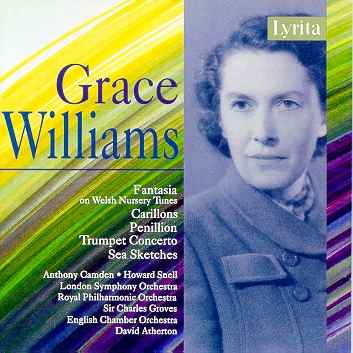


Thesewere not original Lyrita Recordings and were all made
under the auspices of the Welsh Arts Council


*     from EMI ASD 3006 (1973)
**   from EMI ASD 2739 (1071)
*** from Decca SXL 6468 (1970)

SRCD 323 buy here from Crotchet

Fantasia on Welsh Nursery Tunes*
Carillons for Oboe & Orchestra*
Penillion**
Trumpet Concerto*
Sea Sketches
***
    High Wind
    Sailing Song
    Channel Sirens
    Breakers
   Calm Sea in Summer

Anthony Camden oboe
Howard Snell trumpet
Ray Allen trumpet
London Symphony Orchestra*
Royal Philharmonic Orchestra **
English Chamber Orchestra***
Sir Charles Groves * **
David Atherton***


Since May 1998 you are visitor number


Return to:    Classical Music on the Web


These pages are maintained by Dr Len Mullenger.
Mail me.