Mark
Sealey
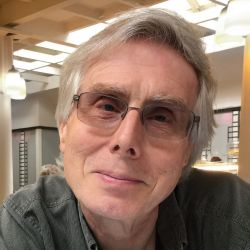 Mark
Sealey is a life long music lover originally from Leeds. He was
born in a household where no-one played an instrument or sang.
He did take piano lessons on and off at an early age; but they
didn't really lead anywhere. Serious music was valued at home,
though; composers were discussed at mealtimes; the radio was always
on.
Mark
Sealey is a life long music lover originally from Leeds. He was
born in a household where no-one played an instrument or sang.
He did take piano lessons on and off at an early age; but they
didn't really lead anywhere. Serious music was valued at home,
though; composers were discussed at mealtimes; the radio was always
on.
Indeed it was largely the Third Programme in the
1960s and 70s that helped to form Mark's musical tastes. Now that
its successor, Radio 3, has so spectacularly lost its way, Mark
is a co-founder of the Friends of Radio 3 (FoR3); he manages its
website.
Mark's mother's family did have something of a
history of amateur performance and his father was a music lover
and hi-fi enthusiast. Mark remembers 'helping' him to assemble
a family of equipment by Heathkit, a system which really distinguished
the casual from the determined enthusiast. He also remembers his
father disposing of a huge quantity of HMV 'plum label' 78s to
make way for LPs. It seemed like sacrilege at the time. so Mark
thought he'd better spend every penny he didn't have to build
up the world's largest record collection to compensate. And still
does.
At this time (mid-1960's) he also learnt to splice
reel-to-reel tape using a chinagraph pencil, and was involved
in school music productions. He also started to hold his own in
a world already beginning to use noise as a weapon. pirate radio
stations, powerful car stereos, house parties, muzak.
A regular audience member of CUMC concerts at Cambridge,
Mark then worked as a teacher, translator and interpreter in Verona
in the late 1970s. He returned in 1979 to do a PGCE at Goldsmiths'
in London, afterwards teaching in ILEA primary schools: for over
ten years he attended two or three concerts a week - the South
Bank halls; Wigmore Hall; St. John's, Smith Square and the Proms.
He moved to Cumbria in 1990 to take a Deputy Head's position in
a small rural primary school.
Fascinated by what computers could do for children,
Mark eventually left teaching to edit a series of magazines and
journals dealing with IT in education, as well as working on literally
hundreds of consulting, writing and developer
jobs. This led to a move to the United States: Mark met his
Los Angeles-born writer and teacher wife, Roberta, via the internet.
Now he works in California as a software engineer for the J Paul
Getty Trust and runs a small web consulting business in his 'spare'
time.
He founded the environmental action clearing house, BlackRhinoceros
(now as good as defunct), writes regularly for 'Freedom' magazine
and is a published poet always having to shut eyes
and ears to the materialism and globalised anti-culture of North
America.
Art music remains Mark's abiding love. Although
he remembers once writing to the Controller of the Third to complain
about the lack of jazz on the station and bought the odd Beatles
record as a teenager, he believes the stature of 'classical' music,
and its unself-conscious reaches to the soul, heart and brain,
are unsurpassable.
His catholic tastes circle around music from cultures
other than those of Europe and the north Atlantic, through the
fragments from Classical Greece and Rome, to Cage and Cardew.
one of the concerts about which Mark has most cherished memories
is a full (ten hour, two day) performance at the 1985 Almeida
Festival of the latter's 'The Great Learning'. It's uncanny that
several of Mark's father's favourite composers (Monteverdi, Beethoven,
Berlioz, Poulenc, Elgar, Shostakovich) are also his. Central to
Mark's pantheon are also Bach, Palestrina and the renaissance
polyphony tradition, Vivaldi and Handel, Purcell and the Elizabethan/Jacobean
British composers.
Now Mark specialises in music before 1750. It has
qualities (rhetoric, informality, spontaneity and expressiveness
as well as its very sounds) which were lost by the end of the
Classical period. Of almost as much delight as the music which
Mark already knows and loves is his conviction that it's inevitable
that composers, compositions and performances every bit as enthralling
and of just as enduring worth to him will always continue to be
discovered at the most unexpected moments.
Since 2007 he reviewed almost 300 items for Music
Web International.