When
this disc first appeared on Hyperion back in 1992 at the
time I took absolutely no notice of it whatsoever. I am somewhat
averse to pianistic pyrotechnics especially those with only
a shallow grasp of musical worth, form and emotional content.
But now that it has appeared on Hyperion’s’ Helios label
I can see how wrong I was. I also see, yet again, how astute
the late Ted Perry was both in helping to discover this extraordinary
music and in selecting the Dutch pianist Rian de Waal. This
pianist is near the head of that rare virtuoso cadre able
to make music from these myriad cascades of notes.
The
seriousness of Godowsky’s musicianship is instantly announced
in the first track, a huge symphonic metamorphosis in the
form of a ‘Passacaglia’ which he calls 44 Variations. There’s
also an extraordinary Cadenza and a fine fugue on the opening
eleven notes of Schubert’s Unfinished Symphony; obviously
one of Godowsky’s favourite composers. The Passacaglia has
been recorded a few times already: once on Hyperion by the
razor-sharp Marc-André Hamelin and also by Konstantin Scherbakov
on Marco Polo; the latter very fine but a little sombre and
dull. Apparently Horowitz, who first played it, never liked
it but it has been said that he was jealous of Godowsky’s
skills. I have been most impressed and it certainly makes
an auspicious start even if musically speaking the rest never
quite lives up to the Passacaglia.
Kunstlerleben is
surely a little OTT. While de Waal’s virtuosity bristles
I am somewhat relieved that he has made some cuts. And what
is especially helpful, is the beautiful recording environment:
it allows detail to shine through but also adds lustre and
glow. Weber’s Invitation to the Dance comes off very
well, with lithe and clean playing. However the arrangement
seems again to be a little too rich, at least for my taste.
The
Schubert arrangements are the most immediately attractive
pieces after the opening track; especially the three songs.
His method is not simply to add tune and accompaniment, but,
for instance at repeats, to alter harmonies, add grace notes
and move about different octaves. This can be clearly heard
in the arrangement of Das Wandern. Gute Nacht from Winterreise sounds
less intimidating than in Schubert’s original. Another technique
noticed here is the adding of inner voices and a descant
line to the tune when in the upper half of the left hand.
While this could create a somewhat fussy effect here it works
just perfectly. Rian de Waal turns Ungeduld into a
Schumannesque romp, a riotous display of joy, adding new
harmonies and using the entire keyboard.
The
very familiar Rosamund music is quite plain in Schubert’s
original. Godowsky’s staccato chordal accompaniment and his
moving of the melody around the hands with odd harmonies
adds an attractive spice which one didn’t realize could ever
be present. In addition the slower middle section sounds
like something out of Grieg's Lyric Pieces.
Finally Alt
Wien is Godowsky’s most popular original composition,
arranged ironically by Heifetz and made even more poplar
as a result. It sums up in a gentle Waltz a sort of fin
de siècle nostalgia which was probably rather ‘old
hat’ by 1932.
If
you go on the internet you can discover other discs of Godowsky
but except for the few tracks mentioned above I have heard
little else. That said, with Rian de Waal one is in safe
and reliable hands. Godowsky’s intentions are not only met
to the full but the music, something of a hybrid perhaps,
is played with musical intensity and elegance.
Good
booklet notes by Jeremy Nicholas, succinct and full of interest
and presenting all the salient facts.
Gary
Higginson



 Rian de Waal
(piano)
Rian de Waal
(piano) 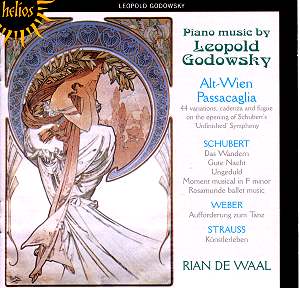
 for
details
for
details












