Here is an interesting concept: three trios
showing the development of musical thought in a city over the
course of a century.
On top of that, throw
in a
big name world premiere recording, and you have quite a package.
The composers, as seen from the header above are Beethoven, Brahms and
Zemlinsky. The premiere, which you may find hard to believe, is the Beethoven piece.
I also found it hard to believe, so I did some looking. There don’t appear
to be any other performances of the work as a trio available — highly unusual,
considering the name of the composer and the fact that the scores of the
trio version and the more familiar guise of this piece as the sextet were
released
to the world within months of each other.
The trio version is a more introverted and placid piece compared to the more
famous sextet version. The brightness in tone that the sextet version is
moderated, but the trio version has a sprightliness in the piano writing
that reminds
one of Mozart’s influence during Beethoven’s early years. I find that I prefer
the use of the horns in the sextet version for the melody line over the two
string parts carrying it in the trio version. However the reduced version has
its merits — the darker tonality of cello and viola show a more stately side
to the piece. The Adagio, at 3:35, is a full minute faster than my
1960s recording of the sextet version made with members of the Berlin Philharmonic.
It shows the trio’s darker tones to advantage, with the horn duet taken over
by the two string parts. This is where the trio version really shines but I
still find myself partial to the gorgeous melding of the horns in the sextet
version. The piano writing for the trio is, on the other hand, makes a more
convincing backdrop than the sextet’s strings. Other listeners may differ,
but that’s all part of the fun with recordings of alternate versions.
The Zemlinsky, composed only five years after the Brahms, has a very
different structure, evidenced from the outset by its expansive first movement.
The flowing opening theme is restated in Rachmaninovian octaves. Overall,
though, the musical language is not all that remote from Brahms. The gravity
of the
left hand part of the piano in the first movement echoes Brahms. Zemlinsky’s
language is further along the Romantic vein, however. Those unfamiliar with
Zemlinsky will see him as a bridge between Brahms and the last Romantics such
as Rachmaninov, who died only a year later, in 1943. In this piece slightly
more fire is drawn from the ensemble, especially during some of the more anxious
moments of the first movement just before the coda. One unfortunate aspect
of this recording is the subdued and distant placement of the microphones.
In certain systems, especially car stereos, this sounds exceptionally remote,
with the piano generally audible, but the two string parts swimming in the
ambience. This evens itself out in a high-end system in one’s living room.
Not everyone has this, however, and those who don’t may find themselves having
to crank up the volume to compensate.
Overall, these are warm, if rather subdued performances, the Brahms done
especially well, but the recording ambience tends to minimise the urgency in
passages where it is needed.
With the above caveat, and with the added plus that we hear a Beethoven world
premiere recording, this disc is recommended.
David Blomenberg



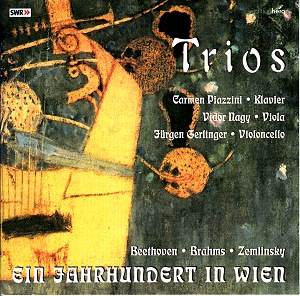
 Vidor Nagy (viola); Jürgen Gerlinger
(violoncello); Carmen Piazzini (piano)
Vidor Nagy (viola); Jürgen Gerlinger
(violoncello); Carmen Piazzini (piano) 











