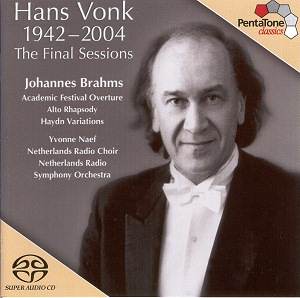
The conductor Hans Vonk, who died in 2004, may be an
unfamiliar name to many readers. This PentaTone Classics
recording, together with a companion release, serves as
a fitting document to mark his final recording sessions.
David Robertson, the Music Director of the Saint Louis
Symphony Orchestra, who collaborated with Hans Vonk, has
provided an insightful personal observation: “
The distinguished
conductor was praised during his career for his stylistic
authority and mastery of orchestral colour. He was known
for administering a heightened degree of discipline, clarity
and refinement to any orchestra he worked with. His interpretations
of a score were deeply grounded in an understanding of
the composer’s intentions. Vonk would sometimes refer to
himself as “the composer’s friend”. Violist Morris Jacob
described Vonk’s “incredible clarity. It’s almost as if
he had coffee with these composers. That’s what made him
so special as a conductor.”
Vonk was born in Amsterdam on 16 June 1942. He studied
piano at the Amsterdam Conservatoire, continuing his conducting
study with Franco Ferrara and Hermann Scherchen. Examination
of Vonk’s curriculum vitae demonstrates an extremely active
international conducting career:
Netherlands
Ballet, conductor 1966-1969.
Concertgebouw
Orchestra, assistant-conductor 1969-1973
Netherlands
Opera, chief-conductor 1976-1985
Netherlands
Radio Philharmonic Orchestra, conductor 1973-1979
Royal
Philharmonic Orchestra, regular guest-conductor 1976-1979
Residentie
Orchestra in the Hague, chief-conductor 1980-1991
Dresden
Staatskapelle and the Dresden State Opera, chief-conductor
from 1985
Netherlands
Radio Philharmonic Orchestra, named first regular guest-conductor
in 1990
Cologne
Radio Symphony Orchestra, chief-conductor 1991-1997
Saint
Louis Symphony Orchestra, chief-conductor 1996-2002
Netherlands
Radio Symphony Orchestra, chief-conductor from 2002 until
his death in 2004
In
addition Vonk directed many orchestras as a guest conductor,
including in the USA: the Philadelphia, Cleveland, Boston
and Los Angeles, to name but a few.
In 2002, record producer Job Maarse asked Vonk if he
would conduct his Netherlands Radio Symphony Orchestra
in some recordings for the PentaTone Classics label. Vonk
liked the idea and suggested that he now felt experienced
enough to record a Brahms cycle. The decision was made
to record all the Brahms Symphonies and four shorter orchestral
works. Unfortunately, before his untimely death Vonk was
only able to record the
Symphony No. 2, the
Tragic
Overture, the
Haydn Variations, the
Academic
Festival Overture and the
Alto Rhapsody. These
works have been released over two PentaTone Classics discs.
The companion disc is PTC 5186 042.
Brahms wrote the
Academic Festival Overture by
way of a thank you for the award of an honorary doctorate
from Breslau University in 1879. In the
Academic Festival
Overture the composer uses four popular student drinking
songs. Brahms himself described the score as, “
a very
jolly potpourri on student songs”.
One cannot really write about the
Academic Festival
Overture, without at least mentioning its companion
work, the
Tragic Overture, Op. 81. Brahms himself
wrote the following on the occasion of a performance
in Breslau at which both works were performed: “
One
weeps, the other laughs” thus pointing up the complete
contrast in character of each work.
Hans Vonk and the Netherlands Radio Symphony Orchestra
successfully display the spirited character of the Concert
Overture in an exciting and committed reading of remarkable
energy. I also admire the recordings from Claudio Abbado
and the Berlin Philharmonic Orchestra, available on Deutsche
Grammophon 469 298-2 and also from Eugen Jochum and the
London Philharmonic Orchestra, on EMI Double Forte CZS5
691515-2.
Brahms based his
Alto Rhapsody on
the poem
Harzreise im Winter (
Winter Journey
through the Harz Mountains) by Johann Wolfgang von
Goethe. Brahms had heard the verse for the first time in
1868 in a setting by Johann Friedrich Reinhardt. The composer
selected verses five to seven for his composition and structured
a three-part score, in which each part represented a different
type of emotion: the loneliness of a person unhappy in
love; her lament against the world and hope-bringing consolation
from the Creator. Although the themes and musical shaping
of the different parts stand independent of one another,
Brahms manages to create a sense of unity in the inner
structure.
It seems odd that Brahms should choose such a darkly
personal text to set to music as a wedding gift for Julie
Schumann, the daughter of his dear friends Clara and the
late Robert Schumann. But there can be little doubt that
Goethe’s poem spoke to him, in his own solitary life, with
unusual directness, and he responded to it with this shattering,
personal music.
Yvonne Naef, the Swiss contralto does not have the same
measure of expression and beauty in her voice as some of
the most eminent exponents of this score, such as Christa
Ludwig, Kathleen Ferrier, Janet Baker, Helen Watts
et
al; few singers do. Nevertheless, Naef makes a highly
effective offering; an insightful and incisive interpretation.
She has a noticeable vibrato which thankfully never detracts
from the proceedings. The male chorus and the orchestra
give sensitive and well paced support. From my collection
my preferred version of the
Alto Rhapsody is performed
by Christa Ludwig with the Philharmonia Orchestra and Choir
under Otto Klemperer, on EMI 5 67029-2 (re-released as
EMI 5 62742 2 - see
review).
In the summer of 1873, Brahms completed his
Variations on a theme by Haydn in
B flat, Op. 56a. Presented in ten short movements the
Haydn Variations was
Brahms’ first purely symphonic score that he had written in fourteen years and
is acknowledged as his first orchestral masterwork. The theme of the
Haydn
Variations was taken from the
Field partita Hob. II: 46, and was probably
not even written by Haydn, but by one of his pupils, most likely Ignaz Pleyel.
It is entitled
Chorale St. Antoni and is based on an old pilgrim’s song.
This is a simple melody, although it contains small, complicated rhythmic elements,
which Brahms worked into eight variations and a concluding
passacaglia.
This is a refined and stately interpretation eminently
suited to the score’s delicate textures. Another high quality
account of the
Haydn Variations from my collection
that I would not wish to be without is from Claudio Abbado
and the Berlin Philharmonic Orchestra, on DG 435 349-2.
The PentaTone Classics label pride themselves on their
first class sound quality; which does not disappoint. The
SACD was played on a standard audio set-up. The annotation
on this release is reasonably interesting and informative.
The only real drawback is the woefully short playing time.
Vonk’s splendid readings do not replace any of my first
choice recordings in these scores but he comes very close
in the two purely orchestral scores. An excellent achievement.
Michael
Cookson



 Yvonne
Naef (alto)
Yvonne
Naef (alto)  [42.44]