Liszt was a prolific composer and one of the greatest virtuoso
pianists of all time. He left us a vast amount of piano music,
some of which ranks amongst the finest and best known in the literature
e.g. his solitary Sonata, the Hungarian Rhapsodies, Transcendental
Studies and the three Years of Pilgrimage. But most of it is hardly
known despite there being a complete recorded survey (by Leslie
Howard for Hyperion) which ran to almost 100 volumes, some with
multiple CDs. It remains to be seen how long the Naxos series
with many different pianists will take to complete but it is good
that they are already exploring some of the less familiar music.
This disc has just one well-known piece - Au bord d’une source
– which first appeared in Album d’un voyageur and then
was transferred, with some revision, into the first (Swiss) year
of pilgrimage. The final, and most substantial work here also
has Alpine influence and uses material derived from the Swiss
composers Huber and Knop. Originally called paraphrases, that
designation seems more appropriate than “morceaux” for
these extended, improvisatory pieces.
Although Liszt wrote much that was based on the work of others,
this was not for lack of original inspiration. The Polonaises
and Ballades were influenced by Chopin and the former were written
soon after his death. Although much less well known than Chopin’s
contributions to the genres, they seem to be on the same level,
particularly the second ballade.
There is much fine pianism to be heard on this disc. The young
French pianist Jean Dubé won the sixth Utrecht Liszt competition
in 2002 and, unsurprisingly, his playing sounds completely idiomatic.
In the more barnstorming parts of these works he seems fearless
but he also relaxes beautifully when required. I do not feel he
surpasses the great Lisztian Jorge Bolet in Au bord d’une
source – this sounds just slightly mannered. Overall, it
is a very fine recital and he is well-recorded with good documentation.
There have already been some splendid discs in Naxos’s Liszt
series. This would be as good a place as any for the uninitiated
to start and will be essential listening for those who already
know the major works.
Patrick C Waller
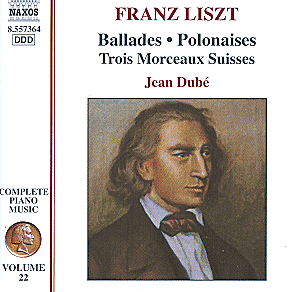
 Jean Dubé (piano)