Raff
was an in-between composer. Although born a Swiss, he is considered
a German, whereas in terms of style, he might be described as
a Classical-Romantic. He was strongly influenced by the music
of Mendelssohn and Liszt, the former recommended the publication
of early piano pieces. Liszt also acted for Raff in a practical
manner, for, as a musical patron, he arranged posts for him first
in Cologne and Stuttgart, and then summoned him to Weimar to serve
as his assistant-cum-secretary for six years from 1850. From 1877
he was Director of the Hoch Conservatoire in Frankfurt, where
he composed and taught (MacDowell being among his pupils). His
output was considerable with over two hundred published works,
among them eleven symphonies, vast amounts of piano music, and
a considerable number of chamber works. Much of the weakness in
his music lies at the very heart of this schizophrenic attempt
to fuse such dissimilar styles, and it tends to fall between two
stools, simply sinking into eclecticism. But it is all tuneful
and skilfully crafted.
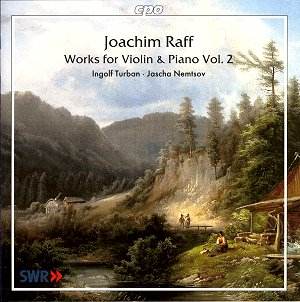
The
music on this second record in the series of Raff’s works for
violin and piano is characteristic of his post-Weimar period,
when he was beginning to establish a certain independence from
Liszt. The substantial sonata (at 38 minutes) contains a good
deal of lyrically shaped musical ideas in its first two movements,
a moderately paced scherzo underlines its dance-like character,
but it’s the finale which fails to sustain interest and runs out
of steam. The six pieces are nicely varied, beginning with a swashbuckling
march, followed by a charming pastoral and gently pretty (and
ultimately Raff’s most familiar work) cavatina, a swift scherzino,
a moving canzona and an infectious Tarantella to conclude. As
one might expect, it is the famous Bridal Chorus which dominates
the paraphrase on Wagner’s Lohengrin, which Liszt premiered
while Raff was in Weimar and the composer in exile at Triebschen,
(the other two works which make up Op.63 draw upon Flying Dutchman
and Tannhäuser).
If
any of Raff’s music gets heard, it’s generally a couple of symphonies
(Im Walde and Lenore, Nos. 3 and 5 respectively).
Here the duo of Turban and Nemtsov continue with CPO’s complete
series of music for violin and piano (five volumes are planned,
Volume 1 CPO
999 767-2 has the first sonata plus fillers, which include
the paraphrase of music from Tannhäuser), with manifest
enthusiasm (‘warmth and animation’ demanded in the sonata’s first
movement) for the task in hand. Their performances eloquently
argue the case for a revival in the fortunes of Raff’s music,
both artists having the poetic imagination (successfully steering
away from any hint of sentimentality) and the technical prowess
to meet the task in hand.
Christopher
Fifield
 Ingolf Turban (violin)