Widor’s Organ Symphonies are always a difficult
fit for the CD medium. One disc is too long for two symphonies
and three will not go unless the organist is fleet of foot, and
there are no repeats.
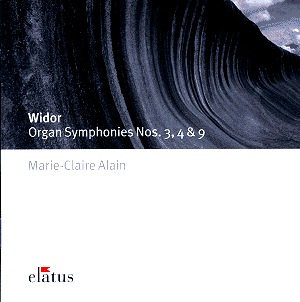
Warner seems to have achieved a compromise here
by issuing two complete symphonies and excerpts from a third to
make one very well filled disc. They have a trump card up their
sleeves by entrusting these works to that doyen of French organists
– the wonderful Marie-Claire Alain, plus they have used a Cavaillé-Coll
instrument, the instrument of favour for these works by the composer.
Although the recordings are not totally up to
date they are of excellent analogue quality. The Erato engineers
have contained the immense power of this organ on to the disc
with consummate skill. The hero, or should I say heroine, of this
whole enterprise is Marie-Claire Alain. She gives accurate performances
of all 2½ works, and what is more, they are in the correct idiom
as outlined by the composer. In addition to writing these and
many other works for organ, Widor spent much time as an influential
teacher who believed in the use of the legato touch and inflexible
rhythm. Originally I thought that there was a little rhythmical
sameness about these performances but discovered that this is
probably due to the soloist following Widor’s own beliefs on how
his works should be played. Full marks to the organist for historical
accuracy.
Most readers will be very well aware of how the
Toccata from the Fifth Symphony has been lifted out of context,
and is often used at weddings, or as an encore to organ recitals
and other such events. This has caused Widor’s Organ symphonies
to become relatively unknown but as with other works of similar
composers this does not mean that the works here should be ignored.
Widor’s 10 Organ Symphonies are superb examples of the organ composer’s
art. All of these symphonies can hold their heads up in the company
of other more famous romantic organ pieces, those of César
Franck for example. Their relative obscurity can be put down to
a number of factors including Widor’s prime activity which led
him to be known as organist at Saint-Sulpice in Paris and this
at the tender age of 24. There he succeeded Lefébure-Wély
as principal organist. Later, he became an influential and somewhat
frosty teacher.
His first four symphonies were published between
1876 and 1879. He was writing these substantial works long before
his perhaps more famous contemporaries were active in the field.
For example César Franck did not produce his chorales until
1890 although his early Trois Pièces pour orgue appeared
between 1878 and 1879.
Widor must therefore be seen as a 19th
Century composer well ahead of his time. He certainly deserves
his place as an early member of the French school of organ composers
who were busy fashioning the history of organ music. This is generally
not accepted largely because of his career as a teacher; this
coupled with the fact that he lived well past the age that an
early composer might have been accepted to have lived. Widor’s
influences on the techniques of organ playing were immense. He
combined the manual dexterity of the French with the nimble pedal
technique of the Germans. He was aided and abetted in this by
his close relationship with Cavaillé-Coll, the organ builder.
A whole school and style of playing developed in France as a result
of these activities. Enthusiastically recommended.
John Phillips
 Marie-Claire Alain
(organ)
Marie-Claire Alain
(organ)