Purchase using PayPal
OVERSEAS CUSTOMERS
It can cost up to £7.50 to post a book by airmail. I am
willing to absorb some of that so if you are not in the UK please
pay an extra £5.00 using this button
Luca Marenzio is one
of those composers whose work we might
be familiar with; we might even have
performed some of his madrigals or sacred
music. But we never learn much about
his background, beyond a short, rather
bald paragraph - something that would
be true of many 16th century
composers.
This book, originally
written in Italian by Marco Bizzarini,
is an attempt to shed some light on
Marenzio’s background. It is not a biography;
we do not possess enough materials to
write a conventional biography. The
book is subtitled ‘The Career of a Musician
Between the Renaissance and the Counter-Reformation’
and Bizzarini sheds a fascinating light
on the background to a musician’s career
in 16th century Rome.
Marenzio was born in
Brescia in 1553 or 1554. Early on he
received training at the court of the
Gonzagas in Mantua. He then moved on
to work for Cardinal Madruzzo. On Madruzzo’s
death, Cardinal Luidi d’Este (owner
of the famous villa in Tivoli) became
Marenzio’s patron. D’Este tried to get
Marenzio a place in the Sistine chapel
choir. If he had succeeded, then Marenzio
the composer of sacred music would be
far better known than Marenzio the composer
of madrigals. As it was, the attempt
failed and Marenzio went on to pour
forth a stream of madrigals. His greatest
period for madrigals was whilst he was
working for d’Este and it is though
that the Cardinal sponsored the many
collections of Marenzio’s madrigals
that were published.
On d’Este’s death,
Marenzio was freelance for a time. Rather
curiously, this meant that if someone
wanted to employ him they had to clear
it with Marenzio’s father in the absence
of a patron. Marenzio then went on to
work for the Grand Duke of Tuscany (who
had been Cardinal Medici). As a result,
he was involved in composing for the
Florentine intermedi which were produced
for the Grand Duke’s wedding. These
intermedi are famous as being important
precursors of fully fledged opera, but
Marenzio seems to have had no inclinations
in this direction.
His time with the Grand
Duke of Tuscany was short and he returned
to Rome working successively for Virginio
Orsini, Duke of Bracciano and the two
more Cardinals. At this point, Marenzio’s
career takes an even more fascinating,
and poorly documented turn. He is sent
to work for the King of Poland. Sigismund
of Poland was fond of large-scale poly-choral
music and sent to Italy for a musical
establishment and director of music.
Marenzio worked for a few years in Poland
before returning to Italy and another
poorly documented period which ends
in his death.
The documents for Marenzio’s
life are limited. His surviving letters
are impersonal ones and Bizzarini has
done a brilliant job at synthesising
the results of his own and other people’s
research to shed light on Marenzio’s
career. This means that the book has
an extremely extensive set of notes
and critical apparatus which can be
off-putting to the casual reader. But
there are other aspects of the book
which might make it difficult for the
average reader.
The language of James
Chater’s translation has a tendency
to be over-flowery. This might be because
Bizzarini’s original text is like that,
but I feel a good editor could have
simplified things. A good editor is
something that the book needs. The text
is very inconsistent with its treatment
of quotations in Italian, sometimes
translating them but sometimes not,
sometimes relegating them to the footnotes.
This sort of thing is very off-putting
to the casual reader, and title of pieces
and collections of music are usually
kept in Italian (or Latin) with no translation
offered.
This was a highly political
period in Rome and Marenzio was involved
as he worked for a series of patrons
who were involved in the labyrinthine
politics of the day. To give a good
background to Marenzio’s story, Bizzarini
has to include much information about
the papal politics and too often this
is done with a surprising lack of clarity.
The problems often relate to simple
things, for instance at one point the
new Pope, Pope Sixtus, is referred to
by three different names in the space
of two paragraphs. Too often the narrative
thread gets lost in a welter of detail
and the reader must closely read a section
to understand the underlying implications.
(The opening of chapter 19 is extremely
unclear about Marenzio’s transfer of
employment from Cardinal Montalto to
Cardinal Aldobrandini).
The entire structure
of the book is also somewhat labyrinthine.
Sometimes events in the narrative give
rise to parenthetical chapters which
could better have been dealt with in
more chronological order. I understand
that in such a work, a thematic organisation
rather than a chronological one is desirable.
But the book opens with Marenzio already
working for Cardinal d’Este and we must
wait for chapter 10 before we learn
about his origins and early years. Then
at the end, Marenzio dies in chapter
21 to be followed by 5 further chapter
on Marenzio’s music and aspects of his
career which could better have been
integrated into the text.
But the book does deal
very well with Marenzio’s music. More
than 40 musical examples are included
and, apart from the final chapters,
the musical analysis is skilfully integrated
into the narrative. Given the lack of
documentary evidence, Bizarrini uses
the music to help shed light on Marenzio
the man.
This is a book containing
much important information about a significant
16th century composer and
it sheds fascinating light on the mechanisms
by which a Roman composer in the period
might construct a career in music. It
is unfortunate that the book’s structure
and editing mean that it could be rather
off-putting for the casual reader.
Robert Hugill
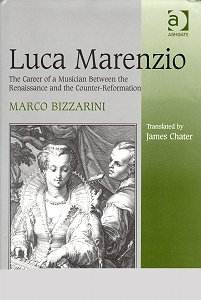
 Ashgate; ISBN 0 7546 0516 7; 370 pages, 10 b/w
illustrations, 40 musical examples
Ashgate; ISBN 0 7546 0516 7; 370 pages, 10 b/w
illustrations, 40 musical examples