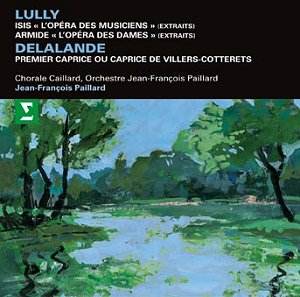
The music on this record
illustrates an interesting period in
the history of taste and musical style.
Recorded in 1972, the extracts from
Lully’s operas ‘Isis’ and ‘Armide’ were
probably important milestones when they
first appeared, indications of the small
amount of growing interest in the reputation
of Lully and his compatriots. But unfortunately,
taste and style have moved on greatly.
Thanks mainly to the pioneering efforts
of William Christie we now know much
more about the style in which these
operas should be performed.
The excerpts from ‘Isis’
includes the ‘choeurs des trembleurs’.
This chorus, in which the choir expresses
their intense cold through repeated
notes and syllables, gained quite a
reputation and it inspired the similar
passage in Purcell’s ‘King Arthur’.
The Act V, Scene 1 rondeau, ‘Plainte
de Io’ is rather marred by the unnamed
soprano’s excessive vibrato. And in
the hunting scene from Act 3, there
is distinct unsteadiness between the
chorus and the orchestra. The excerpts
from ‘Armide’ are similarly variable
with the ‘Duo d’Armide et Hidraot’ marred
both by the soprano’s vibrato and her
tendency to shrillness in upper registers.
I am completely unable
to put names to the soloists as the
booklet does not deign to mention their
names. For that matter, there is no
libretto nor a proper summary of the
action in the various scenes from the
operas. So, if you want to know what
is going on you must find a complete
libretto.
The standard of orchestral
playing is high, but unfortunately it
is just not in style. The orchestral
sound has a solidity and opacity which
might be entirely admirable in later
repertoire but sounds wrong here. I
missed the transparency and lightness
of later recordings. Even the faster
pieces sound a little heavy and laboured
because the essential bounce and rhythmical
subtlety of the music is missing. This
is a shame, as the orchestral playing
is attractive. One just wishes they
were playing something else. The chorus
suffer from similar problems and combined
they make the music sound too big boned.
There is not much in the way of ornamentation
and other stylistic nuances.
More of a reason for
buying the record might be Delalande’s
1st Caprice. This comes from
a recording of all three of Delalande’s
Caprices that Paillard recorded in 1985.
He already recorded them with his orchestra
20 years previously and when this recording
first appeared Gramophone commented
that the orchestral style had not changed
much in the intervening period.
But there is much of
interest in Delalande’s Caprices. Essentially
suites, their importance lies in the
lack of a supporting prop for the music;
it is dependent neither on words nor
on progressions of dance rhythms. Delalande
became the Superintendent io the King’s
Music when Lully died, and much of this
music was written for performance at
court occasions. The delightful music
in the Caprice de Villers-Cotterets
is an interesting example of the early
stages of the development that symphonic
music would take later in the 18th
century.
I am honestly not sure
why anyone would really want to buy
this record unless it were super-budget
price. If all the Delalande Caprices
had been included then the disc would
have the advantage of populating the
rather sparse catalogue of Delalande’s
music. One should not underestimate
the importance of these performances,
particularly the Lully, when they were
first issued. They were important milestones
in the history of both our discovery
of the music of Lully and Delalande
and our education in taste as to how
the music should be performed. But Paillard’s
performances of Lully have been vastly
overtaken in the intervening years.
This disc is mainly of interest as a
historical document rather than library
performances.
Robert Hugill
 Chorale Caillard