Comparison recordings:
Haydn, Arianna. Bartoli, Harnoncourt, Graz Fest. Orch.
OpusArte DVD OA0821D
As an armchair archaeologist I am always intrigued
by the perceptions of the ancient world by artists, so I looked
forward to reviewing this disk and was not disappointed. Greek
poetry was, after all, always sung, so it is natural that
songwriters be drawn to, and be inspired by, the idea of
Greek poetry. By supplying the melody, the composer is, so to
speak, finishing the job for the poet who at one time would have
been expected as a matter of course to furnish his own melodies
and sing them as well.
The mood of most of these songs varies from quiet
reflection to angry outrage; four of them are funeral odes, but
four of them are sensual evocations of desire. Schubert’s particular
magic with this form shines clearly, but we are delighted with
the different styles and colours, and Miss Bradshaw gives us a
dramatic program, finishing off with a bright tune from Schubert.
Miss Bradshaw has a bright, full, well controlled
voice in high as well as lower registers. She projects the words
clearly while keeping a pure tone, and easily reaches the intervals
in the modern songs, intervals which a less skilled singer might
find uncomfortable. Although very young, Miss Bradshaw has rapidly
established a career in opera performance and teaching and has
written and starred in a musical play based on the life of a famous
opera singer. One is not surprised then to see her select an unusual
and exploratory song program.
Debussy wrote two separate works on poems from
Pierre Louys’ Bilitis—a chamber suite with spoken recitation,
and the three songs with piano presented here.
The Haydn work, very well received when it premiered
in London starring one of the great castrati of the day,
is presented here in the composer’s original keyboard version;
the orchestration on the Harnoncourt-Bartoli recording is unattributed
and of much later vintage. As I said in my review of that video
performance, the orchestral version seems overblown, forcing the
music into an operatic format, the soprano responding to a large
orchestra in a full size hall leading to a uniform sense of excess—whereas
here in a recital hall with keyboard accompaniment, the drama
is more appropriate to the style of the music and the vocal line
can be shaped more sensitively. The result of this is that Ariadne’s
horror and shock at being abandoned are actually more forcefully
communicated here than on the Bartoli recording, because everything
leading up to it has not been overplayed.
Accompanist Collins presents the varied dramatic
styles of the accompaniments capably and with excellent tone,
well balanced with the singer.
Paul Shoemaker
Chris Howell has also listened to this
disc and cannot agree
It looked like a nice idea, but when I put on
the first track and heard Bradshaw’s pinched, tremulous voice
with its uncertain high notes, lack of phrasing and unvaried approach,
plus such very reticent accompanying, I wondered if I was going
to stay the course. Stern duty made me hear it through, in the
course of which I noted that though she essays four languages
her vowel sounds remain thoroughly English in all of them (particularly
deleterious in French, obviously), that Italian, even not very
good Italian, draws better singing out of her (hopelessly undramatic
though she is in Haydn’s remarkable scena, long a show-piece of
Janet Baker), and that she makes quite a pretty job of the final
Der Musensohn. I think there is little point in going into
detail, which would only be hurtful. I just cannot understand
how those involved in the production didn’t realise that, when
the big, wide world outside contains things like Schwarzkopf and
Fischer’s Ganymed, beside which Bradshaw and Collin are
merely pretty, and Cortot’s magical realisation of the Debussy
Chansons de Bilitis with Maggie Teyte, which leaves present
pair sounding uncomprehendingly literal, this disc could find
a place in the market. And if comparison with the giants sounds
unfair, then let them contrast Christiane Iven’s heartfelt rendering
of Iphigenia on a recent Naxos disc with the Conservatoire-bound
version here.
Contrary to what you might think, I don’t enjoy
writing like this, especially when I think the verdict is "not
ready yet" rather than "not up to it" in an absolute
sense. Bradshaw sings in tune, the voice is potentially attractive
and the basic musicality seems to be there. I suggest she comes
back again after two or three years’ work with a damn good teacher.
The listing of the works without opus, Deutsch
or Hoboken numbers, and the provision of translations without
the original texts, simply adds to the homespun impression of
the enterprise.
Christopher Howell
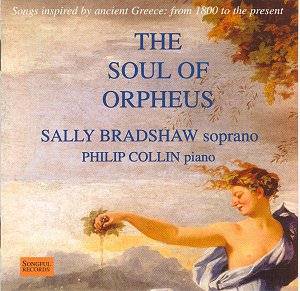
 Sally Bradshaw, soprano;
Philip Collin, piano
Sally Bradshaw, soprano;
Philip Collin, piano