Is there anyone who
doesn't have this classic concerto coupling
(emails to the editor please)? Though
they were recorded in the same year,
1964, the Violin and Piano concertos
were issued separately and it was not
until later that they became harnessed
together, in which form many will have
first encountered them, either on the
classic CBS LP or subsequent reissues.
This latest Sony Classical is a straight
reissue of SMK60004, which came out
c1998 and I don't think it necessary
to detain you long with the plaudits.
The Concerto is the
classic Stern/Bernstein. Short of digging
up Albert Spalding to reprise his premiere
performance I've never wavered in my
admiration for this disc, close-up CBS
sound or not. It's true that the dynamic
ranges are not helped by the production,
that the expressive pianissimi never
quite register as they should, but that's
a small price to pay for the drive and
drama of the opening movement and the
double basses' succulent theme at 5.40,
Stern's exceptional eloquence and touching
soaring cantilena, and his leonine explosivity
and bravura in the finale et al. Incidentally
I'm not quite sure if Julian Haylock's
notes reprise those for the previous
issue or if they were written specifically
for this one, but surely an old fiddle
fancier like Haylock knows the identity
by now of the young violinist who commissioned
the work and whose "identity remains
something of a mystery"? Not to
me ' it was the presumptuous Iso Briselli,
who has long since atoned via his charitable
work in Philadelphia.
The Piano Concerto
clearly has less of a hold on the public's
attentions, as is reflected in the volume
of recordings and performances. This
is the earlier of Browning's two recordings
and in terms of drive, power, concision
and strength demonstrably, I think,
the finer (the other was the 1991 RCA
St Louis/Slatkin). Szell's forces are
more energised and Browning makes that
much a convincing case for the solo
part in 1964. This is not to imply technical
or other concessions in the 1991 recording,
or that Slatkin is any way flabby or
negligent, rather that Szell is on frequently
invincible form. It's also fair to say
that the sound accorded the Piano Concerto
is slightly more amenable than that
for its companion.
I'd hardly call the
other works 'fillers'; the Essay for
Orchestra is the famous Schippers disc
recorded in New York and sounding very
well here. An incisive and powerful
piece, though not superior to the first
Essay (which you should try to catch
in Ormandy's Philadelphia recording)
few recordings can match this one, nor
the fizzy School for Scandal overture.
The Adagio for Strings comes from the
aforementioned forces of Ormandy and
the Philadelphians. I'd not heard it
in a long while and was prepared for
a wallow ' which shows how you should
never prejudge things, because there's
noble expression quite without specious
swellings and underlinings and a sense
of free-flowing lyricism that stands
as an admirable rebuke to more self-indulgent
practitioners of the art.
This is self-evidently
a disc that needs little more encomia
from me ' an Essential Classic that
preserves performances of outstanding
commitment and understanding.
Jonathan Woolf
Editorial Note
Marc S. Mostovoy of Mostovoy
Artistic Services has written with some further details about the
Barber/Briselli connection. He points out that he was a close
friend of Iso Briselli, the violinist for whom Barber wrote his
Violin Concerto. While he appreciates the acknowledgement of Mr.
Briselli's "charitable work in Philadelphia", he strenuously
objects to the characterization of Mr. Briselli as "presumptuous"
and having "long since atoned ..." Atoned for what?, he says. Mr
Mostovoy goes on to say: "If [it is meant] that Briselli was
presumptuous in asking Barber to rewrite the third movement, there
was no atonement. Mr. Briselli never changed his position
regarding the finale's effectiveness. He felt that it did not have
a sense of belonging; it seemed musically unrelated to the first
two movements, and he thought it was insufficient in compositional
form or development to stand as the finale of a major work.
Although the Concerto is indeed a wonderful work ... opinion is very
much divided about the finale. A number of leading critics were
and are in agreement with Mr. Briselli that the third movement
doesn't measure up to the first two. Perhaps, had the composer
heeded the violinist's advice, there would be no controversy."
Those who would like to follow this matter further and make up
their own minds can visit the following very detailed site www.isobriselli.com
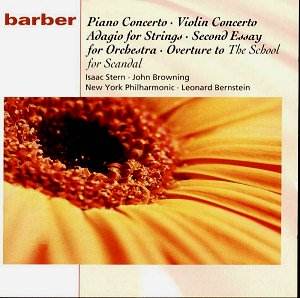
 SONY CLASSICAL SBK87948 [74.09]