I admit I was expecting a rigorous workout listening
to Sorabji’s songs. It would be easy to denigrate them as Szymanowski-and-water
(spiced with a dash of Debussy) but that would, I think, be to
underestimate the peculiarly tenacious bifurcation of Sorabji’s
musical mind. This was one that encouraged the vocal and piano
parts into almost total independence of line. Instances where
reflection and refraction exist are rare. Instances where the
piano part responds directly to the sung line are, if not inaudible,
at least hard to locate (to be fair there are some). That said
these are not obviously rebarbative settings, though the Exquise
nature of many of them does – it’s true – render me sometimes
ambiguous.
There are many points of interest however; the
nicely rippling middle section – and the leaps that test the voice
- of Correspondances from Trois Poèmes, one of a
trio of settings dating from 1918-19 or the second and best of
the three, Crépuscule du Soir Mystique, a
Verlaine setting. An ascending opening piano line, spare and aloof,
then descends; the constant rise and fall of the musical line
tangentially reflects the lyrics, subtle, night-haunted and one
that generates increasing fluency as the poem poisons in the middle
section. Declamatory chords hammer home the fixity. It ends in
an ascending, displaced imitation of the opening piano phrases,
a vortex of fin-de-siècle intensity and characterised with
discernment. As if to banish care Sorabji’s setting of the last
of the three is light, wispy and witty. Chrysilla dates
from a few years earlier – 1915 – and packs a tremendous amount
into its three-minute length. This is a complex impressionistic
setting with full chords, a declamatory role for the soprano (Elizabeth
Farnum really comes into her own here) and some passionate outbursts
and, finally, moments of intense reflection. Roses du Soir
certainly represents an austere Arcadia – but also a romantic
one once more with bold chordal flourishes. The Poplars
may well be his first setting of a song; it’s in English too,
which is unusual for Sorabji who, as an aesthete, naturally decided
his own native language was unable to bear the weight of his genius.
It’s mordant, full of darkening unease, pensive left hand, dark
sonorities in the bass and made me wish he’d deigned to set more
English lyrics. L’Heure Exquise vapours into stillness
and by contrast Vocalise sees the piano-voice dichotomy
bridged at least partially, the piano reflective in the spaces
between the soprano’s vocalise – the whole setting ending on a
note of unresolved assertion.
L'Étang opens with deep rolling
thunder in the bass – pictorial, effective – and is full of sombre
glinting light, spectral and rather sickly menace. Hymne à
Aphrodite is a big setting – tough, too, ranging from truly
declamatory outburst to interiority and reserve. I admired the
trill-as-laugh game of Verlaine’s Le Faune and how, unlike
the first two settings of the cycle, La Dernière Fête
Galante opens in an unashamedly avuncular way, replete with
a sophisticated, if knowing, coolness. The allusive piano part
– here as elsewhere Margaret Kampmeier is right inside her music
– evokes the ripple on the water. The long L’Irrémédiable,
a poem of Baudelaire, is a setting of frequently abrasive
emotionalism, one that ranges from rugged to elfin. It seems to
encompass a huge amount (in truth, too much). The Arabesque
of 1920 ends the recital in suitably elliptical, jewel-like fashion;
it glints in the sun.
The excellent notes are by the curator of the
Sorabji archive, Alistair Hinton. The poems are broken up into
paragraphs in the text, poetic line endings indicated with a "forward
slash." As Mr Punch almost said – that’s not the way to do
it. Still, the musicians are admirable in their roles. Farnum
is certainly stretched by some of Sorabji’s less grateful writing
but she acquits herself with distinction.
Jonathan Woolf
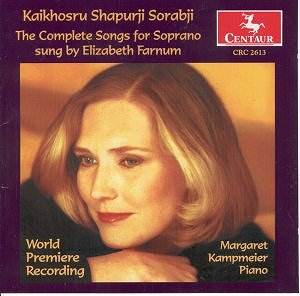
 Elizabeth Farnum (soprano)