Villa Lobos has not generally been known as a symphonist.
These two works, part of a complete cycle currently being recorded
by these forces, go some way to explaining why. Villa-Lobos wrote
a total of 12 symphonies, throughout his composing life. These
two works come from his early and late periods.
The Third was composed in 1919 to a commission
by the Brazilian Government to celebrate the Armistice. It was
performed that year, initially only the first two movements, and
then later complete. It formed, with symphonies 4 and 5, a war
symphonic triptych based loosely on texts by Brazilian poet, Escragnole
Dorla. The poem does not appear in the score, but was reproduced
in full in the original programme notes. There are no specific
points of contact between poem and score, as the poem is about
war in very general terms, and the inspiration is more to do with
general war-like feelings than specific events.
This is probably all to the good as far as Villa-Lobos
was concerned. Although he was more interested in shorter descriptive
pieces he had a strict formalist streak, which was satisfied by
the writing of symphonies, string quartets (17) and a number of
other classically-structured works.
The Third Symphony is scored for two piccolos,
english horn, bass clarinet, contrabassoon, four horns, four trumpets,
four trombones, tuba, timpani, tam-tam, xylophone, matraca, bass
drum, celesta, harp, fanfare brass section, strings and mixed
chorus "ad libitum." Be warned however – the choir required
by the composer is missing!
Given the size of the orchestra and the subject
of the inspiration for the work one might be forgiven for thinking
that we were in for an assault on the eardrums. Although there
is plenty of activity, I was surprised how relatively restrained
it is. The work is very skilfully orchestrated as you might expect
but the tunefulness is somewhat limited – however this is quite
common in modernish symphonies – we can’t all be Tchaikovskys.
The Ninth Symphony is scored for piccolo, english
horn, bass clarinet, contrabassoon, four horns, four trumpets,
four trombones, tuba, timpani, tam-tam, cymbals, coconut hulls,
bass drum, xylophone, celesta, vibraphone, harp and strings. It
is very similar in sound to the earlier work, but the ternary
nature of the work is noticeable.
There is a short declamatory first movement,
followed by a both contemplative and dramatic adagio in ternary
structure. A scherzo, again in tertiary form, follows with the
short rhythmic nature of the themes add to the level of activity.
The finale is in rondo form (ABCA plus coda), and displays a fugato
passage as the second subject, started off by cellos, double basses
and bassoon. This makes for an unusual format but quite interesting
listening. The symphony is dedicated to the composer’s second
wife, Mindinha.
The Overture sounds very French, and is quite
a contrast with the remainder of the disc; not a trace of Brazilian
atmosphere.
Performances appear to be first class and the
recording quality is of very good broadcast quality, clear and
bright. Anyone investing in this disc is likely to be very pleased
with their purchase.
John Phillips
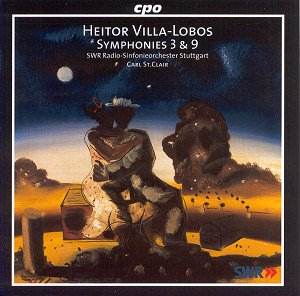
 SWR Radio-Sinfonieorchester,
Stuttgart/Carl St. Clair.
SWR Radio-Sinfonieorchester,
Stuttgart/Carl St. Clair.