Though he had an early work accepted by the BBC in 1946,
John Buller decided against a musical career and worked as an architectural
surveyor until the early 1970s. He resumed his musical studies and
from 1959 studied with the late Anthony Milner, taking his B.Mus.
(London) in 1964. From the early 1970s, he composed a number of
substantial works that put him firmly on the British musical map,
though it should be noted that his list of works is not over-abundant..
Beside the pieces recorded here, his output includes a full evening
opera BAKXAI controversially sung in the original
ancient Greek and two large-scale orchestral works Bacchae
Meters and Illusions as well as some chamber
and vocal pieces.
Proença, a commission for
the Proms Jubilee season in 1977, was a resounding success and
the work was selected by the 1978 International Rostrum of Composers
in 1978. It is scored for mezzo-soprano, electric guitar and large
orchestra. French Provence is something of a historical paradox.
In the 11th and 12th centuries, it witnessed
the blossoming of poetry, that of the troubadours who celebrated
courtly and not-so-courtly love but who also commented on the
brutal events of the so-called crusade against the Albigensian
heretics, which led to numerous massacres. The ruined castle of
Montségur became the symbol of these terrible events. Buller’s
settings of Provençal poems by some of the best known troubadours
such as Jaufré Rudel, Pèire d’Alvernha, Bernard
de Ventadorn, Marcabrun, Comtesse de Dia, Bertrand de Born and
Pèire Cardenal, to name but a few, deal with the manifold
aspects of Provençal culture and history, courtly and warlike.
Significantly enough, the last section sets a poem by Guiraud
Riquièr, ‘the last of the troubadours’ who "was born
too late" (his own words). The first section dealing with
the troubadours’ desire to sing new songs emerges out of the indeterminate
sounds of the orchestra’s tuning, thus suggesting the flowering
of a new poetical era. The second section deals with sexual love
whereas the third illustrates the aristocrat’s feudal love showing
that things were not always as idyllic or romantic as one might
have thought. The fourth section is a peaceful interlude calmly
speaking of wisdom. The fifth, seventh and ninth sections (poems
by Arnaud Danièl described by Dante as ‘the finer maker’)
are interspersed by the sixth and eighth sections that deal with
the mounting pressures on the society, sometimes in strong terms
(Churchmen pass for shepherds/but they’re murderers – Pèire
Cardenal [6th section] or The pope and the legate
and the cardinal/have twisted such a cord ... that no-one can
escape committing treachery – Pèire Cardenal [8th
section]). The instrumental tenth section briefly but tellingly
reflects on the final collapse of that society, symbolised by
the ruins of Montségur, the destruction of which signalled
the end of the Albigensian heresy. All that is left is regret,
poignantly expressed by Guiraud Riquièr, "who was
born too late" and who prays the Virgin that she might "obtain
for us, through pity of your son, our Redeemer, grace, pardon
and love". The piece ends with a lonely sad flute echoing
the last word Amor. Although based on material drawn from
troubadour sources Buller’s music is never bluntly picturesque.
Among these sources is a song by Folquet de Marseilles who in
his early manhood was a troubadour and who later became Abbot
of Le Thoronet and later still the hated Bishop of Toulouse and
one of the fiercest persecutors of the Albigensian heretics. The
work digs deep under the surface and reflects the many moods suggested
by the poems in vivid musical terms of great urgency, passion
and violence; but its most striking quality is its gripping expressive
strength. A major work.
Buller’s large-scale symphonic score The
Theatre of Memory, another BBC commission for the 1981
Proms season, is a substantial concerto for orchestra in all but
the name. The piece also reflects two of Buller’s concerns, i.e.
Greek theatre and architecture. I will not repeat the composer’s
detailed notes. Suffice it to say that the orchestra is laid-out
as the classical Greek theatre, i.e. in seven tiers divided by
seven gangways. In the front row at the foot of the ‘amphitheatre’,
seven players function as the ancient Greek chorus: flute, cor
anglais, bass clarinet, trumpet, harp, celesta and cello. The
basic material makes use of several Greek meters derived e.g.
from the first Delphic hymn. All this is again intricately woven
into the musical fabric and worked-out with much imagination and
invention. The Theatre of Memory opens in much the
same way as Proença. A powerful trumpet call
emerges out of the orchestra’s tuning. From then on, the music
moves on in several inter-linked sections playing without break
and ending with a deeply moving dirge.
Two major works by a distinguished composer who
still has not been given his due. He is well served by exceptional
performances. Sarah Walker obviously loves Proença
and her superb singing works wonders in this beautiful, though
exacting work. She is superbly partnered by Timothy Walker and
the BBC Symphony Orchestra in top form. The performance of The
Theatre of Memory is hardly less compelling and is beautifully
recorded. The uncredited solo players are William Boughton (trumpet),
David Butt (flute), Jane Marshall (cor anglais), Anthony Jennings
(bass clarinet), John Marson (harp), Malcolm Hicks (celesta) and
Ross Pople (cello). Originally released by Unicorn during the
LP era and re-issued in CD format some time ago (Unicorn DKPC
9045), these excellent recorded performances are again available,
and, we must hope, for the long run.
Hubert Culot
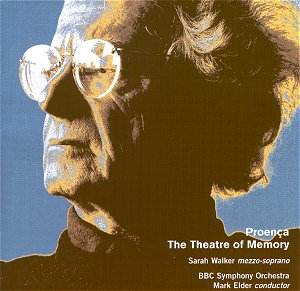
 BBC Symphony Orchestra/Mark
Elder
BBC Symphony Orchestra/Mark
Elder