These are premiere recordings and in some cases
very likely premiere performances. It would be good indeed to
think that as a result of this pioneering and excellently prepared
disc by all concerned we would now be seeing Sorabji’s songs in
the repertoire but it will not happen.
What a strange state. The music of a composer
who deliberately did not promote himself and in the case of the
piano music even forbade its performance. This is the music of
a man who is unlikely ever to reach anything other than a minority
audience and the music of a man whose songs are not only a major
challenge for the singer but a mega challenge for the pianist.
Indeed one could almost describe them as piano pieces with text.
They cannot be performed by amateurs and probably only by distinguished
students upwards, and then only if the scores can be hunted down.
Some here have been especially edited. Yet, this music must be
heard and the producers of this recording are making the statement
that they believe in it and that it is of considerable merit and
value.
As can be seen, the songs mostly date from no
earlier than 1915 to 1919. They are all in French except for two.
There is then a jump to 1927 and then to 1941. Is there a stylistic
development? Yes.
1915 was the year when Sorabji, whilst preparing
a book on Ravel, suddenly got the idea of composing himself. He
was 23 and so a late developer. There is no doubt that these early
songs are strongly influenced by Debussy, perhaps for example
the ‘Trois Chansons de Bilitis’ of 1898 to texts by Debussy’s
symbolist poet-friend Pierre Louÿs. Debussy himself wrote
two sets of ‘Fêtes Galantes’ the second set (1904) to poems
by Verlaine. Sorabji’s ‘Fêtes Galante’ also sets Verlaine
including ‘La Faune’- memories of Debussy’s famous Prelude perhaps.
These early songs also use whole tone scales and pentatonic scales.
‘La Dernière Fête Galante’ is one of the few pieces
to be mostly diatonic in a Debussian sense.
Whereas Debussy looks at his texts as an outsider
viewing from the wings, Sorabji is interested in the texts as
a vehicle for decoration and elaboration. He often disguises personal
emotion, although it most certainly does exist and can be found.
For instance the first song on the CD,’Correspondances’, with
a text by Baudelaire, hits a wonderful climax point at the end
of verse three: "And others, corrupted, sumptuous and exultant".
For the symbolists, poetry aspired to the condition of music as
Mallarmé reputedly said. It is an essentially abstract
art creating its own form and self-expression for constant re-interpretation
and ambiguity. Sorabji said that his music aspired to be nothing
more or less than a highly elaborate Persian carpet. It is decorated
all over in a myriad shapes and colours which relate only to those
in their immediate vicinity and not directly to any others. Their
existence can only be explained in the context of the overall
design.
The texts are important because Sorabji’s word
painting is not obvious. Like the carpet, each line relates to
its immediate successors and predecessors and exists to express
the text. An individual word will rarely be ‘painted’ as you will
find in English contemporaries like Warlock or Moeran or Gurney.
Sadly, Centaur only gives us an English translation; no French
texts at all. This is a silly decision and for a full price disc,
unacceptable, Most of Sorabji’s songs are in French, and a difficult
French to boot. We need the words for a full understanding of
the songs. Elizabeth Farnum’s diction is outstanding and my French
reasonably good but I still need the texts. It is important.
Lets look briefly at three songs to give you
a taste of what to expect.
The ‘Hymne à Aphrodite’ (Aphrodite, immortal
goddess of joyous laughter) is an amazingly competent piece for
a man who has only been composing for a year. It is also very
impassioned and, at nearly five minutes, quite long. The vocal
line is in a constantly elevated state, with a massive climax
after verse 1 and then an oscillating Debussian passage whilst
the vocal part is restricted to one note. Then it passionately
opens out into a flowery glade where, just occasionally the voice
receives tangible support. Intensity builds to another climax
and then an even greater one capped by a vocal top C and piano
tremolandi. Darius Milhaud criticized this song and others for
having too complex a piano part. What about the poor singer?
Moving to 1927 for the Baudelaire setting’L’Irrémédiable’
we come to longest song at just over six minutes. This is in Sorabji’s
own mature style. The myriad cascades of opening notes is not
only reminiscent of Schoenberg but is in fact atonal. The song
proceeds in a sometimes pointillist manner and sometimes in an
expressionist post-romantic language where the voice is forced
to use the whole range. Again, (verse 3 "A poor wretch under
the evil eye") we find more words incantated on single notes
with steamy piano harmonies. This song takes harmony, virtuosity
and vocal demands even further than ‘Aphrodite’.
Finally ‘La Faune’ from the Trois Chants of 1941.This
song is roughly contemporaneous with the piano pieces like ‘St.Bertrand
de Comminges’ where the textures have been thinned a little and
the individual ideas given a little more identity. The piano writing
is still extraordinarily complex however but there is a considerable
effort at concentrating a vocal image into a smaller time span.
Elizabeth Farnum is terrific, she has made a
speciality of contemporary music but this disc must have taken
some preparation as can be seen from the recording dates. Margaret
Kampmeier is, if anything, even more outstanding, mastering some
of the most difficult accompaniments in the history of song-writing
and never overbalancing the texture. The booklet notes, although
small, are excellent with an essay and also commentary on each
song or each set.
Gary Higginson
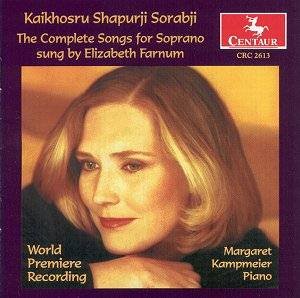
 Elizabeth Farnum (soprano)