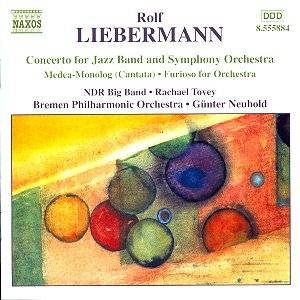
This CD has been to me, at least, quite a revelation:
five works, all astonishingly different, by a composer, I’m ashamed
to say, was unknown to me before. Each piece is distinctive and
each is extraordinarily original. It has been a fascinating journey
listening to these works, but to understand them further we should
begin with the composer’s biography. Liebermann was born in Zurich
where at first he studied law and later at the music conservatory.
In the 1940s he wrote songs and worked for Swiss Radio. He later
moved to Hamburg. From 1959 to 1973 he worked in Paris at the
Opera. He has connections with America and American music and
was always at the forefront of developments being also associated
with Darmstadt. His music reflects his international background
and cosmopolitan leanings.
Let’s take each piece in turn. The title of the
opening piece will not let you down because ‘Furioso’ it most
certainly is. Premiered at Darmstadt in 1947 it is a moto perpetuo
in ternary form with a quieter middle section. The loud ostinatos
and syncopations of its outer sections bring John Adams’ ‘Short
ride in a fast machine’ to mind. This most un-Darmstadt, I think,
at least by reference to the Darmstadt one has come to understand
through the works of Stockhausen and Boulez. It makes a good start
and it is recorded with immediacy and clarity, as are most of
the other works.
The ‘Geigy’ Concerto is a fun piece. It was commissioned
by the chemical firm Geigy and is really a concerto for snare
drum and orchestra. It has an intriguing inspiration. Basle is
a city with which Leibermann was associated in the 1950s. I will
quote from the booklet: "on the first Sunday after Lent at
four o’clock in the morning to the sound of drums and pipes, different
groups go through the city with lanterns. It was Liebermann who
first gave the snare drum a solo part in a symphonic work"
(perhaps Nielsen’s 5th does not count in this context).
The notes continue "at the beginning the folksong ‘Basel
an mym rhy’ is heard depicting a still, sleeping city. The call
of the watch is the first entry of the solo drum … The church
clock strikes and the drummer plays his morning signal",
a virtuoso solo which strikes up from nowhere. The third movement
(there is no break between movements) quotes Basle’s so-called
Arabi-March. Then a retreat is sounded by the drummer before other
traditional Swiss melodies and marches end the piece. It is all
over in twelve minutes.
The next work is the ‘Media-Monologue’ with a
text by Gedicht von Ursula Hass. This is stylistically the most
challenging work on the disc; in a sense the most old fashioned
although the most recent. Being an atonal expressionist work in
German I have to say that Schoenberg’s ‘Ewartung’ came to mind.
In the writing for female chorus, especially the rhythmic spoken
passages under an orchestral backdrop, it recalls late Stravinsky,
possibly the ‘Requiem Canticles’. Other works might also be recalled
but this is a powerful piece with a particularly arresting start.
At twenty-three minutes this is just the right length. Anyway
it makes a total contrast with the rest of the programme. Soprano,
Rachael Tovey is absolutely on top of this demanding score. The
choir however is disappointingly recessed … or are they deliberately
off-stage. I’m not quite sure and nothing in the booklet notes
offers an explanation.
The three minute Symphony ‘Les Echanges’ is performed
here in an arrangement for seven percussionists and has another
odd background story to tell having been written for the Swiss
National Exhibition in Lausanne. Liebermann had the sound of the
machines operating at the exhibition turned into a co-ordinated
noise, as it were, the rhythms and tone colours then were recorded
onto tape and this in turn was made into a proper piece played
back for the audience. Siegfried Fink of the Wurzburg Percussion
Ensemble arranged it for the seven percussionists.
Then comes the last piece. There is no question
in my mind that I greatly enjoyed the Concerto (grosso) for Jazz
Band and Symphony Orchestra. There are eight quite brief movements
beginning with an impressionistic orchestral opening then into
a ‘Jump’ movement for the band. The two ensembles basically alternate
until the final ‘Mambo’ when they raise a great and exciting climax
together. Sometimes the transitions are helped by a theme passing
noticeably from one to the other. Sometimes there is a sense of
‘a bit of this and now a bit of that’. Even so this is a very
imaginative work. Incidentally, Liebermann deliberately bases
the work on the idea of a concerto grosso.
I find it a wonder that Naxos continue to turn
out such amazing discs as this for less than £5. There is an excellent
essay by Eva Pinter and the full text of ‘Acquittal for Medea’
is given in German and nicely translated into English (sadly on
a different page) by the ubiquitous Keith Anderson. This is music
that offers the open-minded listener considerable interest and
pleasure and at such a price should not be missed. However the
only problem is, are you, like me, running out of shelf space?
Gary Higginson
 NDR Bigband/Simon Nabatov
**
NDR Bigband/Simon Nabatov
**