Comparison recordings:
Glazunov Symphony #8, Alexander Anissimov, Moscow
SO Naxos 8.553660
Glazunov complete Symphonies, Vladimir Fedoseyev, Moscow Large
SO LP Urania
Glazunov, Symphony #5, Vladimir Fedoseyev US LP
Columbia Masterworks
The Glazunov Symphonies have long been the staple
of Russian concert programs but have not caught on in the West.
There was an integral recording of them by Vladimir Fedoseyev
conducting the Moscow Radio Large Symphony Orchestra (now renamed
the Tchaikovsky Symphony Orchestra) which was available on Urania
LP, and from that set #’s 5 & 6 were briefly available in
the US on the CBS label. That Fedoseyev Glazunov Fifth Symphony
recording is one of the greatest recordings of anything ever made,
but unfortunate deterioration of the master tape probably means
we’ll never see it on commercial CD (Mark Obert-Thorn, are you
listening?). There was another set issued on Orfeo CDs performed
by Neemi Järvi and the Bavarian Radio Orchestra which failed
to arouse critical or popular interest, although the #1 was pretty
good. The Fedoseyev version of the eighth was perplexing, one
of the least successful: movements 1 and 2 were performed extremely
well, while 3 and 4 were of much lower concentration.
This new set by Valeri Polyansky may well be,
from what I have so far heard, overall the best complete set ever
and this release of the Eighth Symphony leaves only Nos. 6 and
7 yet to go. Most disks in the series also contain other orchestral
and vocal works. His recording of No. 5 compares favourably with
the legendary Fedoseyev recording and has much better sound. But
we must endure an embarrassment of riches in that Naxos has released
a complete Glazunov Symphony series with Alexander Anissimov and
the Moscow SO. These are also excellently played and recorded,
but the performances tend to be a little tidier and the sound
a little less sensual, less extravagant than in the Polyansky
recordings. The Anissimov recordings use fewer disks for the complete
symphonies, so for a cycle they are doubly more economical.
The Eighth Symphony opens with a broad tune reminiscent
of the Saint-Saëns Third Violin Concerto, and, German style
or no, at five minutes in we find ourselves in a fugue which shortly
strettos back into more typical Glazunov theme-and-repetitions-in-a-new-colour
development, rather like the Dvořák
Eighth Symphony, with some of the same steadily gathering harmonic
drama. The second movement is reminiscent of the Vaughan Williams
6th in its repeated funereal brass chords. It proceeds with sighing
phrases and solemn cadences, and is generally considered
to be the finest single movement in any of the symphonies containing
the darkest most despairing music Glazunov ever wrote. It was
essentially complete on paper at the time of the 1905 uprising
in Russia. This music is Glazunov’s "Tapiola"; after
writing it, Glazunov, like Sibelius, drifted off into an alcoholic
haze from which he never emerged. In fact the Tapiola imitation
of blowing wind can be heard in the third movement. It is surely
no accident that Glazunov’s sobriety and the Russian Romanov Dynasty
under which he had been born disappeared at the same time. Glazunov
continued to teach, composed a few concertos and minor pieces,
eventually leaving Russia for Paris, where he died in 1936.
The program notes point out the uncanny resemblance
between the third movement scherzo of the Glazunov Eighth
and the rondo of the Elgar Second, underscoring the point
made by Vaughan Williams that the "Non-German Style"
of English, Russian, etc., composers while not to be considered
inferior to German symphonic style, is simply different, an equally
valid parallel evolution. Glazunov tends to end his symphonic
scherzi very decisively, so that I expect in live performance
many in the audience applaud thinking the work is finished. The
last movement opens with a solemn chorale which gradually becomes
grand and triumphant with the suggestion of flying banners and
flocks of doves.
The vocal works are quite interesting as well,
full of good tunes and the broad romantic Russian gestures we
love in the music of Tchaikovsky, or, more to the point, Prokofiev
during his Stalinist period. The solo in the Commemorative
Cantata is sung with quivering devotion by Ms. Kuznetsova.
The Poem is wistful and very charming, not unlike some
of the slow symphony movements, although on a smaller scale.
Have no fear: these recordings, made in Russia,
are fully up to Chandos’s customary stratospheric sonic standards.
They present this music in the best possible light. As to future
SACD or DVD-A release, Chandos aren’t committing themselves.
Paul Shoemaker
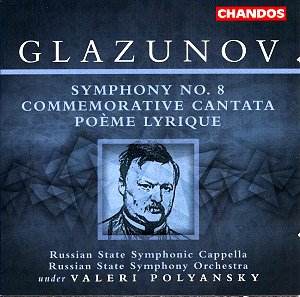
 Ludmila Kuznetsova,
mezzo; Vsevolod Grivnov, ten
Ludmila Kuznetsova,
mezzo; Vsevolod Grivnov, ten