Richard Wernick was a pupil of a number of distinguished
talents – Ernst Toch, Aaron Copland and Boris Blacher amongst them.
He was himself a teacher for nearly thirty years at the University of
Chicago; not that there is anything remotely academic or didactic about
these two strongly characterised and powerfully argued concertos. As
Bernard Jacobson’s notes judiciously aver Wernick’s music fuses technical
expertise and a highly personalised use of tonal and near tonal elements.
Structurally individual as well, Wernick’s concertos resist confident
critical judgement. He belongs to no convenient "school" and
his often rough hewn and angular music is full of the most impressive
sonorities and conjunctions.
The Piano Concerto was composed between 1989
and 1990, commissioned by the National Symphony Orchestra of Washington
and Mstislav Rostropovich – and it was premiered by them and by Lambert
Orkis in February 1991. A complex fantasia first movement ("Tintinnabula
Academiae Musicae") opens with some viciously saturnine trombones
contrasted with the solo piano’s almost pointillist displacements before
some resolute and decisive rhythmic attacks. By some way the longest
of the three movements it gathers itself in intensity and complexity
and by the time of its final peroration the orchestra has grown impressively
stentorian, with brass dominant, percussion strong and the piano taking
an ever more expansive role. The slow movement is static, rather romantic,
with Mahlerian hints, bedecked with some rather keeningly expressive
orchestral solos. The middle section however, in utter contrast, is
fractious and active, insinuating with percussive drive before a sense
of dappled calm returns, flecked and rapturous and yearning. The brisk
finale ("Réjouissance") is ebullient, with virtuoso
percussion and driving, unstoppable culminatory spirit.
The Violin Concerto was written a few years
earlier, in 1984, and was premiered in 1986 by Gregory Fulkerson with
the Philadelphia Orchestra and Riccardo Muti. Wernick, something of
a master of oppositional trajectory, sets up nervous energy in profusion
in the first movement – in which the edgy solo violin is contrasted
with the assured orchestral responses. The massed orchestra is more
powerful, slow moving and less nimble than the protagonist who, finally,
at the short movement’s conclusion has the last, decisive word. In the
slow movement – the longest at over twelve minutes – Wernick explores
incremental changes of texture and tempo, discovering moments of almost
spectral intensity, assailed, but never consumed, by the orchestra’s
jabbing, baleful brass. The finale follows immediately from the involved
complexity of the slow movement. It’s tough, pungent, rhythmically exultant
but attempting to resolve thematic material previously left unresolved.
It is intriguing that the full-scale cadenza toward the end of the work
is not at all experimental but firmly in "The Tradition".
It seems in some oblique way to recognise some hierarchical place in
the syntax of the concerto form in which to explore thematic material.
And it does so in a confirmatory and affirmatory way, drawing together
strands that lead satisfactorily to the conclusion of the work.
Wernick uses dissonant counterpoint; his rhythms are
dramatic and driving; his orchestration is colourful, his lineage eclectic,
his gift for oppositions, for characterisation strong. These are tough
works in many ways and I wouldn’t want to pretend otherwise, but they
are creatively tough and journey with intense drama and feeling.
Jonathan Woolf
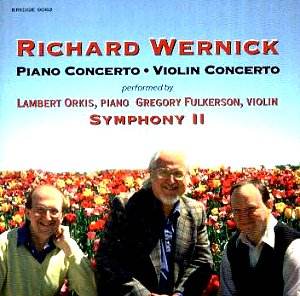
 Lambert Orkis (piano)