Since its re-discovery
in 1984, Zemlinsky’s Die Seejungfrau
(The Mermaid) has been quite popular
in both the concert hall and the recording
studio (five recordings are listed in
the R.E.D. Classical Catalogue) and
this is the second recording of it released
by Chandos. The first was, in 1997,
by the Danish National Radio Orchestra
conducted by Thomas Dausgaard on CHAN
9601.
The notes for these
two Chandos recordings (for the new
recording by its conductor, Antony Beaumont
who has published a study of Zemlinsky
and Paul Banks for the Danish recording)
provide conflicting facts. Banks states
that ‘Zemlinsky was so taken aback by
the coolness of the audience’s response
that he withdrew his piece and it remained
unheard (indeed it was considered ‘lost’)
until 1984. Whereas Beaumont comments,
"On 25 January, 1905, Die Seejungfrau
shared the stage with Schoenberg’s
Pelleas und Melisande. Zemlinsky’s
score was applauded vociferously; Schoenberg’s
played to an accompaniment of jeers
and catcalls. After two further performances
of Die Seejungfrau (in
Prague and Berlin) the score disappeared
from the repertoire, not to be heard
again until 1984. Pelleas und Melisande
lived on to be hailed as a masterpiece."
Whatever, little wonder
that Zemlinsky’s Fantasy for Orchestra
is so popular now, for it is a very
attractive and accessible composition,
extraordinarily evocative, wonderfully
tuneful - and it is quite clear who
influenced Korngold’s use of luscious
orchestration.
Zemlinsky started work
on the composition a few days before
the wedding of the woman he loved, Alma
Schindler to Gustav Mahler. Zemlinsky
was devastated and it took years for
him to recover from the blow. Clearly,
The Mermaid’s story of rejected love
had profound autobiographical significance
for Zemlinsky at this time and he confided
in Schoenberg that the work was actually
a preliminary study for a projected
‘Symphony of Death’ that was never written.
The composition is based on the story
by Hans Christian Anderson. On the seabed
the mermaid becomes obsessed with the
notion of becoming immortal by winning
the love of a mortal. After she has
saved the life of a prince from a shipwreck,
she takes a magic potion to enable her
to take human form in order to win the
prince. But he marries a princess. Devastated,
in her agony, she plans to kill the
prince in his sleep but at the last
moment she throws away her knife and
ends her tormented life. In her renunciation
she achieves the immortality she longs
for as a spirit of the air.
In realising the story,
Zemlinsky uses a large orchestra. It
has all the heroic and romantic hallmarks
of a great Late Romantic symphony –
in fact Beaumont argues that it ‘qualifies
today for nomination as a symphony.’
The obvious influence is Richard Strauss
but there is also something of Tchaikovsky
– in fact one of the motifs is very
like one Tchaikovsky used in the second
movement of his Fifth Symphony. There
is atmospheric material for the opening
scene on the seabed, powerfully evocative
music for the storm that shipwrecks
the prince, erotic, voluptuous, perfumed
music for the mermaid’s dreaming of
love and immortality and of yearning
and sweet devotion for her unresponsive
prince.
Both Chandos recordings
are impressive. Antony Beaumont goes
for the dramatic high ground pressing
the music forward more strongly clipping
some three minutes off the Danish recording.
I prefer, however, the more relaxed
pace, more detailed, more poetic reading
of Dausgaard. Funnily enough, to my
ears Dausgaard sounds faster, it is
probably all a matter of pulse.
Zemlinsky’s early Symphony
in D minor is a lesser work. Very Brahmsian,
its opening movement is heroic and virile.
I think that Beaumont is being unkind
in suggesting, here, that Zemlinsky
‘takes refuge in histrionics’. I would
prefer to say that it has its excitements.
The scherzo second movement is a perky
and merry creation with Schubertian
lyricism in its associated Trio. The
introspective, rather Brucknerian third
movement is the most interesting while
the work is rounded off by a sunny,
melodic Finale.
I should add that the
Dausgaard recording has the more interesting
fill-ups: Zemlinsky’s mature, more hard-edged,
darkly lyrical Sinfonietta (1938); and
his Overture to his first opera, the
Wagner-influenced Sarema (1897).
This is the second
Chandos recording of the attractive,
richly romantic Die Seejungfrau
(The Mermaid). Although it is powerful
enough, I prefer their original 1997
recording, the more relaxed, more poetic,
yet exciting view of Dausgaard
Ian Lace
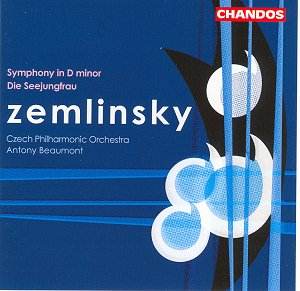
 Czech Philharmonic Orchestra/Antony Beaumont